
If you have ever wondered whether to say Happy Holidays or Happy Holiday, you are not alone. Both expressions are grammatically possible, but they are used differently in everyday English. Choosing the right one depends mainly on whether you are referring to one holiday or the holiday season as a whole.
In this guide, we will explain the difference between happy holidays vs happy holiday in simple English. You will learn when to use each phrase, which one sounds more natural to native speakers, how American and British English treat these expressions, and which greeting is best for cards, emails, social media posts, and everyday conversations.
Quick Answer
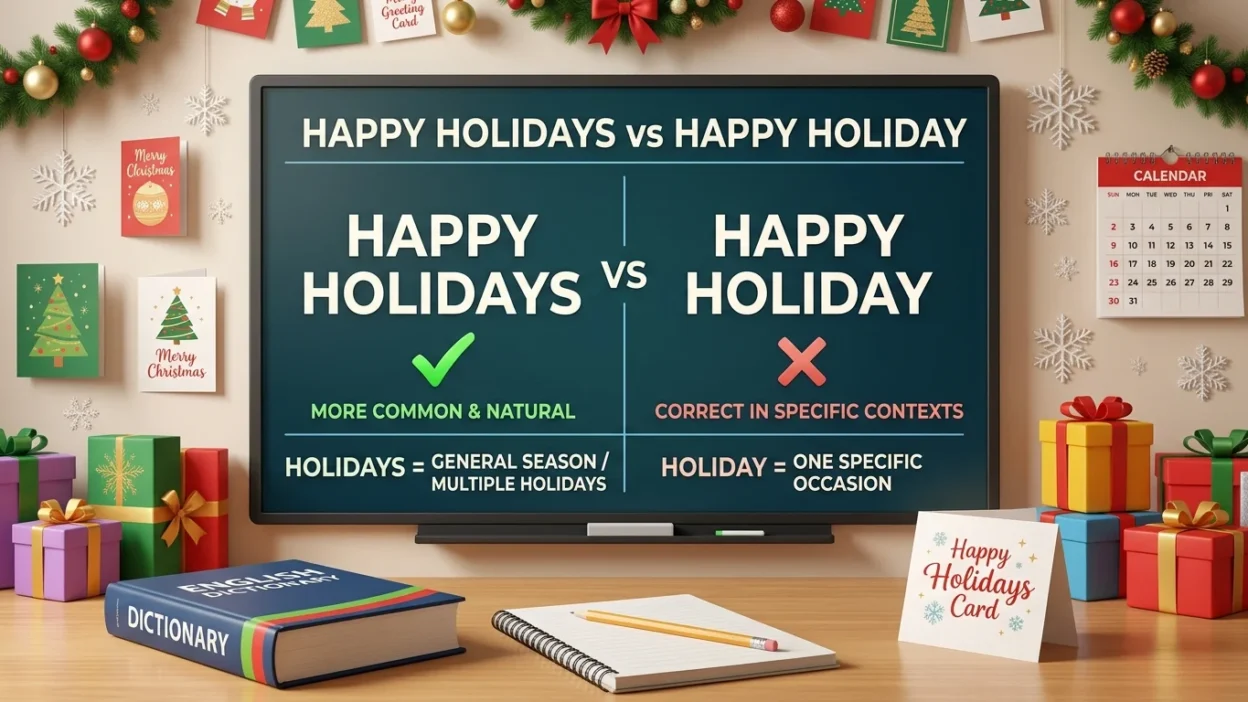
Happy Holidays is the much more common expression, especially when referring to the entire holiday season or several holidays.
Happy Holiday is grammatically correct when you are talking about one specific holiday or one holiday occasion, but it is less common as a general seasonal greeting.
The simple rule:
- Happy Holidays = a general greeting for the holiday season or multiple holidays.
- Happy Holiday = a greeting referring to one particular holiday.
- Happy Holidays! = the most natural choice when you want a broad, inclusive seasonal greeting.
For example:
- Happy Holidays! I hope you have a wonderful season.
- Have a happy holiday with your family.
- Happy Christmas! is more specific because Christmas is one particular holiday.
What Does Happy Holidays Mean?
Happy Holidays is a common English greeting used during the holiday season. It expresses good wishes for happiness, enjoyment, and peace during a period when several holidays may be celebrated.
The word holidays is plural because the expression can refer broadly to a number of holidays occurring around the same time.
In the United States, the phrase is especially common during the period around Christmas, Hanukkah, New Year, and other winter celebrations.
The phrase can also be useful when you do not know which holiday someone celebrates. Instead of choosing a specific greeting such as Merry Christmas, you can use Happy Holidays as a more inclusive expression.
Examples of Happy Holidays
- Happy Holidays! I hope you enjoy the festive season.
- Wishing you Happy Holidays and a wonderful New Year.
- Happy Holidays to you and your family!
- Our team wishes everyone Happy Holidays.
- Have a safe and happy holiday season.
What Does Happy Holiday Mean?
Happy Holiday uses the singular form of holiday. It can be correct when you are referring to one specific holiday, vacation, or holiday occasion.
However, as a general seasonal greeting, Happy Holiday sounds less natural than Happy Holidays to many native English speakers.
The singular form may be appropriate when the context clearly identifies one holiday.
For example:
- Have a happy holiday in Spain.
- I hope you have a happy holiday with your family.
- Have a happy holiday weekend.
- We wish you a happy holiday.
Here, holiday can refer to a particular vacation or holiday period.
Happy Holidays vs Happy Holiday: Main Difference
The biggest difference is singular vs plural.
| Expression | Meaning | Common Use | Naturalness |
|---|---|---|---|
| Happy Holidays | Good wishes for the holiday season or multiple holidays | Seasonal greetings | Very common |
| Happy Holiday | Good wishes for one holiday or holiday period | Specific situations | Correct but less common |
| Happy Holiday Season | Good wishes for the whole season | Formal and inclusive greetings | Very natural |
| Have a Happy Holiday | Good wishes for someone’s particular holiday/vacation | Personal situations | Natural |
The important point is that Happy Holidays is not simply a grammatically plural version of Happy Holiday. It has developed into a widely recognized seasonal greeting.
Why Is Happy Holidays More Common?
The plural form is popular because the end-of-year period can include several celebrations.
For example, people may celebrate:
- Christmas
- Hanukkah
- Kwanzaa
- New Year’s
- Thanksgiving
- Other cultural or religious holidays
Using Happy Holidays allows the speaker to offer a general good wish without assuming which particular holiday another person celebrates.
This is one reason the phrase is frequently used by businesses, schools, organizations, workplaces, and public institutions.
It is also common on greeting cards, advertisements, emails, websites, and social media.
When Should You Use Happy Holidays?
Use Happy Holidays when you want to give a general seasonal greeting.
It works particularly well when:
1. You Do Not Know Someone’s Holiday
If you are unsure what holiday a person celebrates, Happy Holidays is a safe and inclusive greeting.
2. You Are Talking About the Holiday Season
When referring to the broader festive period rather than one celebration, the plural form is usually better.
3. You Are Writing a Business Message
Companies often use Happy Holidays in customer emails, newsletters, greeting cards, and workplace messages.
4. You Are Greeting a Group
Happy Holidays works naturally when addressing a large or diverse group of people.
For example:
- Happy Holidays, everyone!
- Happy Holidays to all our customers!
- Happy Holidays from our entire team!
When Should You Use Happy Holiday?
Use the singular form when holiday clearly refers to one particular occasion, trip, or period.
For example:
- I hope you have a happy holiday.
- Have a happy holiday with your children.
- We hope you have a happy holiday weekend.
- Have a happy holiday in London.
In these sentences, the speaker is usually talking about a specific holiday experience rather than the general festive season.
Happy Holidays vs Merry Christmas
These greetings are related but not identical.
Merry Christmas specifically refers to Christmas.
Happy Holidays is broader and can refer to the holiday season or several celebrations.
For example:
- Merry Christmas! = specifically Christmas.
- Happy Holidays! = broader seasonal greeting.
Neither expression is automatically better. The best choice depends on your audience and context.
If you know someone celebrates Christmas and want to specifically wish them well, Merry Christmas is perfectly natural.
If you want a broader greeting, Happy Holidays is a good choice.
Common Mistakes
Mistake 1: Assuming Happy Holiday Is Always Wrong
Happy Holiday is not grammatically incorrect. The singular form can be completely natural when referring to one holiday or vacation.
Mistake 2: Using Happy Holiday as the Standard Seasonal Greeting
Although understandable, Happy Holiday is generally less idiomatic than Happy Holidays when giving a broad end-of-year greeting.
Mistake 3: Thinking Holidays Always Means Vacations
In American English, holiday can refer to a special day or celebration, while vacation is commonly used for time away from work or school.
The meaning depends heavily on context.
Mistake 4: Believing Happy Holidays Is Only for Christmas
Happy Holidays is broader than Christmas. It can refer to the holiday season and can be used without specifying a particular celebration.
Mistake 5: Adding an Unnecessary Apostrophe
Do not write Happy Holiday’s or Happy Holidays’. The standard greeting is simply:
Happy Holidays!
American English vs British English
There is an interesting difference between American and British English when it comes to the word holiday.
In American English, holiday commonly refers to a special day or celebration, while vacation is often used for a trip or extended break from work or school.
In British English, holiday can commonly mean both a special day and a vacation.
For example, a British speaker might naturally say:
- We are going on holiday next week.
An American speaker would more commonly say:
- We are going on vacation next week.
However, Happy Holidays is widely understood in both varieties of English, especially as a seasonal greeting.
American English particularly favors Happy Holidays as a broad holiday-season greeting. British English may use more specific greetings depending on the occasion, such as Happy Christmas or Merry Christmas.
Happy Holidays in Professional Communication
Happy Holidays is particularly useful in professional English because it is polite, friendly, and broadly applicable.
Businesses often use it in:
- Email signatures
- Customer newsletters
- Greeting cards
- Company announcements
- Social media posts
- Holiday promotions
- Workplace messages
For example:
Happy Holidays! Thank you for your continued support throughout the year.
This type of message sounds warm without being overly personal.
Synonyms and Related Holiday Greetings
Depending on the situation, you can use several related expressions.
- Happy Holidays
- Happy Holiday Season
- Season’s Greetings
- Warm Holiday Wishes
- Best Wishes for the Holidays
- Have a Wonderful Holiday Season
- Merry Christmas
- Happy New Year
- Happy Christmas
- Enjoy the Festive Season
Season’s Greetings is another traditional and fairly formal expression. It is especially useful for business cards and professional messages.
How to Remember the Difference
A simple memory trick can help:
Multiple holidays or the whole season → Happy Holidays
One particular holiday or vacation → Happy Holiday
Think of the number:
One = holiday
More than one / general season = holidays
This simple rule will help you choose the natural expression in most situations.
FAQs
Is Happy Holidays grammatically correct?
Yes. Happy Holidays is grammatically correct and is a very common seasonal greeting, particularly in American English.
Is Happy Holiday correct?
Yes. Happy Holiday can be grammatically correct when referring to one particular holiday, vacation, or holiday period. However, it is less common as a general seasonal greeting.
Which is more common, Happy Holiday or Happy Holidays?
Happy Holidays is much more common as a general holiday-season greeting.
Should I say Happy Holidays or Merry Christmas?
Use Merry Christmas when specifically wishing someone well for Christmas. Use Happy Holidays when you want a broader seasonal greeting.
Is Happy Holidays American or British English?
Happy Holidays is especially common in American English, but it is understood in British English as well.
Can I use Happy Holidays in a business email?
Yes. Happy Holidays is an appropriate, friendly, and inclusive greeting for many professional emails and business messages.
Is Happy Holidays offensive?
Generally, no. It is commonly used as a broad seasonal greeting and can be useful when you do not know which holiday someone celebrates.
What is another way to say Happy Holidays?
You can say Season’s Greetings, Warm Holiday Wishes, Have a Wonderful Holiday Season, or Best Wishes for the Holidays.
Summary
The main difference between happy holidays vs happy holiday is the number and context. Happy Holidays is the standard and much more common choice when referring to the holiday season or offering a broad seasonal greeting. It is especially useful in American English, professional communication, greeting cards, and messages to groups of people.
Happy Holiday is not wrong, but it is more appropriate when holiday refers to one specific occasion, vacation, or holiday period. When you are simply wishing someone well during the festive season, Happy Holidays will usually sound more natural and idiomatic.

Liam James is a language enthusiast and content writer at Verseslay, specializing in word comparisons, grammar debates, and vocabulary insights. He helps readers understand language nuances through clear, engaging, and practical explanations.