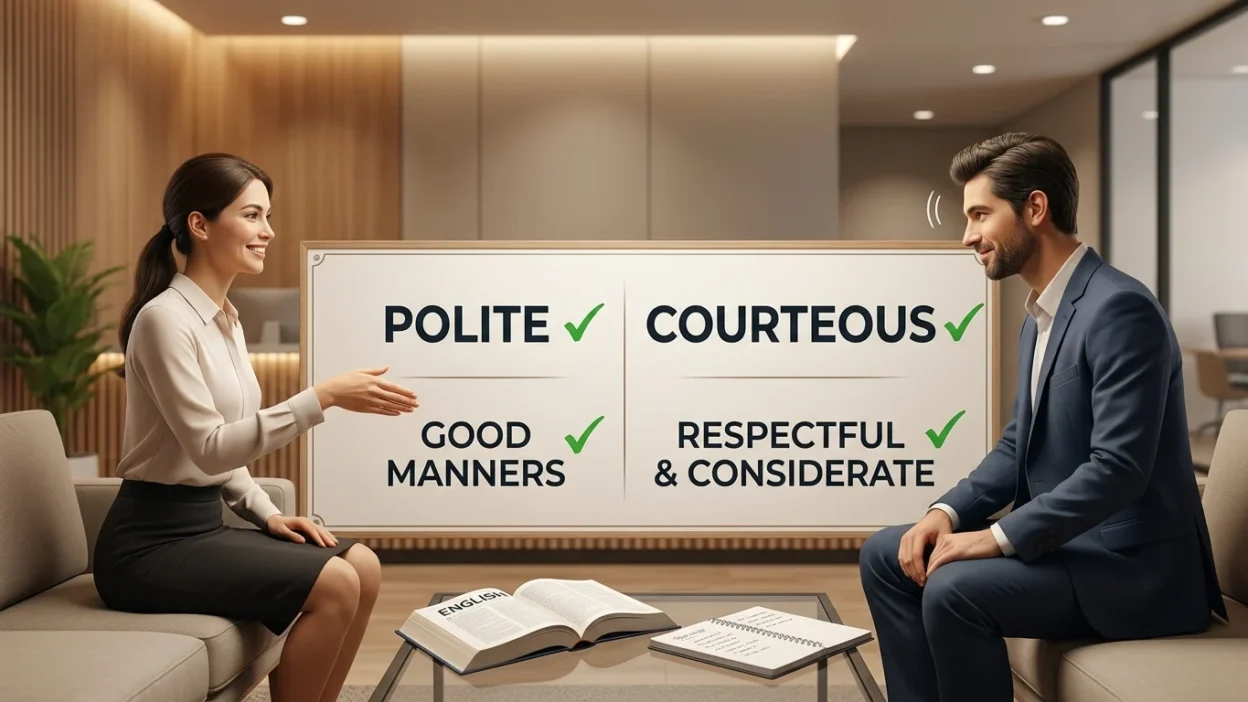
When you want to describe someone who treats others with respect and good manners, both polite and courteous can seem like perfect choices. They are very close in meaning, and in many sentences, either word can describe respectful behavior. However, there are subtle differences in tone, usage, and context that are worth understanding.
The main difference is that polite is the more common and everyday word, while courteous often sounds slightly more formal and emphasizes considerate, respectful behavior toward other people. Understanding polite vs courteous can help you choose the word that sounds most natural in conversations, professional communication, academic writing, and everyday English.
Quick Answer: Polite vs Courteous
Polite and courteous both describe respectful and well-mannered behavior, but they are not always identical in tone.
- Polite = having good manners and behaving respectfully.
- Courteous = showing respect, consideration, and good manners toward others.
- Polite is more common in everyday English.
- Courteous often sounds more formal or professional.
For example:
She was polite to the waiter.
She was courteous to the waiter.
Both sentences are correct. The second can sound slightly more formal and may emphasize considerate treatment.
What Does Polite Mean?
Polite means behaving in a way that shows good manners, respect, and consideration for other people.
It is one of the most common English words for describing appropriate social behavior.
Examples include:
- Saying please and thank you
- Listening when someone speaks
- Avoiding rude language
- Holding a door open for someone
- Respecting other people’s personal space
- Speaking respectfully
For example:
He was very polite to everyone at the meeting.
This means he behaved respectfully and used good manners.
The word polite can describe both a person’s general behavior and a particular action or expression.
Examples:
- That was a polite response.
- She asked a polite question.
- Please be polite to the guests.
- He gave me a polite smile.
- The children were polite to their teacher.
What Does Courteous Mean?
Courteous means showing respect, consideration, and good manners toward other people.
It is closely related to polite, but it often has a slightly more formal or refined tone.
For example:
The receptionist was courteous and helpful.
This suggests that the receptionist treated the person respectfully and thoughtfully.
Other examples include:
- The driver was courteous to pedestrians.
- Please be courteous to other passengers.
- The staff provided courteous service.
- He remained courteous throughout the discussion.
- She was courteous even when she disagreed.
The word is particularly common in professional settings, customer service, formal communication, and descriptions of respectful conduct.
Polite vs Courteous: Comparison Table
| Feature | Polite | Courteous |
|---|---|---|
| Basic meaning | Showing good manners and respect | Showing respect and consideration |
| Commonness | Very common | Less common |
| Tone | Everyday and natural | Slightly formal or professional |
| Used in conversation | Very common | Common but more formal |
| Used in business | Common | Very common |
| Can describe behavior | Yes | Yes |
| Can describe language | Yes | Sometimes |
| Example | She was polite to the guest. | She was courteous to the guest. |
The meanings overlap significantly, so context often determines which word sounds better.
Polite vs Courteous: The Main Difference
The easiest way to understand the difference is to think about everyday manners versus considerate behavior.
Polite often focuses on following accepted standards of good manners.
Courteous often emphasizes being respectful, considerate, and thoughtful toward other people.
Compare:
He was polite when I asked him a question.
This tells us that he responded with good manners.
He was courteous when I asked him a question.
This can suggest that he not only behaved politely but also showed consideration toward the other person.
The distinction is subtle, and native speakers frequently use the words interchangeably.
Examples of Polite
Here are some natural examples:
- Please be polite to your guests.
- She was polite to everyone at the party.
- He gave a polite answer.
- The student asked a polite question.
- It is polite to say thank you.
- She politely declined the invitation.
- He was always polite to his neighbors.
These examples focus mainly on good manners and respectful social behavior.
Examples of Courteous
Now consider these examples:
- The customer service representative was courteous.
- Please be courteous to other passengers.
- The driver was courteous and allowed the pedestrian to cross.
- She remained courteous during the disagreement.
- The hotel staff provided courteous service.
- He was courteous enough to listen to the entire explanation.
- The receptionist gave every visitor courteous assistance.
These examples often emphasize respectful and considerate treatment.
Polite vs Courteous in Everyday Conversation
In casual conversation, polite is usually the more natural choice.
For example:
He was very polite.
This sounds completely natural.
You could say:
He was very courteous.
This is also correct, but it may sound more formal or deliberate.
If a friend asks you how someone behaved at dinner, you are more likely to say:
She was very polite.
Rather than:
She was very courteous.
The second version is not wrong; it simply has a more formal flavor.
Polite vs Courteous in Professional English
Both words are useful in professional communication.
However, courteous is especially common when describing customer service, workplace behavior, or formal interactions.
For example:
Our staff is committed to providing polite and professional service.
This is natural.
You could also say:
Our staff is committed to providing courteous and professional service.
The second version sounds particularly suitable for business policies, customer-service standards, and formal communications.
Common professional phrases include:
- Courteous service
- Courteous behavior
- Courteous response
- Courteous communication
- Courteous treatment
- Courteous staff
Is Courteous More Formal Than Polite?
Generally, yes.
Polite is neutral and extremely common.
Courteous tends to sound somewhat more formal, especially when describing professional conduct or customer service.
Compare:
Thank you for being polite.
This sounds natural in everyday conversation.
Thank you for your courteous response.
This sounds more formal and could appear in a business email or official communication.
This difference in register is one of the most useful things to remember about these two words.
Polite vs Courteous: Are They Always Interchangeable?
No. Although they are close synonyms, they do not always produce exactly the same tone.
For example:
It is polite to say please and thank you.
This sounds very natural because the sentence discusses a basic rule of good manners.
It is courteous to say please and thank you.
This is grammatically correct, but it sounds somewhat more formal.
On the other hand:
The company provided courteous customer service.
This sounds very natural.
The company provided polite customer service.
This is also possible, but courteous service is a more established professional expression.
Common Mistakes With Polite and Courteous
Mistake 1: Assuming They Are Completely Different
The meanings overlap considerably.
You do not need to treat polite and courteous as opposites or completely separate concepts.
Both describe respectful behavior.
Mistake 2: Thinking Courteous Means Extremely Formal
Courteous can sound formal, but it does not necessarily describe extremely formal behavior.
A person can be courteous in ordinary everyday situations.
Mistake 3: Using Courteous When Polite Sounds More Natural
For simple everyday situations, polite is often the better choice.
For example:
Please be polite to your younger brother.
This sounds more natural than:
Please be courteous to your younger brother.
The second sentence is correct but unusually formal for the situation.
Mistake 4: Thinking Polite Always Means Friendly
Being polite does not necessarily mean being warm or friendly.
Someone can behave politely while still being distant.
For example:
He gave me a polite but brief answer.
This suggests good manners without necessarily suggesting friendliness.
Polite vs Courteous vs Respectful
These three words are related but have slightly different meanings.
| Word | Main Idea | Example |
|---|---|---|
| Polite | Good manners | She was polite to the guests. |
| Courteous | Respectful and considerate behavior | He was courteous to the customer. |
| Respectful | Showing respect or regard | The students were respectful toward their teacher. |
Respectful can describe attitudes and behavior toward people, traditions, opinions, or authority.
Polite is especially connected with social manners.
Courteous emphasizes considerate treatment of others.
American vs British English
There is no major difference between American and British English in the basic meanings of polite and courteous.
Both words are standard in both varieties.
However, polite is generally more common in everyday conversation in both American and British English, while courteous often appears in more formal, professional, or written contexts.
For example:
She was polite to the customer.
is natural in both varieties.
The staff provided courteous service.
is also natural in both varieties, especially in professional contexts.
Synonyms for Polite
Depending on the context, synonyms and related words include:
- Well-mannered
- Respectful
- Civil
- Courteous
- Considerate
- Gracious
- Tactful
- Well-behaved
These words are not always exact replacements.
For example, tactful focuses more on handling sensitive situations carefully, while well-mannered focuses on good social behavior.
Synonyms for Courteous
Related words include:
- Polite
- Respectful
- Considerate
- Civil
- Gracious
- Thoughtful
- Well-mannered
- Tactful
Again, context matters.
Considerate emphasizes thinking about other people’s feelings or needs, while courteous often emphasizes respectful social behavior.
Why Politeness and Courtesy Matter
Politeness and courtesy help people communicate more effectively and avoid unnecessary conflict.
Simple expressions such as:
- Please
- Thank you
- Excuse me
- Sorry
- Would you mind…?
- Could you please…?
can make communication feel more respectful.
Courtesy can be especially important in workplaces, customer service, schools, public spaces, and situations where people have different opinions.
Being polite does not mean that you must agree with everyone. You can disagree while remaining respectful and courteous.
FAQs
What is the difference between polite and courteous?
Both mean showing good manners and respect. Polite is more common in everyday English, while courteous often sounds more formal and emphasizes considerate treatment.
Is courteous more formal than polite?
Generally, yes. Courteous often has a more formal or professional tone, while polite is neutral and common in everyday conversation.
Can polite and courteous be used interchangeably?
Often, yes. They are close synonyms, but the tone may change slightly depending on which word you choose.
Is courteous a synonym for polite?
Yes. Courteous is a close synonym for polite, although it can emphasize consideration and respectful behavior.
Which word is better for everyday conversation?
Polite is usually the more natural choice for everyday conversation.
Which word is better in professional writing?
Both can work, but courteous is especially common in professional contexts such as customer service, formal correspondence, and workplace communication.
Are polite and courteous used differently in American and British English?
There is no major difference in their meanings. Both are used in American and British English. Polite is generally more common in ordinary conversation, while courteous often sounds more formal.
Can someone be polite but not friendly?
Yes. Polite describes good manners, not necessarily genuine friendliness or warmth. Someone can be polite while remaining distant or formal.
Final Summary
The difference between polite vs courteous is mostly a matter of tone and emphasis, rather than completely different meanings. Both words describe respectful and well-mannered behavior. Polite is the more common, everyday word and is often used when discussing basic social manners, respectful language, or appropriate behavior.
Courteous, on the other hand, often sounds slightly more formal and emphasizes consideration and respectful treatment of other people. It is particularly common in professional communication, customer service, and formal descriptions of behavior. Both words are standard in American and British English, and native speakers frequently use them as close synonyms.