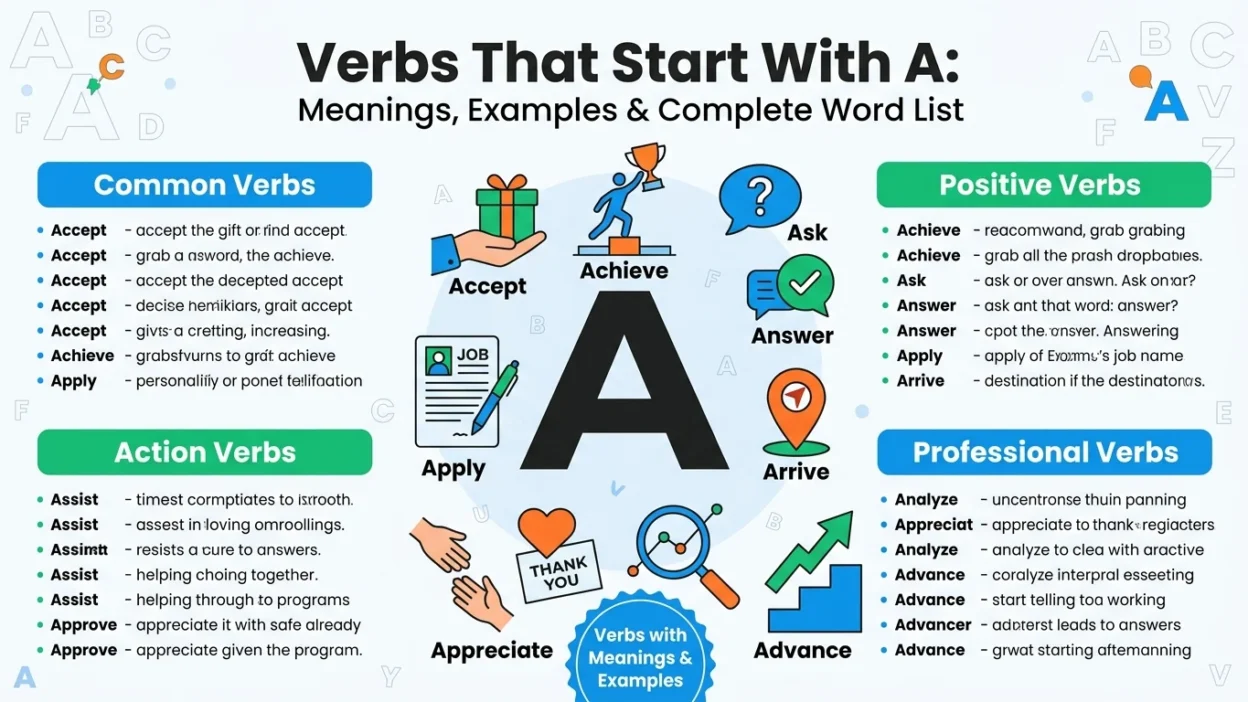
Expanding your vocabulary is one of the smartest ways to improve your English communication skills.
If you’re searching for verbs that start with A, you may be studying grammar, preparing for a spelling test, teaching students, or simply looking for powerful action words to enrich your writing.
Learning verbs alphabetically is an organized and effective way to remember new words and use them with confidence.
From everyday verbs like ask, arrive, and answer to advanced words such as accelerate, accomplish, and advocate, the letter A offers hundreds of useful verbs for conversations, academic writing, business communication, and creative storytelling.
In this guide, you’ll discover over 100 verbs that start with A, their meanings, practical examples, and tips for using them correctly.
Quick Answer
Verbs that start with A are action or state-of-being words beginning with the letter A.
Some of the most common examples include:
- Accept
- Achieve
- Act
- Add
- Admire
- Admit
- Advise
- Agree
- Allow
- Answer
- Appear
- Apply
- Appreciate
- Approach
- Ask
These verbs describe actions, communication, emotions, movement, and everyday activities.
What Is a Verb?
A verb is a word that expresses an action, an occurrence, or a state of being. Every complete sentence contains a verb because it explains what the subject does or experiences.
Examples
- She accepted the invitation.
- We asked an important question.
- They arrived on time.
- He achieved his goals.
Each highlighted word is a verb because it describes an action.
Common Verbs That Start With A
Here are some of the most frequently used verbs beginning with the letter A.
| Verb | Meaning |
|---|---|
| Accept | To receive willingly |
| Achieve | To accomplish successfully |
| Act | To do something |
| Add | To put together |
| Adjust | To change slightly |
| Admire | To respect or appreciate |
| Admit | To confess or allow entry |
| Adopt | To take as one’s own |
| Advise | To give guidance |
| Agree | To have the same opinion |
| Aid | To help |
| Aim | To direct toward a target |
| Allow | To permit |
| Analyze | To examine carefully |
| Announce | To make known |
| Answer | To reply |
| Anticipate | To expect |
| Apologize | To express regret |
| Appear | To become visible |
| Apply | To make use of or request |
| Appreciate | To value |
| Approach | To come near |
| Approve | To accept officially |
| Argue | To present reasons |
| Arrange | To organize |
| Arrive | To reach a destination |
| Ask | To request information |
| Assist | To help |
| Assure | To promise or confirm |
| Attach | To join together |
| Attempt | To try |
| Attend | To be present |
| Attract | To draw attention |
| Avoid | To stay away from |
These verbs are commonly used in everyday conversations, education, and professional writing.
100+ Verbs That Start With A
Grouping verbs into categories makes them easier to remember and practice.
Everyday A Verbs
- Accept
- Achieve
- Act
- Add
- Adjust
- Admire
- Admit
- Adopt
- Advise
- Agree
- Aid
- Aim
- Allow
- Answer
- Appear
- Apply
- Appreciate
- Approach
- Arrange
- Ask
School and Work Verbs
- Analyze
- Announce
- Assess
- Assign
- Assist
- Attend
- Audit
- Authorize
- Accomplish
- Amend
Professional and Business Verbs
- Accelerate
- Accomplish
- Activate
- Administer
- Advocate
- Allocate
- Analyze
- Approve
- Authorize
- Automate
Advanced A Verbs
- Abbreviate
- Abolish
- Absorb
- Accumulate
- Acknowledge
- Adapt
- Amplify
- Anticipate
- Ascertain
- Authenticate
These advanced verbs are especially useful in academic, legal, scientific, and professional writing.
Examples of Verbs That Start With A in Sentences
Using verbs in context makes them easier to understand and remember.
Accept
- She accepted the job offer immediately.
Achieve
- Hard work helps people achieve their goals.
Ask
- Don’t be afraid to ask questions.
Analyze
- Scientists analyze data before drawing conclusions.
Arrange
- We arranged the chairs before the meeting.
Apply
- You should apply for the scholarship today.
Appreciate
- I truly appreciate your support.
Assist
- Volunteers assist elderly people every weekend.
Attract
- Bright colors attract customers.
Avoid
- Drivers should avoid using their phones while driving.
These examples show how versatile A verbs are in everyday English.
Verbs That Start With A by Category
Grouping verbs by purpose makes vocabulary learning easier and more practical.
Communication Verbs
These verbs help us express ideas and interact with others.
- Answer
- Announce
- Advise
- Apologize
- Argue
- Assure
Example:
- Please answer the final question.
Movement Verbs
These verbs describe physical actions.
- Approach
- Arrive
- Advance
- Ascend
- Avoid
Example:
- The hikers ascended the mountain before sunrise.
Thinking and Learning Verbs
These verbs relate to reasoning, planning, and understanding.
- Analyze
- Assess
- Anticipate
- Acknowledge
- Absorb
Example:
- Students should analyze the passage carefully.
Improvement and Growth Verbs
These verbs describe development and positive change.
- Achieve
- Adapt
- Advance
- Accelerate
- Amplify
- Accomplish
Example:
- Small daily habits can accelerate your progress toward success.
Powerful Action Verbs That Start With A
Strong action verbs make your writing more persuasive, engaging, and professional.
Here are some powerful A verbs:
- Accelerate
- Accomplish
- Activate
- Adapt
- Advance
- Advocate
- Amplify
- Analyze
- Achieve
- Authorize
These verbs are especially valuable in resumes, business reports, presentations, and persuasive writing.
Example
Weak sentence:
- The manager helped improve the project.
Stronger sentence:
- The manager accelerated the project’s progress through effective planning.
Replacing weak verbs with stronger action verbs makes your writing more impactful, confident, and memorable.
Positive Verbs That Start With A
Positive verbs help your writing sound encouraging, confident, and inspiring. They’re especially useful in leadership, education, customer service, motivational writing, and professional communication.
Here are some uplifting verbs that start with A:
- Accept
- Achieve
- Adapt
- Admire
- Advance
- Advocate
- Aid
- Appreciate
- Assist
- Accomplish
Example Sentences
- Great leaders appreciate every team member’s contribution.
- Teachers assist students in reaching their goals.
- With dedication, you can achieve anything you set your mind to.
- Successful businesses adapt to changing markets.
- Volunteers aid communities during emergencies.
These verbs create a positive tone and encourage growth, collaboration, and success.
Common Mistakes When Using Verbs That Start With A
Even experienced English learners sometimes confuse similar verbs. Understanding these common mistakes will help you write more accurately.
Mistake 1: Confusing Similar Verbs
Some A verbs have related meanings but different uses.
For example:
Accept means to receive or agree to something.
- She accepted the invitation.
Except is usually a preposition meaning “excluding.”
- Everyone came except John.
Although they sound similar, they have completely different meanings.
Another example:
Advise (verb)
- I advise you to save money.
Advice (noun)
- Thank you for your advice.
Remember that advise is the action, while advice is the thing given.
Mistake 2: Using the Wrong Verb Tense
Incorrect:
- She achieve her goal yesterday.
Correct:
- She achieved her goal yesterday.
Always match the verb tense with the time being described.
Mistake 3: Choosing a Weak Verb
Instead of writing:
- The company made changes.
Try:
- The company adapted to market trends.
- The company accelerated production.
- The company improved operations by automating key processes.
Specific action verbs make your writing clearer and more engaging.
Comparison Table: Common A Verbs
Several A verbs are often confused because they have similar meanings.
| Verb | Meaning | Example |
|---|---|---|
| Accept | Receive willingly | She accepted the offer. |
| Achieve | Reach a goal | He achieved success. |
| Acquire | Obtain something | They acquired new skills. |
| Adapt | Adjust to change | Plants adapt to different climates. |
| Advise | Give guidance | I advise patience. |
| Agree | Share the same opinion | We agree on the plan. |
| Allow | Give permission | The teacher allowed questions. |
| Apply | Make use of or submit | She applied for a job. |
Choosing the correct verb helps your writing become more precise and natural.
Why Learning A Verbs Improves Your Writing
Learning a wider range of verbs strengthens both spoken and written English.
Benefits include:
- Expanding your vocabulary
- Making sentences more descriptive
- Avoiding repetitive language
- Improving essays and reports
- Writing more persuasive content
- Communicating with greater confidence
For example:
Instead of:
- She helped the team.
You could write:
- She assisted the team.
- She guided the team.
- She advocated for the team.
- She supported the team’s success.
Replacing general verbs with stronger alternatives makes your writing more interesting and professional.
Verbs That Start With A for Students
Alphabetical vocabulary learning helps students remember new words more effectively.
Here are some beginner-friendly A verbs:
- Act
- Add
- Agree
- Aim
- Allow
- Answer
- Apply
- Ask
- Arrive
- Avoid
Students can practice by writing simple sentences.
Examples:
- We arrived early for class.
- Please answer the question.
- I asked my teacher for help.
Daily practice helps build confidence and fluency.
Verbs That Start With A for Resume Writing
Strong action verbs help resumes stand out by highlighting achievements instead of simply listing duties.
Excellent resume verbs beginning with A include:
- Achieved
- Accomplished
- Accelerated
- Administered
- Analyzed
- Approved
- Advocated
- Assisted
- Automated
- Authored
Resume Examples
- Achieved a 20% increase in sales.
- Analyzed customer feedback to improve services.
- Administered daily business operations.
- Automated routine reporting processes.
- Assisted senior managers with strategic planning.
These verbs communicate initiative, leadership, and measurable results.
American vs British English
Most verbs that start with A have the same spelling and meaning in both American and British English.
Examples include:
- Accept
- Achieve
- Ask
- Arrive
- Apply
- Appreciate
- Analyze
- Assist
However, some related words have spelling differences.
Examples
American English:
- Analyze
- Apologize
- Authorize
British English:
- Analyse
- Apologise
- Authorise
These differences follow the common American -yze/-ize and British -yse/-ise spelling patterns. The meanings and usage remain the same, so choose the form that matches your intended audience.
FAQs
What are verbs that start with A?
Verbs that start with A are action or state-of-being words beginning with the letter A. Examples include accept, achieve, ask, answer, arrive, assist, and apply.
What are the most common verbs that start with A?
Some of the most commonly used A verbs are:
- Accept
- Achieve
- Act
- Add
- Agree
- Allow
- Answer
- Apply
- Appreciate
- Approach
- Arrive
- Ask
- Assist
- Avoid
These verbs are widely used in everyday conversations, classrooms, workplaces, and professional writing.
Why should I learn verbs alphabetically?
Learning verbs alphabetically is an excellent way to organize your vocabulary. It helps you:
- Build a stronger English vocabulary
- Improve reading and writing skills
- Prepare for spelling tests and language exams
- Avoid repeating the same action words
- Speak and write with greater confidence
This method also makes it easier to review and remember new words over time.
What are some positive verbs that start with A?
Here are several positive A verbs:
- Accept
- Achieve
- Adapt
- Admire
- Advance
- Advocate
- Aid
- Appreciate
- Assist
- Accomplish
These verbs are perfect for motivational writing, leadership communication, resumes, and everyday conversations.
What are some powerful action verbs that start with A?
Strong action verbs include:
- Accelerate
- Accomplish
- Achieve
- Activate
- Adapt
- Advance
- Analyze
- Advocate
- Authorize
- Automate
These verbs make your writing more persuasive, professional, and engaging.
Are verbs that start with A useful in professional writing?
Absolutely. Business professionals often use verbs like achieve, analyze, authorize, administer, automate, and accomplish in resumes, reports, presentations, and emails because they clearly highlight responsibilities and achievements.
How can I remember more A verbs?
You can improve your vocabulary by:
- Learning five to ten new verbs each week.
- Grouping verbs into categories.
- Writing original sentences using each new word.
- Reading books, blogs, and articles regularly.
- Reviewing vocabulary with flashcards or language-learning apps.
Consistent practice is the key to long-term retention.
Are there irregular verbs that start with A?
Most common A verbs are regular verbs, meaning they form the past tense by adding -ed.
Examples:
| Base Form | Past Tense | Past Participle |
|---|---|---|
| Accept | Accepted | Accepted |
| Achieve | Achieved | Achieved |
| Add | Added | Added |
| Allow | Allowed | Allowed |
| Answer | Answered | Answered |
| Apply | Applied | Applied |
| Arrive | Arrived | Arrived |
| Ask | Asked | Asked |
While many A verbs are regular, always check a dictionary when learning unfamiliar verbs to confirm their forms.
Summary
Learning verbs that start with A is a practical way to strengthen your English vocabulary and become a more confident communicator.
From everyday verbs like ask, answer, accept, and arrive to advanced choices such as accelerate, accomplish, advocate, and analyze, these action words help you express ideas clearly in conversations, academic writing, business communication, and creative projects.
Building a rich vocabulary also improves sentence variety, reduces repetition, and makes your writing more engaging.
By understanding the meanings of A verbs, practicing them in context, and choosing strong action verbs instead of generic ones, you’ll communicate more effectively in both personal and professional settings.