Building a strong vocabulary is one of the most effective ways to improve your English communication skills.
If you’re searching for verbs that start with E, you may be studying grammar, teaching students, preparing for a spelling activity, or simply looking for new action words to enrich your writing.
If your goal, learning verbs alphabetically is an easy and organized way to grow your vocabulary.
From common verbs like eat, enter, and enjoy to advanced words such as encourage, eliminate, and evaluate, the letter E offers many useful verbs for everyday conversations, academic writing, business communication, and creative storytelling.
In this guide, you’ll discover common and advanced E verbs, their meanings, example sentences, and practical tips to use them confidently.
Quick Answer
Verbs that start with E are action or state-of-being words beginning with the letter E.
Some of the most common examples include:
- Earn
- Eat
- Educate
- Elect
- Eliminate
- Encourage
- End
- Enjoy
- Enter
- Escape
- Establish
- Estimate
- Evaluate
- Examine
- Explain
These verbs are widely used in everyday speech, school assignments, professional writing, and business communication.
What Is a Verb?
A verb is a word that expresses an action, occurrence, or state of being. Every complete sentence needs a verb because it tells us what the subject is doing or experiencing.
Examples
- She enjoys reading novels.
- They entered the classroom quietly.
- We examined the evidence carefully.
- He earned a promotion.
Each highlighted word describes an action.
Common Verbs That Start With E
Here are some of the most frequently used verbs beginning with E.
| Verb | Meaning |
|---|---|
| Earn | To receive through work or effort |
| Eat | To consume food |
| Educate | To teach |
| Elect | To choose by voting |
| Eliminate | To remove completely |
| Embrace | To accept warmly |
| Emerge | To come into view |
| Encourage | To give support or confidence |
| End | To finish |
| Endure | To tolerate |
| Enjoy | To take pleasure in |
| Enlarge | To make bigger |
| Enroll | To register |
| Enter | To go into |
| Entertain | To amuse |
| Escape | To get away |
| Establish | To create or set up |
| Estimate | To roughly calculate |
| Evaluate | To assess |
| Examine | To inspect carefully |
| Exchange | To trade |
| Excite | To make enthusiastic |
| Excuse | To forgive or allow |
| Execute | To carry out |
| Exercise | To perform physical activity |
| Exhibit | To display |
| Exist | To be |
| Expand | To grow larger |
| Expect | To anticipate |
| Explain | To make something clear |
| Explore | To investigate |
| Express | To communicate thoughts |
| Extend | To make longer |
These verbs appear regularly in both spoken and written English.
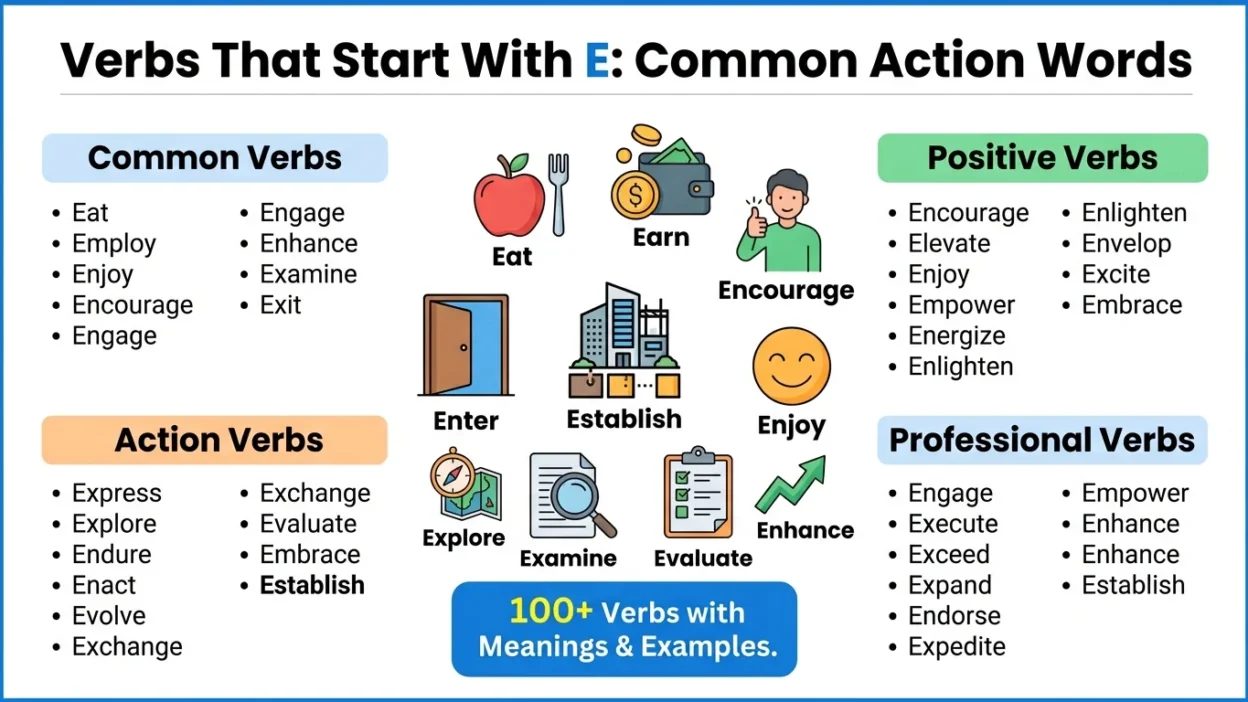
100+ Verbs That Start With E
Grouping vocabulary into categories makes learning easier.
Everyday E Verbs
- Earn
- Eat
- Echo
- Edit
- Educate
- Elect
- Eliminate
- Embrace
- Emerge
- Encourage
- End
- Endure
- Enjoy
- Enlarge
- Enroll
- Enter
- Entertain
- Escape
- Establish
- Estimate
School and Work Verbs
- Evaluate
- Examine
- Explain
- Edit
- Exchange
- Execute
- Expand
- Express
- Explore
- Estimate
Professional and Business Verbs
- Empower
- Enhance
- Enforce
- Engage
- Ensure
- Execute
- Establish
- Evaluate
- Expand
- Exceed
Advanced E Verbs
- Exaggerate
- Evacuate
- Elucidate
- Envision
- Evoke
- Exclude
- Exempt
- Exemplify
- Exterminate
- Equalize
Learning these verbs helps improve both your vocabulary and your communication skills.
Examples of Verbs That Start With E in Sentences
Using verbs in real sentences helps you understand how they work.
Eat
- We eat dinner together every evening.
Earn
- She earned a scholarship through hard work.
Encourage
- Good teachers encourage students to ask questions.
Examine
- The doctor examined the patient carefully.
Explain
- Please explain the instructions again.
Explore
- The children explored the forest during the trip.
Establish
- They established a successful business.
Evaluate
- Managers evaluate employee performance each year.
Expand
- The company plans to expand into new markets.
Express
- It’s important to express your ideas clearly.
These examples demonstrate how versatile E verbs are in everyday life.
Verbs That Start With E by Category
Grouping verbs by purpose makes them easier to remember.
Communication Verbs
These verbs help us share ideas and information.
- Explain
- Express
- Exchange
- Encourage
- Excuse
- Echo
Example:
- Please explain your answer in detail.
Movement Verbs
These describe physical actions.
- Enter
- Escape
- Exit
- Explore
- Extend
- Emerge
Example:
- The hikers escaped the storm safely.
Thinking and Learning Verbs
These involve reasoning, studying, and decision-making.
- Evaluate
- Examine
- Estimate
- Expect
- Envision
- Educate
Example:
- Scientists evaluate data before drawing conclusions.
Improvement and Growth Verbs
These describe development and positive change.
- Enhance
- Expand
- Empower
- Establish
- Encourage
- Enrich
Example:
- Reading daily can enrich your vocabulary.
Powerful Action Verbs That Start With E
Strong action verbs make your writing more engaging, persuasive, and professional.
Some excellent choices include:
- Empower
- Enhance
- Encourage
- Enrich
- Establish
- Execute
- Expand
- Exceed
- Evaluate
- Elevate
These verbs are particularly useful in resumes, reports, presentations, and persuasive writing.
Example
Weak sentence:
- She helped improve customer service.
Stronger sentence:
- She enhanced customer service by introducing new support strategies.
Replacing general verbs with stronger action verbs makes your writing more impactful and memorable.
Positive Verbs That Start With E
Positive verbs help your writing sound more encouraging, inspiring, and optimistic. They’re especially valuable in leadership, education, customer service, and motivational content.
Here are some uplifting verbs that start with E:
- Encourage
- Empower
- Enrich
- Enhance
- Energize
- Embrace
- Elevate
- Enlighten
- Excel
- Enjoy
Example Sentences
- Great mentors empower others to succeed.
- Reading books can enrich your knowledge.
- Positive feedback encourages employees to improve.
- Exercise helps energize your body and mind.
- We should embrace new opportunities with confidence.
These verbs create a positive tone and inspire action.
Common Mistakes When Using Verbs That Start With E
Even simple verbs can be confusing if they’re used incorrectly. Here are some common mistakes to avoid.
Mistake 1: Confusing Similar Verbs
Some E verbs have related meanings but different uses.
For example:
Ensure means to make certain.
- Please ensure the door is locked.
Insure means to provide insurance.
- They insured their new house.
Although they sound similar, they are not interchangeable.
Mistake 2: Incorrect Verb Forms
Some verbs have irregular forms that learners often misuse.
Incorrect:
- She has eat breakfast.
Correct:
- She has eaten breakfast.
Another example:
Incorrect:
- He begin the lesson yesterday.
Correct:
- He began the lesson yesterday.
Always check verb tenses when writing.
Mistake 3: Overusing General Verbs
Instead of writing:
- The company made improvements.
Try:
- The company enhanced its services.
- The company expanded its operations.
- The company established new partnerships.
Specific verbs make your writing clearer and more engaging.
Comparison Table: Common E Verbs
Several E verbs are easy to confuse. This comparison table highlights the differences.
| Verb | Meaning | Example |
|---|---|---|
| Encourage | Give support or confidence | Teachers encourage students. |
| Empower | Give authority or ability | Good leaders empower their teams. |
| Examine | Inspect carefully | The doctor examined the patient. |
| Evaluate | Assess quality or value | Managers evaluate performance. |
| Ensure | Make certain | Ensure all forms are complete. |
| Enter | Go into | She entered the room quietly. |
| Escape | Get away | The prisoner escaped. |
| Explain | Make something clear | Please explain your answer. |
Understanding these differences will help you use the right verb in every situation.
Why Learning E Verbs Improves Your Writing
Expanding your vocabulary helps you communicate with greater precision and confidence.
Benefits include:
- Improving sentence variety
- Avoiding repetitive language
- Strengthening essays and reports
- Writing more persuasive content
- Making conversations more engaging
For example:
Instead of:
- The manager helped the team.
You could write:
- The manager empowered the team.
- The manager encouraged the team.
- The manager elevated team performance.
Choosing stronger verbs creates more vivid and professional writing.
Verbs That Start With E for Students
Learning verbs alphabetically is a simple way for students to build vocabulary.
Here are some beginner-friendly E verbs:
- Eat
- End
- Enjoy
- Enter
- Escape
- Earn
- Explain
- Examine
- Exercise
- Explore
Teachers can ask students to create simple sentences using these verbs.
Examples:
- We eat lunch at noon.
- They entered the classroom quietly.
- I enjoy reading storybooks.
Regular practice helps students remember these words more easily.
Verbs That Start With E for Resume Writing
Action verbs make resumes stronger because they focus on achievements rather than responsibilities.
Here are some excellent resume verbs beginning with E:
- Enhanced
- Established
- Executed
- Expanded
- Evaluated
- Encouraged
- Empowered
- Exceeded
- Examined
- Engineered
Resume Examples
- Enhanced customer satisfaction through improved support.
- Executed multiple projects within budget.
- Expanded sales into international markets.
- Evaluated financial reports for senior management.
- Exceeded quarterly performance targets.
These verbs demonstrate initiative, leadership, and measurable results.
American vs British English
Most verbs that start with E have the same spelling and meaning in both American and British English.
Examples include:
- Eat
- Enjoy
- Enter
- Explain
- Explore
- Examine
- Evaluate
- Escape
However, some related words and spellings differ.
Example
American English:
- Enroll
British English:
- Enrol
Another example:
American English:
- Emphasize
British English:
- Emphasise
These differences follow common American -ize versus British -ise spelling patterns and the American tendency to use -ll differently in some words. Regardless of the spelling variation, the meanings remain the same.
FAQs
What are verbs that start with E?
Verbs that start with E are action or state-of-being words beginning with the letter E. Common examples include eat, earn, enjoy, enter, encourage, explain, and explore.
What are the most common verbs that start with E?
Some of the most frequently used E verbs are:
- Eat
- Earn
- Enjoy
- Enter
- Encourage
- Explain
- Explore
- Examine
- Evaluate
- Establish
These verbs are commonly used in daily conversations, schoolwork, and professional writing.
Why should I learn verbs alphabetically?
Learning verbs alphabetically makes vocabulary building more organized and manageable. It also helps you:
- Expand your English vocabulary
- Improve reading and writing skills
- Remember new words more easily
- Prepare for spelling tests and language exams
- Communicate with greater confidence
What are some positive verbs that start with E?
Here are several positive E verbs:
- Encourage
- Empower
- Enhance
- Enrich
- Energize
- Embrace
- Elevate
- Enlighten
- Excel
- Enjoy
These verbs are ideal for motivational writing, speeches, teaching, and leadership communication.
What are some strong action verbs that start with E?
Powerful action verbs include:
- Execute
- Establish
- Enhance
- Expand
- Evaluate
- Empower
- Elevate
- Exceed
- Explore
- Examine
These words help make resumes, reports, and persuasive writing more impactful.
Are verbs that start with E useful in professional writing?
Absolutely. Professionals frequently use verbs like execute, evaluate, enhance, establish, expand, and exceed in resumes, emails, business reports, and presentations because they clearly describe achievements and responsibilities.
How can I remember more E verbs?
You can improve your vocabulary by:
- Learning five to ten new verbs each week
- Grouping verbs into categories
- Writing your own example sentences
- Reading books, blogs, and articles regularly
- Practicing with flashcards or vocabulary apps
Consistent practice helps you remember new words more effectively.
Are there irregular verbs that start with E?
Yes. While many E verbs are regular, a few are irregular.
Examples include:
| Base Form | Past Tense | Past Participle |
|---|---|---|
| Eat | Ate | Eaten |
| Earn | Earned | Earned |
| Enter | Entered | Entered |
| Escape | Escaped | Escaped |
| Explain | Explained | Explained |
Among these, eat is the most common irregular verb and should be memorized separately.
Summary
Learning verbs that start with E is a practical way to improve your English vocabulary and communicate with greater confidence.
If you’re using everyday verbs like eat, enter, enjoy, and earn or advanced choices such as empower, enhance, evaluate, and execute, these action words help you express ideas more clearly in conversations, essays, business documents, and creative writing.
Strong verbs also make your writing more engaging, precise, and professional.
By understanding their meanings, practicing them in context, and replacing weak or repetitive words with stronger alternatives, you’ll develop a richer vocabulary that enhances every aspect of your English communication.
Actionable Takeaway
Start by mastering these 10 essential verbs that start with E:
- Eat
- Earn
- Enjoy
- Enter
- Encourage
- Explain
- Explore
- Examine
- Evaluate
- Establish
Challenge yourself to write one original sentence using each verb every day. As your confidence grows, begin incorporating advanced verbs like empower, enhance, elevate, and execute into your writing. Over time, these verbs will become a natural part of your vocabulary, helping you communicate more effectively in both personal and professional settings.