Have you ever typed imput instead of input and wondered whether both spellings are correct? You’re not alone. The two words look remarkably similar, and the pronunciation of input can sometimes make the spelling confusing. This is especially common when typing quickly or writing about computers, data, forms, or communication.
The good news is that the difference between input vs imput is simple. Input is the correct standard English word, while imput is generally a misspelling. In this guide, we’ll explain what input means, show you how to use it correctly, explore common mistakes, and answer frequently asked questions about this commonly confused spelling.
Quick Answer
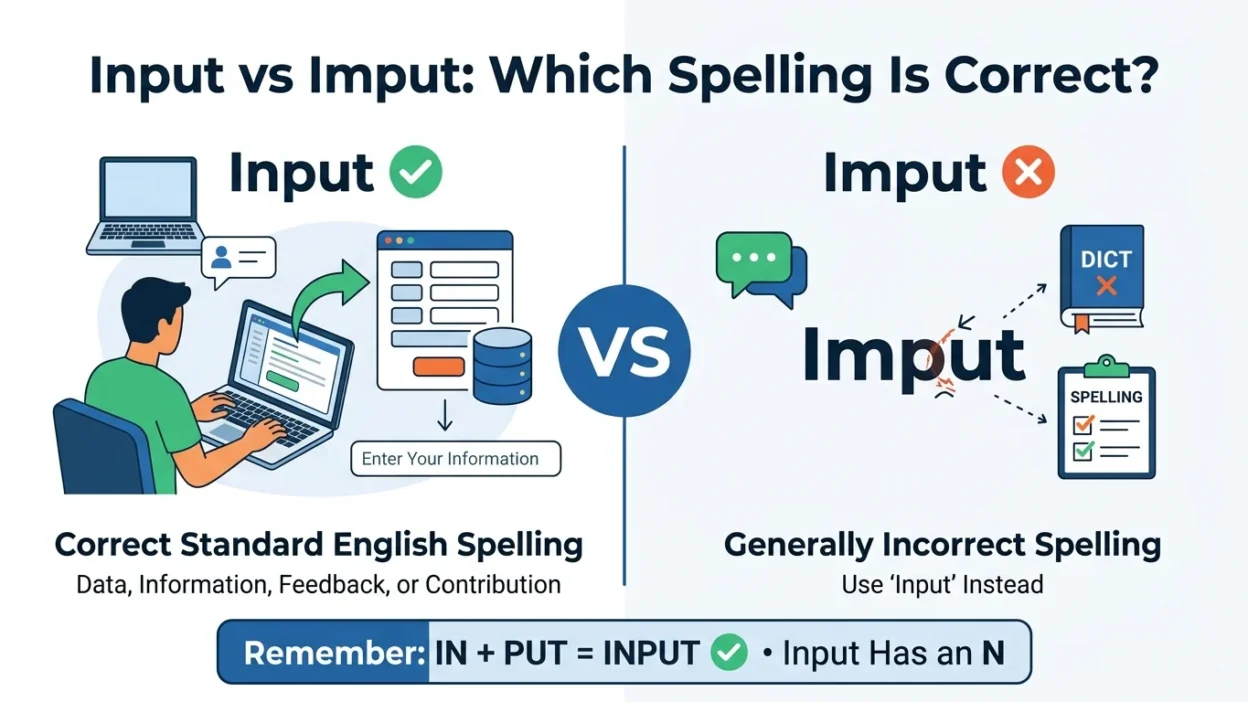
Input is the correct spelling. ✅
Imput is generally incorrect and should not be used in standard English. ❌
The word input can be used as a noun or a verb.
Examples
- Please enter your input in the form. ✅
- Your input was valuable during the meeting. ✅
- The user input the data into the system. ✅
Incorrect:
- Please enter your imput in the form. ❌
If you’re unsure, always choose input.
What Does “Input” Mean?
The word input has several related meanings, depending on context.
In general, it refers to:
It can also mean the act of entering information into a computer or system.
Input as a Noun
As a noun, input can mean information, advice, or a contribution.
Examples:
- We need your input before making a final decision.
- Her input helped improve the project.
- The manager asked for everyone’s input.
- Your feedback provided valuable input for the team.
In these examples, input means an opinion, contribution, or suggestion.
Input in Technology
In computing, input refers to data entered into a computer, application, or digital system.
Examples include:
- Keyboard input
- Mouse input
- User input
- Data input
- Audio input
- Text input
For example:
Here, input refers to information supplied to the computer.
What Does “Input” Mean as a Verb?
Input can also be used as a verb meaning:
Examples:
- Please input your password.
- The employee input the customer’s information into the database.
- Users can input data using the keyboard.
- I need to input these figures into the spreadsheet.
Although enter is often more natural in everyday instructions, input is common in technical and professional contexts.
What Does “Imput” Mean?
In standard English, imput is generally not a correct spelling.
It is usually a typographical or spelling error caused by confusion about the word input.
For example:
- Incorrect: Please imput your information.
- Correct: Please input your information.
If you see imput in a sentence, the writer probably intended to write input.
Input vs Imput: Key Difference
The main difference is simple: input is a real and standard English word, while imput is generally a misspelling.
| Word | Correct? | Meaning | Example |
|---|---|---|---|
| Input | ✅ Yes | Data, information, advice, or contribution | We need your input. |
| Imput | ❌ Generally no | Usually a misspelling of “input” | Avoid this spelling. |
This makes the choice easy.
When you mean information, data, feedback, or something entered into a system, use input.
Why Do People Spell “Input” as “Imput”?
There are several reasons people make this mistake.
1. Pronunciation Confusion
The pronunciation of input can sometimes make the word sound like it contains an m sound, particularly in rapid speech.
This can lead some people to write imput instead of input.
However, the correct spelling remains:
I-N-P-U-T
2. Confusion With Similar Words
English contains many words beginning with im-, such as:
- import
- improve
- impossible
- immature
Because of this familiar pattern, some writers may mistakenly assume that imput is the correct spelling.
3. Typing Errors
When typing quickly, it’s easy to accidentally replace n with m, especially because the letters are close together on a keyboard.
Common Mistakes to Avoid
Mistake 1: Writing “Imput”
Incorrect:
Correct:
Mistake 2: Using “Input” When You Mean “Feedback”
Technically, input can mean feedback or an opinion, but context matters.
For example:
This means:
Mistake 3: Confusing Input With Output
These two terms are opposites in many technology contexts.
- Input = information provided to a system.
- Output = result produced by a system.
Example:
Input vs Output: A Simple Comparison
Understanding input becomes easier when you compare it with output.
| Term | Meaning | Example |
|---|---|---|
| Input | Information provided to a system | You type a question. |
| Process | The system works with the information | The computer analyzes it. |
| Output | The resulting information | The computer displays an answer. |
This input-process-output model is widely used in computing and information technology.
Examples of Correct “Input” Usage
Here are examples across different contexts.
In Everyday Communication
- I appreciate your input.
- We need everyone’s input.
- Thank you for your input on the project.
In Business
- The manager requested employee input.
- Customer input helped shape the new product.
- We value your input during the planning process.
In Technology
- Enter your input in the search box.
- The system accepts keyboard input.
- The application processes user input.
In Education
- Students provided valuable input during the discussion.
- The teacher asked for the class’s input.
American vs British English
There is no meaningful spelling difference between American and British English when it comes to input.
Both varieties use:
- input ✅
The spelling imput is not considered the standard spelling in either variety.
However, pronunciation can vary slightly depending on accent and region. These pronunciation differences do not change the correct spelling.
So whether you’re writing for an American or British audience, use input.
Related Words and LSI Keywords
If you’re learning about input vs imput, you may also encounter these related terms:
- data input
- user input
- input data
- information input
- keyboard input
- computer input
- input field
- input box
- enter information
- provide feedback
- give your input
- user contribution
- data entry
- input process output
These terms are commonly associated with computing, business communication, and general English usage.
How to Remember the Correct Spelling
Here’s a simple trick:
Think of the word in + put.
IN + PUT = INPUT
You’re putting information in.
This isn’t the historical origin of the word, but it’s a useful memory aid.
You can also remember:
Whenever you mean information entered into a system or someone’s opinion or contribution, spell it:
I-N-P-U-T
Is “Input” a Countable Noun?
In many contexts, input is treated as an uncountable noun when it means advice, feedback, or contribution.
For example:
- We need your input.
- Thank you for your input.
However, in technical contexts, inputs can be used as the plural when referring to separate pieces or types of information.
Example:
- The system receives multiple inputs from different sensors.
The correct form depends on the context.
FAQs
Which is correct: input or imput?
Input is the correct spelling. Imput is generally a misspelling.
Is “imput” a word in English?
In standard English, imput is generally not recognized as the correct spelling of the word meaning data, information, or contribution. Use input instead.
What does input mean?
Input can mean information, data, feedback, advice, or a contribution. In computing, it can also mean information entered into a system.
How do you use input in a sentence?
You can say: “We need your input before making a decision.” You can also say: “Please input your information into the form.”
Why do people write “imput”?
It’s usually caused by pronunciation confusion, typing errors, or confusion with other English words beginning with im-.
Is input spelled differently in British English?
No. Input is spelled the same way in both American and British English.
What is the opposite of input?
In computing, the opposite is often output. Input is information provided to a system, while output is the result produced by it.
Can input be a verb?
Yes. Input can be used as a verb meaning to enter information into a computer or system.
Summary
The difference between input vs imput is straightforward: input is the correct standard English spelling, while imput is generally a spelling mistake. The word input can refer to data entered into a computer, information provided to a system, or someone’s feedback, advice, or contribution. It can function as both a noun and a verb, making it a versatile word in everyday, professional, and technical English.
If you’re writing a business email, completing a computer form, creating technical documentation, or discussing someone’s opinion, input is the spelling you should choose. American and British English use the same spelling, so there is no need to change it depending on your audience.