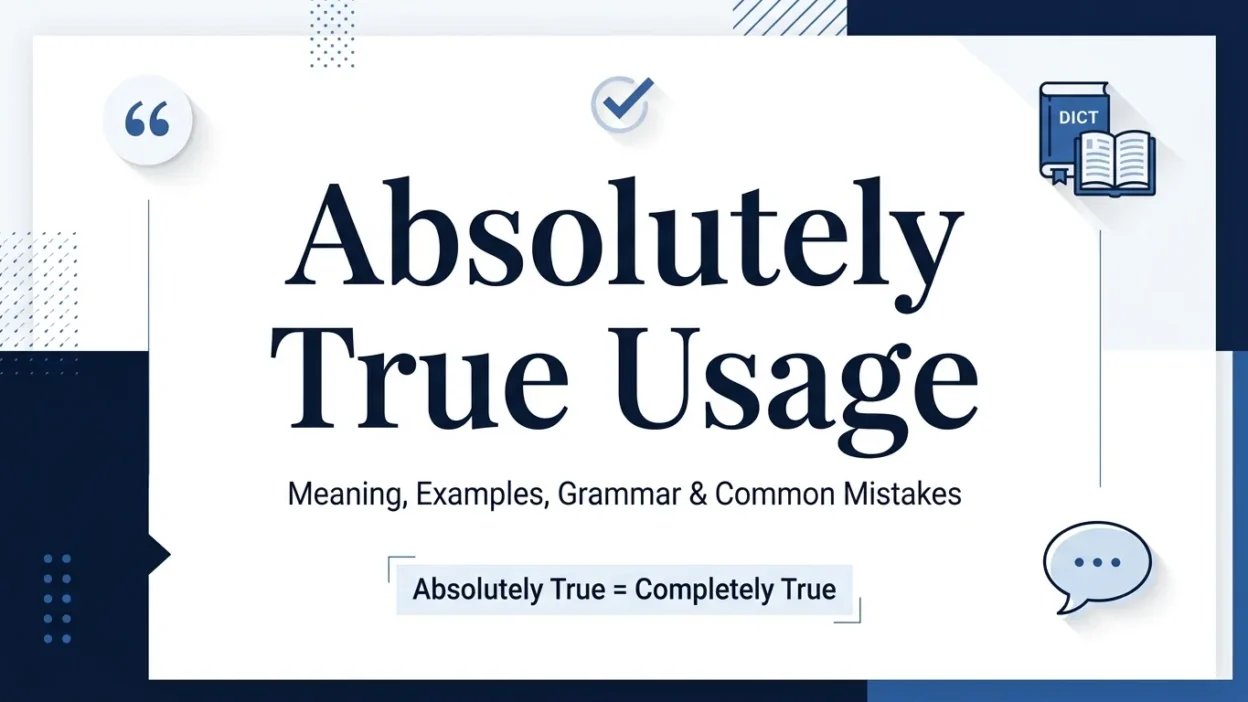
Have you ever wondered whether saying “absolutely true“ is grammatically correct or whether absolutely sounds unnecessary before true? This is a common question among English learners because both words express a strong sense of certainty. The good news is that absolutely true is a perfectly natural and widely used English expression.
Understanding absolutely true usage can help you sound more confident and natural in everyday conversations, professional communication, and written English. In this guide, we’ll explore what absolutely true means, how to use it correctly, when it sounds natural, common mistakes to avoid, and how it compares with expressions such as completely true, totally true, and very true.
Quick Answer
Absolutely true is grammatically correct and means:
The word absolutely is an adverb that intensifies the adjective true.
Examples
- That statement is absolutely true.
- What you said is absolutely true.
- It’s absolutely true that practice improves your skills.
- “Is this information correct?” — “Yes, absolutely true.”
The expression is especially useful when you want to strongly agree with a statement or emphasize that something is completely accurate.
What Does “Absolutely True” Mean?
The phrase absolutely true combines two words:
- Absolutely = completely, entirely, without doubt
- True = correct, accurate, or in accordance with reality
Together, absolutely true means something is completely correct or unquestionably true.
Simple Definition
For example:
You might respond:
Here, you’re strongly agreeing with the statement.
Is “Absolutely True” Grammatically Correct?
Yes, absolutely true is completely grammatical.
The structure is:
Here:
- Absolutely = adverb
- True = adjective
The adverb modifies or intensifies the adjective.
Similar examples include:
- absolutely correct
- absolutely certain
- absolutely clear
- absolutely necessary
- absolutely amazing
So, absolutely true follows a normal and widely accepted English grammar pattern.
How to Use “Absolutely True” in a Sentence
There are several natural ways to use the phrase.
1. To Agree Strongly
You can use absolutely true to show strong agreement.
This is common in everyday conversation.
2. To Emphasize Accuracy
Use it when you want to emphasize that information is completely accurate.
3. To Confirm a Statement
You can use it as part of a longer sentence.
Examples of “Absolutely True”
Here are some natural examples from different situations.
Everyday Conversation
- That’s absolutely true.
- What you said is absolutely true.
- It’s absolutely true that nobody is perfect.
Academic Context
- It is absolutely true that education plays an important role in society.
- The statement is absolutely true based on the available evidence.
Professional Communication
- Your observation is absolutely true.
- It is absolutely true that customer service affects business success.
Social Media or Informal Writing
- So true! Absolutely true!
- This is absolutely true. I couldn’t agree more.
Absolutely True vs Very True
Both expressions are grammatically possible, but they have different levels of emphasis.
| Expression | Meaning | Strength | Naturalness |
|---|---|---|---|
| Absolutely true | Completely or unquestionably true | Very strong | Very natural |
| Very true | Highly true or accurate | Strong | Natural |
| Completely true | Entirely true | Very strong | Natural |
| Totally true | Completely true | Very strong | More informal |
| Quite true | Fairly or considerably true | Moderate | Depends on context |
Example
This shows agreement.
This shows stronger, more emphatic agreement.
Absolutely True vs Completely True
These phrases are very similar.
Absolutely True
This often emphasizes certainty or strong agreement.
Completely True
This emphasizes that there is no part of the statement that is false.
In many situations, the two expressions can be used interchangeably.
Absolutely True vs Totally True
Totally true is common in casual, conversational English.
For example:
It sounds enthusiastic and informal.
Absolutely true is also conversational but can work comfortably in more formal contexts.
For professional or academic writing, absolutely true or completely true may sound more polished than totally true.
Common Mistakes to Avoid
1. Thinking “Absolutely True” Is Redundant
Some people believe that true doesn’t need an intensifier.
However, English commonly uses adverbs to strengthen adjectives.
Examples:
- absolutely true
- absolutely correct
- absolutely certain
So, absolutely true is not grammatically redundant.
2. Confusing “Absolutely” With “Absolute”
These words are related but have different grammatical functions.
Correct:
Here, absolutely modifies true.
Another structure is:
Here, absolute is an adjective modifying truth.
3. Using “Absolutely True” for Opinions
Be careful when calling an opinion “absolutely true.”
For example:
This is an opinion, so calling it absolutely true may not be appropriate.
Instead, you could say:
Use absolutely true when discussing something that can reasonably be considered factual or accurate.
“Absolutely True” vs “Absolutely Right”
These expressions are related but not identical.
Absolutely True
Focuses on whether a statement or fact is accurate.
Absolutely Right
Focuses on whether a person, answer, or conclusion is correct.
Both expressions can show strong agreement.
American vs British English
There is no significant difference between American and British English when it comes to absolutely true.
The phrase is natural in both varieties.
Examples:
- American English: That’s absolutely true.
- British English: That’s absolutely true.
The pronunciation may vary slightly depending on the speaker’s accent, but the meaning and grammar remain the same.
When Should You Use “Absolutely True”?
Use absolutely true when:
- You strongly agree with someone.
- You want to emphasize accuracy.
- You are confirming a fact.
- You want to express complete certainty.
- You are responding enthusiastically to a statement.
Example
This response strongly confirms the speaker’s point.
When Should You Avoid It?
Avoid using absolutely true when:
- The statement is clearly an opinion.
- The information is uncertain.
- You don’t have enough evidence to confirm something.
- You’re exaggerating for no reason.
For example, instead of saying:
If you’re not certain, say:
This distinction is especially important in professional, academic, and factual writing.
Related Words and LSI Keywords
If you’re exploring the meaning and usage of absolutely true, these related phrases can expand your vocabulary:
- completely true
- totally true
- entirely true
- genuinely true
- unquestionably true
- definitely true
- perfectly true
- absolutely correct
- completely accurate
- strongly agree
- fully agree
- express certainty
- emphasize truth
These expressions can help you choose the right level of emphasis depending on your context.
FAQs
Is “absolutely true” grammatically correct?
Yes. Absolutely true is a grammatically correct and commonly used English expression.
What does “absolutely true” mean?
It means completely true, entirely accurate, or unquestionably true.
Can I say “That’s absolutely true”?
Yes. This is one of the most natural ways to use the phrase when strongly agreeing with someone.
Is “absolutely true” better than “very true”?
Not necessarily. Absolutely true expresses stronger certainty, while very true is a less emphatic way to agree.
Is “totally true” correct?
Yes. Totally true is common in informal conversation, while absolutely true may be more suitable for a wider range of contexts.
Can “absolutely true” describe an opinion?
It can, but it may not be appropriate if the statement is subjective. For opinions, expressions such as I absolutely agree may be more natural.
Is “absolutely true” used in American and British English?
Yes. The expression is natural and widely understood in both American and British English.
What is the difference between “absolutely true” and “absolutely right”?
Absolutely true focuses on the accuracy of a statement, while absolutely right usually refers to a person’s answer, opinion, or conclusion being correct.
Summary
Understanding absolutely true usage is simple once you recognize the role of absolutely as an intensifying adverb. The phrase means completely true, entirely accurate, or unquestionably true. It is grammatically correct and can be used in everyday conversations, professional communication, and many forms of writing. A common example is “That’s absolutely true,” which is a natural way to express strong agreement.
The phrase is similar to completely true and totally true, although each can have a slightly different tone. Absolutely true is particularly useful when you want to emphasize certainty or strongly confirm a statement. However, it’s best to reserve it for facts or claims that can reasonably be considered true rather than using it for every personal opinion or uncertain claim.