Have you ever wondered whether the correct word is envision or invision? These two spellings look very similar, and it’s easy to see why English learners—and even native speakers—sometimes confuse them. However, when you’re trying to express the idea of imagining something or seeing a future possibility in your mind, there is one standard English spelling you should choose.
Understanding envision vs invision is useful for improving your spelling, vocabulary, professional writing, and everyday English. In this guide, we’ll explain the meaning of envision, discuss why invision is usually considered incorrect, provide practical examples, compare related words, highlight common mistakes, and explain whether American and British English use the same spelling.
Quick Answer
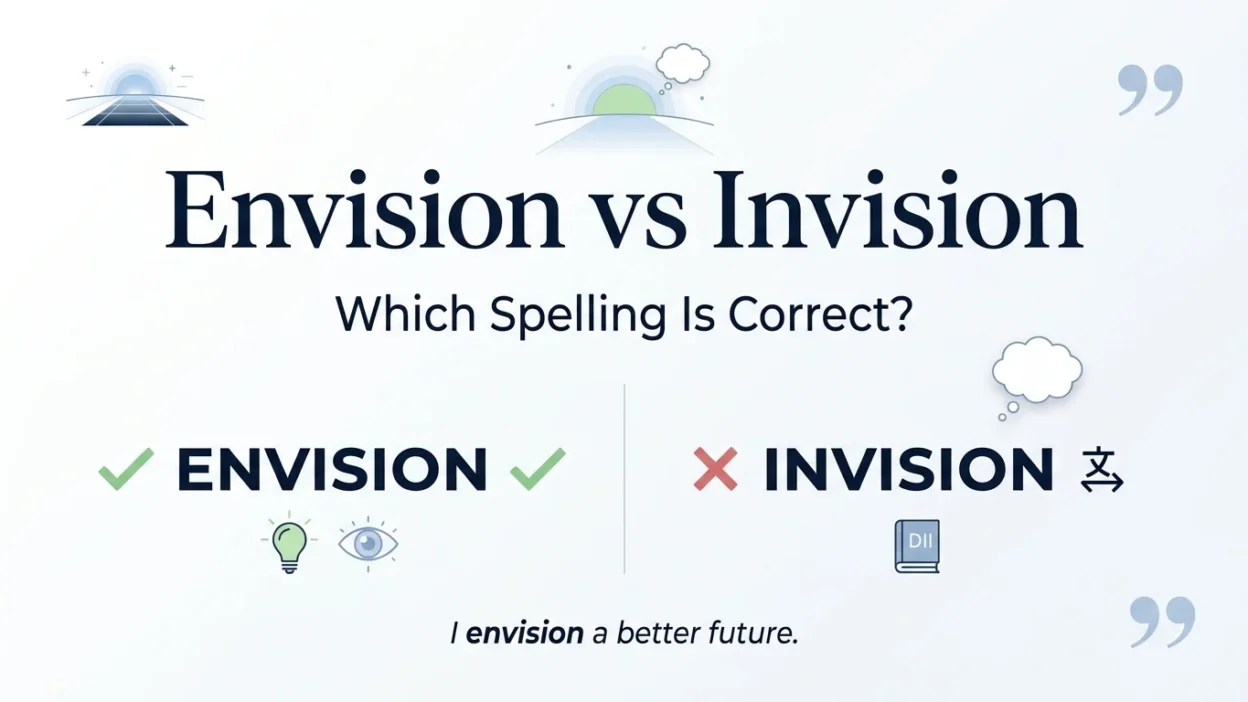
Envision is the correct standard English word when you mean to imagine, visualize, or picture something in your mind, especially something that may happen in the future. ✅
Invision is generally considered a misspelling when used with this meaning. ❌
Examples
- I envision a better future for everyone. ✅
- She envisions herself becoming a successful writer. ✅
- We envisioned a completely different outcome. ✅
Not standard:
- I invision a better future. ❌
Simple rule
What Does “Envision” Mean?
Envision is a verb that means to imagine or visualize something in your mind.
It is often used when talking about:
- Future plans
- Goals
- Dreams
- Possibilities
- Ideas
- Expected outcomes
- Long-term visions
For example:
The speaker is imagining or picturing a possible future.
Another example:
This means she imagines herself having her own business in the future.
Is “Invision” a Correct Word?
In most standard English writing, invision is not the correct spelling of the verb meaning “to imagine” or “to visualize.
The correct word is:
If you write invision when you mean “imagine,” most English dictionaries and style guides would treat it as a spelling error or nonstandard usage.
Incorrect
Correct
The mistake is understandable because the pronunciation and spelling can make invision seem like a logical alternative. However, the standard English word is envision.
Envision vs Invision: Comparison Table
| Word | Standard English? | Meaning | Example |
|---|---|---|---|
| Envision | ✅ Yes | To imagine or visualize something | I envision a better future. |
| Invision | ❌ Usually incorrect | Common misspelling of “envision” | I invision a better future. |
| Visualize | ✅ Yes | To form a mental picture | I can visualize the final design. |
| Imagine | ✅ Yes | To form an idea or picture in the mind | Imagine living by the sea. |
| Foresee | ✅ Yes | To anticipate something in the future | We foresee some challenges. |
The most important point is that envision is the correct choice when you want to express the idea of imagining a future possibility or mental picture.
How to Use “Envision” in a Sentence
The verb envision is usually followed by a noun, pronoun, or a phrase describing what someone imagines.
Examples
- I envision a world without poverty.
- She envisions a successful career.
- They envisioned a new approach to education.
- We envision a brighter future.
- He envisions himself becoming a doctor.
You can also use envision + -ing to describe an imagined activity or situation.
Examples
- I can’t envision living anywhere else.
- She envisions working from home.
- They envision building a new school.
- He envisions becoming a successful entrepreneur.
Envision in Professional and Business English
Envision is especially common in professional, business, and organizational contexts.
Companies often talk about what they envision for the future.
Examples
- The company envisions expanding into international markets.
- Our team envisions a more efficient system.
- The organization envisions creating better opportunities for students.
- We envision a workplace where everyone can contribute.
In these examples, envision communicates a future goal, plan, or desired outcome.
This is why the word is often associated with terms such as:
- vision
- strategy
- innovation
- future
- goals
- planning
- development
Envision vs Imagine
Envision and imagine are closely related, but they aren’t always interchangeable.
Imagine
Imagine is a broad and very common word.
Envision
Envision often sounds more purposeful or future-oriented.
Imagine can refer to almost anything you create in your mind, while envision often focuses on a particular possibility, plan, or future situation.
Envision vs Visualize
These words are also similar.
Visualize often emphasizes creating a mental picture.
Envision can mean imagining a future situation, possibility, or outcome.
In some contexts, the two words can be used interchangeably.
Envision vs Foresee
The word foresee is slightly different.
Envision means to imagine or picture something.
Foresee means to anticipate or expect something based on what you know.
The difference is subtle but useful:
- Envision → imagine or picture
- Foresee → anticipate or predict
Common Mistakes to Avoid
1. Writing “Invision” Instead of “Envision”
Incorrect:
Correct:
Remember that the standard spelling is envision.
2. Confusing “Envision” With “Invasion”
These words look and sound somewhat similar but have completely different meanings.
- Envision = imagine or visualize
- Invasion = an act of entering a place by force
For example:
3. Confusing “Envision” With “Vision”
The words are related, but they aren’t identical.
- Vision = an idea or picture of a future goal
- Envision = to imagine or picture something
Example:
4. Using “Envision” When You Mean “Predict”
Envision doesn’t always mean that you believe something will definitely happen.
For example:
This expresses an imagined possibility or goal, not a guaranteed prediction.
American vs British English
There is no significant spelling difference between American and British English for envision.
Both varieties use:
For example:
American English:
British English:
The meaning is also the same.
You may sometimes encounter envisage, particularly in British English. Envisage is a standard word that can mean to imagine or consider something as a possibility.
Example
In American English, envision is generally more common.
However, envision is also perfectly acceptable in British English.
Envision vs Envisage
This is a useful distinction for English learners.
| Word | Common Usage | Meaning |
|---|---|---|
| Envision | Common in American English and widely understood elsewhere | Imagine or visualize |
| Envisage | Especially common in British English | Imagine or consider a future possibility |
Examples:
Both can express a similar idea.
Why Do People Write “Invision”?
The spelling mistake invision is probably influenced by the pronunciation of envision and by other English words beginning with in-.
English spelling can be unpredictable, so it’s understandable that someone might assume invision is correct.
However, if you’re writing an article, essay, email, report, or professional document, remember:
A simple way to remember it is to connect envision with vision:
Related Words and LSI Keywords
If you’re learning the difference between envision vs invision, these related terms can help expand your English vocabulary:
- envision meaning
- envision definition
- envision examples
- envision synonym
- imagine
- visualize
- envisage
- foresee
- picture in your mind
- future vision
- future goals
- long-term planning
- mental image
- imagine the future
- common spelling mistakes
- English vocabulary
- confusing English words
Understanding these related words will help you choose the most accurate expression for different situations.
FAQs
Is “envision” or “invision” correct?
Envision is the correct standard English spelling when you mean “to imagine” or “to visualize.” Invision is generally a misspelling in this context.
What does “envision” mean?
Envision means to imagine, picture, or visualize something in your mind, especially a future possibility or desired outcome.
Is “invision” a real English word?
Invision is not generally accepted as the standard spelling of the verb meaning “to imagine.” In most everyday and professional writing, use envision instead.
What is a synonym for “envision”?
Common synonyms include imagine, visualize, picture, conceive, and, depending on context, envisage.
What is the difference between “envision” and “imagine”?
Imagine is a broader term for forming an idea or picture in your mind. Envision often suggests imagining a particular future situation, goal, or possibility.
Is “envision” used in American and British English?
Yes. Envision is standard in both American and British English. Envisage is also common, particularly in British English.
Can “envision” mean “predict”?
Not exactly. Envision means to imagine or picture something, while predict means to say what you believe will happen in the future. An envisioned outcome is not necessarily a certain prediction.
How do you use “envision” in a sentence?
You can say:
Or:
Summary
The difference between envision vs invision is straightforward: envision is the standard English word, while invision is generally a misspelling when you want to express the meaning “to imagine” or “to visualize.” You can use envision when discussing dreams, plans, future possibilities, goals, and mental images. For example, “I envision a better future” is completely correct.
The word envision is widely used in American and British English, although British speakers may also use envisage. Depending on the context, words such as imagine, visualize, and foresee may be suitable alternatives, but they don’t always carry exactly the same meaning. Choosing the right word makes your writing more precise and natural.