
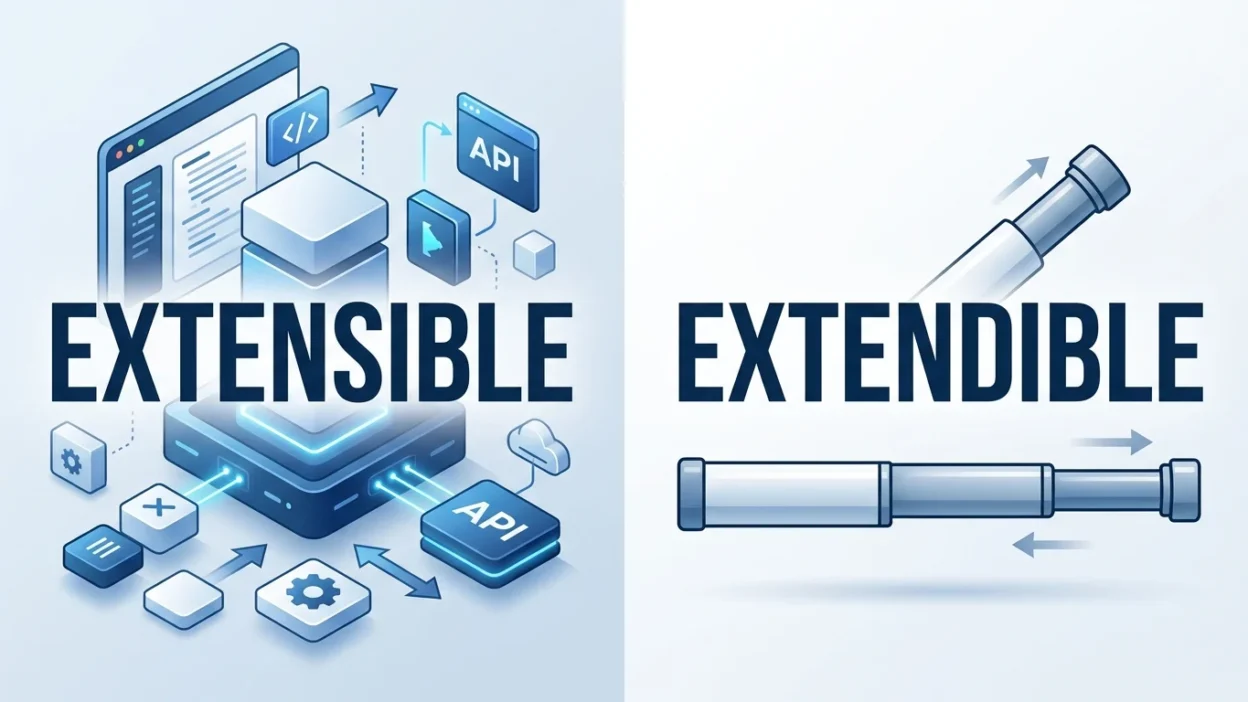
If you have ever come across the words extensible vs extendible, you may have wondered whether they mean the same thing or whether one of them is incorrect. The two words are closely related, and in many contexts, they can both describe something that can be extended or expanded. However, their usage and popularity can differ depending on the subject and context.
The good news is that choosing between extensible and extendible is usually easier than it first appears. In this guide, we will explore their meanings, differences, examples, common mistakes, and usage in American and British English. Whether you are writing about software, technology, a physical object, or general English, you will know exactly which word fits best.
Quick Answer: Extensible vs Extendible
Extensible and extendible both generally mean capable of being extended, expanded, or enlarged.
However, extensible is much more common, especially in technology, software, programming, and systems design.
- Extensible: The preferred and more widely used word, especially for software and systems that can be expanded with new features.
- Extendible: A valid but less common alternative that usually means something can be physically or conceptually extended.
Example:
As a general rule, choose extensible when talking about software, technology, systems, or designs that can grow through additions. Use extendible when the context specifically focuses on something that can be physically extended, although extensible may still work in many cases.
What Does “Extensible” Mean?
Extensible is an adjective that means capable of being extended, expanded, or developed further.
The word comes from the verb extend, which means to make something longer, larger, broader, or more extensive.
In modern English, extensible is especially common when discussing things that are designed to grow or accept additional components.
For example:
This means the framework can be expanded or modified to support additional functionality.
You might also hear the word in:
- Software development
- Programming
- Web development
- Computer systems
- APIs
- Databases
- Business models
- Product design
- Architecture
- Organizational structures
The important idea behind extensible is often future expansion.
Examples of Extensible
- The platform has an extensible architecture.
- We need an extensible software solution.
- The API is highly extensible.
- The system was designed to be extensible.
- This framework provides an extensible plugin system.
- The application has an extensible structure.
In these examples, something can be expanded by adding new features, modules, or capabilities.
What Does “Extendible” Mean?
Extendible also means capable of being extended.
It is formed from the same basic idea as extensible, but it is less frequently used in everyday modern English.
For example:
This suggests that the table can be made longer, perhaps by adding extra sections.
Other examples might include:
- An extendible ladder
- An extendible table
- An extendible contract
- An extendible deadline
- An extendible structure
That said, the exact choice often depends on the context. In some cases, extendable may sound more natural than either extensible or extendible, especially when describing something that can simply be made longer.
Extensible vs Extendible: Comparison Table
| Feature | Extensible | Extendible |
|---|---|---|
| Basic meaning | Capable of being extended or expanded | Capable of being extended |
| Standard English | Yes | Yes |
| Frequency of use | More common | Less common |
| Technology | Very common | Uncommon |
| Software | Preferred | Rare |
| Programming | Common | Rare |
| Physical objects | Possible | Often suitable |
| General English | Common | Less common |
| Meaning | Often suggests future expansion | Often focuses on the ability to be extended |
The main difference is therefore usage and context rather than a completely different definition.
Extensible vs Extendible in Software and Technology
The word extensible is especially important in the technology industry.
When developers describe software as extensible, they usually mean that the software has been designed so developers can add new functionality without completely rebuilding the original system.
For example:
This could mean that developers can add:
- Plugins
- Extensions
- Modules
- Integrations
- New features
- Custom functionality
Similarly, an extensible API is designed to allow additional capabilities or functions to be introduced as the system evolves.
Examples in Technology
In these situations, extensible is clearly the more natural choice.
You would rarely see a professional software developer describe a system as extendible when extensible is available.
Extensible vs Extendible in General English
Outside technology, the difference becomes less obvious.
Both words can describe something that is capable of being extended, but extensible remains the more widely recognized choice.
Consider these examples:
Both may be understood as saying that the agreement can be extended, but the second sentence is less common in general usage.
In many situations, extendable may also be a natural alternative:
Here, extendable clearly communicates that the contract can be extended.
This gives you three related words:
- Extensible — commonly used for systems, software, structures, and things capable of expansion.
- Extendible — valid but less common.
- Extendable — often used when something can simply be extended, such as a deadline, contract, or physical object.
Extensible vs Extendible vs Extendable
These words are closely related, so it is easy to confuse them.
Extensible
Best when something is designed to accommodate future additions or expansion.
Extendible
Means capable of being extended, but is less common.
Extendable
Often used when something can be made longer or continued for a longer period.
The differences are not always strict. In some contexts, more than one word may be grammatically possible, but one will usually sound more natural to native speakers.
Common Mistakes With Extensible vs Extendible
Mistake 1: Assuming “Extendible” Is Incorrect
Some people believe that extendible is always wrong because extensible is more common.
That is not necessarily true. Extendible is a recognized English word. It is simply much less common in many modern contexts.
Mistake 2: Using “Extendible” in Software Writing
If you are writing about software architecture, programming frameworks, APIs, or platforms, extensible is usually the better choice.
Less natural:
Better:
Mistake 3: Thinking the Two Words Have Completely Different Meanings
The meanings overlap significantly. Both words describe the possibility of extension.
The main distinction is often context, frequency, and natural usage, rather than a strict difference in dictionary meaning.
Mistake 4: Using “Extensible” Everywhere
Although extensible is the more common word, it is not automatically the best choice in every sentence.
For example, when talking about a deadline, extendable may sound more natural:
This is often clearer than:
Always consider the noun you are describing.
American English vs British English
There is no major difference between American and British English regarding the basic meanings of extensible and extendible.
Both varieties recognize extensible as a standard word, and both can use extendible to mean capable of being extended.
However, actual usage may vary depending on the industry and context. In international technology writing, extensible is particularly common because it is widely used in software engineering and technical documentation.
For example, both American and British English speakers would naturally understand:
The same is true for terms such as:
- Extensible software
- Extensible framework
- Extensible system
- Extensible API
- Extensible design
The important point is that extensible is the safer choice for modern technical and professional writing.
How to Remember the Difference
If you are unsure which word to use, remember this simple rule:
Technology and software → Extensible
Something that can be physically or generally extended → Extendible or extendable
This is not an absolute grammar rule, but it is a useful guideline.
For example:
When describing something that can grow by accepting new features or components, extensible is usually your best choice.
FAQs
1. Is “extensible” or “extendible” correct?
Both extensible and extendible are valid words. They generally mean capable of being extended. However, extensible is more common, particularly in technology and software contexts.
2. What is the difference between extensible and extendible?
The two words have very similar meanings. Extensible is more widely used and is especially common when describing software, systems, frameworks, and technology. Extendible is less common and may be used for things that can be physically or generally extended.
3. Is “extensible” better than “extendible”?
In many situations, yes. Extensible is generally the more familiar and widely accepted choice, especially in professional and technical writing. However, extendible is not necessarily incorrect.
4. Should I use “extensible” in software development?
Yes. Extensible is the standard and natural choice when describing software that can be expanded with additional features, plugins, modules, or integrations.
5. Is “extendible” a real word?
Yes. Extendible is a valid English word meaning capable of being extended. It is simply less common than extensible in many modern contexts.
6. Is “extendable” the same as “extensible”?
They are closely related but may sound more natural in different contexts. Extensible often suggests a system or design that can support future expansion, while extendable commonly describes something that can simply be extended or continued.
7. Is extensible used in American and British English?
Yes. Extensible is used in both American and British English. There is no significant regional spelling difference between the two.
8. Which word should I use in formal writing?
When discussing technology, software, systems, or architecture, extensible is usually the safest and most natural choice. For other contexts, consider whether extendible or extendable better fits the sentence.
Final Summary
The difference between extensible vs extendible is relatively small because both words describe something that can be extended. The biggest difference is how frequently they are used and the contexts in which they sound most natural. Extensible is the more common word and is especially preferred in technology, software development, programming, APIs, frameworks, and system architecture.
Extendible is also a valid word, but it is less common in modern usage. When describing a physical object or something that can be continued or made longer, extendible may work, while extendable is often an even more natural option. If you are writing technical content or discussing software that can grow through new features and extensions, extensible is almost always the best choice.