
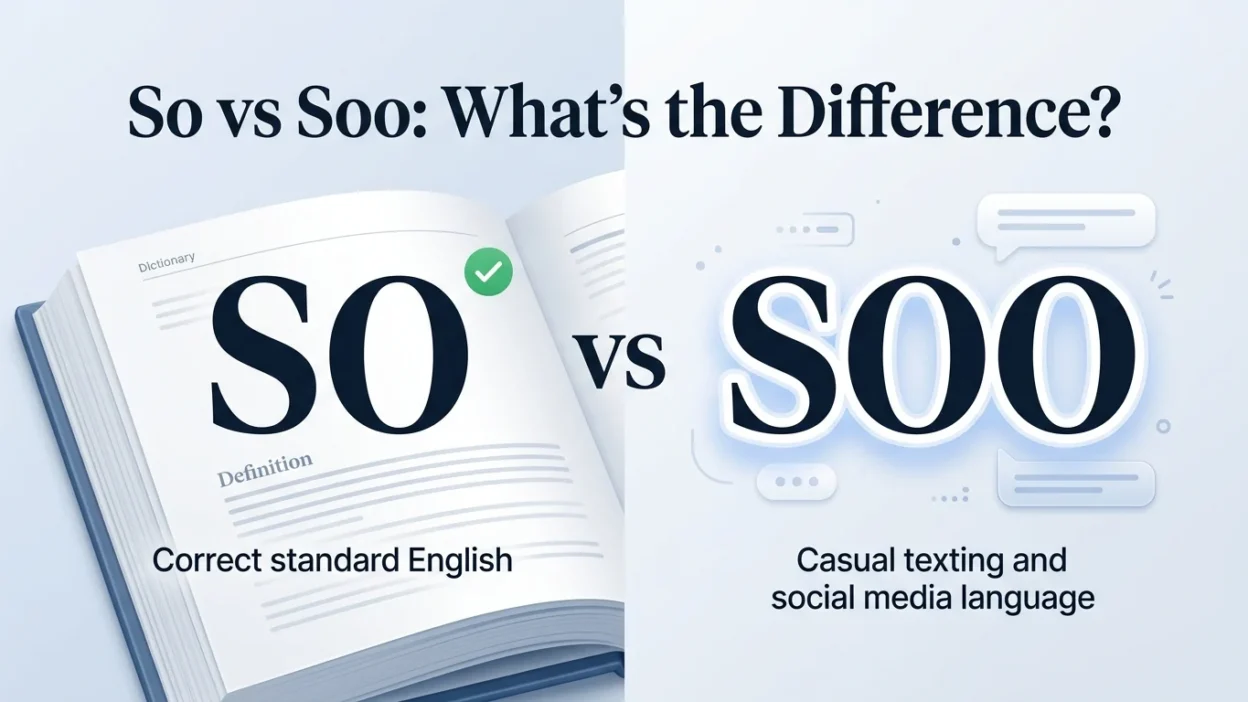
If you have ever wondered about “so vs soo,” you are not alone. These two spellings look almost identical, especially in texting and social media, but they are not used in the same way. One is a standard English word, while the other is usually an informal spelling used online.
The good news is that the difference is simple once you understand the context. In this guide, we will explain so vs soo, their meanings, correct usage, examples, common mistakes, and the difference between standard English and informal internet language.
Quick Answer: So vs Soo
So is the correct standard English spelling. It is used in formal and informal writing and can mean to such a degree, therefore, in this way, or for that reason.
Soo is generally not a standard English word. People sometimes use it informally in texting, chats, social media, or online conversations to stretch the pronunciation of “so” or add emphasis.
Example:
- Standard: I am so happy today.
- Informal texting: I am soo happy today!
For school, work, professional communication, essays, and formal writing, always use so.
What Does “So” Mean?
The word so has several meanings in English, depending on how it is used in a sentence. It is one of the most common words in both American and British English.
Here are some of its main uses.
1. “So” to Show a High Degree
We often use so before an adjective or adverb to emphasize how much or how strongly something happens.
Examples:
- She is so kind.
- The movie was so interesting.
- He runs so quickly.
- This food is so delicious.
- I am so tired today.
In these examples, so adds emphasis to the words that follow it.
2. “So” to Mean “Therefore”
So can also introduce a result or consequence.
Examples:
- It was raining, so we stayed home.
- I was tired, so I went to bed early.
- She studied hard, so she passed the exam.
- The shop was closed, so we came back later.
Here, so connects a reason with its result.
3. “So” to Mean “In This Way”
Sometimes so means in this way or like that.
Examples:
- Don’t do it so.
- I think so.
- If you feel so, you should tell him.
- Why are you so upset?
The exact meaning depends on the sentence and surrounding context.
4. “So” in Questions and Expressions
The word so is also common in everyday expressions.
Examples:
- So, what are you doing?
- So, how was your day?
- I think so.
- I hope so.
- Is that so?
These uses are perfectly normal in both spoken and written English.
What Does “Soo” Mean?
Unlike so, soo is generally not considered a standard English spelling. You will often see it in text messages, social media posts, comments, memes, and casual online conversations.
People use soo mainly to express extra emphasis or to imitate the way someone might stretch the pronunciation of so.
For example:
- That was soo funny!
- I am soo excited!
- You are soo cute!
- This is soo good!
In each case, soo is being used informally instead of so.
The extra o does not create a new standard English word. It simply changes the visual style of the message.
So vs Soo: Comparison Table
| Feature | So | Soo |
|---|---|---|
| Standard English word | Yes | No, generally |
| Correct in formal writing | Yes | No |
| Used in school assignments | Yes | No |
| Used in professional emails | Yes | No |
| Common in texting | Yes | Yes |
| Used for emphasis | Yes | Often used informally |
| Used in social media | Yes | Yes |
| Standard dictionary usage | Yes | Generally no |
| Example | I am so happy. | I am soo happy! |
The key point is that so is the standard spelling, while soo is usually an informal, playful, or exaggerated spelling.
So vs Soo: Examples in Sentences
Let’s look at some examples to make the difference clearer.
Correct Standard English: “So”
- The weather is so beautiful today.
- I am so happy to see you.
- She was so tired after work.
- He was late, so he missed the bus.
- I so agree with you. (Less common in everyday speech but grammatically possible in certain contexts.)
Informal Texting: “Soo”
- I am soo excited for tomorrow!
- That dress is soo pretty!
- This cake is soo delicious!
- You are soo funny!
- I am soo sorry!
In casual online communication, people usually understand soo immediately. However, it should not replace so in standard English writing.
When Should You Use “So”?
Use so whenever you are writing standard English.
You should choose so in:
- School assignments
- Essays
- Exams
- Business emails
- Job applications
- Reports
- Articles
- Academic writing
- Professional messages
- Formal letters
Example:
This sentence is correct and appropriate in both casual and formal situations.
When Is “Soo” Acceptable?
Soo can be acceptable when you are intentionally writing in a casual, expressive, or playful style.
For example, you might see it in:
- Text messages
- Instagram captions
- Social media comments
- Online chats
- Friendly conversations
- Memes
- Informal posts
However, even in casual communication, so is always the safer and more standard choice.
If you are unsure, use so.
Common Mistakes With So vs Soo
Mistake 1: Using “Soo” in Formal Writing
Incorrect:
Better:
The second version is the correct standard English form.
Mistake 2: Thinking “Soo” Is a Different English Word
Some learners believe that soo has a completely different meaning from so. In most online contexts, this is not true.
Usually, soo is simply an informal spelling of so used to add emphasis.
Mistake 3: Using “Soo” in Schoolwork
Even though your friends may use soo in messages, it is best to avoid it in assignments and exams.
Use:
Avoid:
Mistake 4: Adding Too Many “O”s
Online, you may also see spellings such as sooo, soooo, or even sooooo.
For example:
This is an expressive texting style, not standard English spelling. It can be fun in casual messages, but it should not be used in formal writing.
Is “Soo” a Real Word?
The answer depends on what you mean by “real word.”
In standard modern English, so is the correct and established word. Soo is generally an informal spelling rather than a standard alternative.
However, Soo can appear as a proper name, surname, place name, or part of a name in some contexts. That is different from using soo as an informal version of so.
Therefore, if your question is about everyday English grammar and spelling, remember:
So = standard English
Soo = informal internet/texting spelling
American English vs British English: So vs Soo
There is no major American vs British English difference between so and soo.
Both American English and British English use so as the standard spelling.
For example:
- American English: I am so tired.
- British English: I am so tired.
The spelling remains the same.
Soo is not a standard spelling in either variety. If you see it in American or British social media, it is generally being used as an informal texting style rather than a regional English difference.
So vs Soo in Texting and Social Media
Internet language often changes the way words are written. People may add extra letters to show emotion, excitement, surprise, or exaggeration.
For example:
- so → neutral
- soo → more emphasis
- sooo → even more emphasis
- sooooo → strong emotional emphasis
This is similar to writing:
instead of:
The extra letters communicate emotion, but they do not necessarily change the basic meaning of the word.
This style is common in digital communication, but it is best to keep it separate from formal English.
FAQS
1. Is “so” or “soo” correct?
So is the correct standard English spelling. Soo is generally an informal spelling used in texting and online communication.
2. Can I use “soo” in an essay?
It is best not to use soo in an essay. Use so instead because it is the standard English spelling.
3. Why do people write “soo” instead of “so”?
People often write soo to add emphasis or make their message sound more emotional, excited, cute, or playful.
4. Is “soo” grammatically correct?
As an informal internet spelling, people understand soo, but it is not normally considered standard English grammar or spelling.
5. Is “soo” used in American English?
You may see soo in casual American texting and social media, but it is not a standard American English spelling of so.
6. Is “soo” used in British English?
The same rule applies to British English. So is the standard spelling, while soo may appear informally online.
7. Can I write “sooo” in a text message?
Yes. In casual texting, people often write sooo to express stronger emotion or emphasis. However, it should generally be avoided in formal writing.
8. What is the easiest way to remember so vs soo?
Remember this simple rule:
If you are writing standard English, use “so.”
If you see “soo” online, it is usually an informal way of emphasizing “so.”
Summary
The difference between so vs soo is mainly about standard English versus informal internet language. So is the correct standard English word and can be used to express degree, show a result, or introduce ideas in different sentence structures. It is appropriate for everything from everyday conversations to formal writing.
Soo, on the other hand, is generally an informal spelling used to stretch the sound of so and add extra emotion or emphasis. You may see it in texts, social media, and online chats, but it is not the best choice for schoolwork, professional writing, or formal communication. When in doubt, choose so—it is always the safe and standard option.