
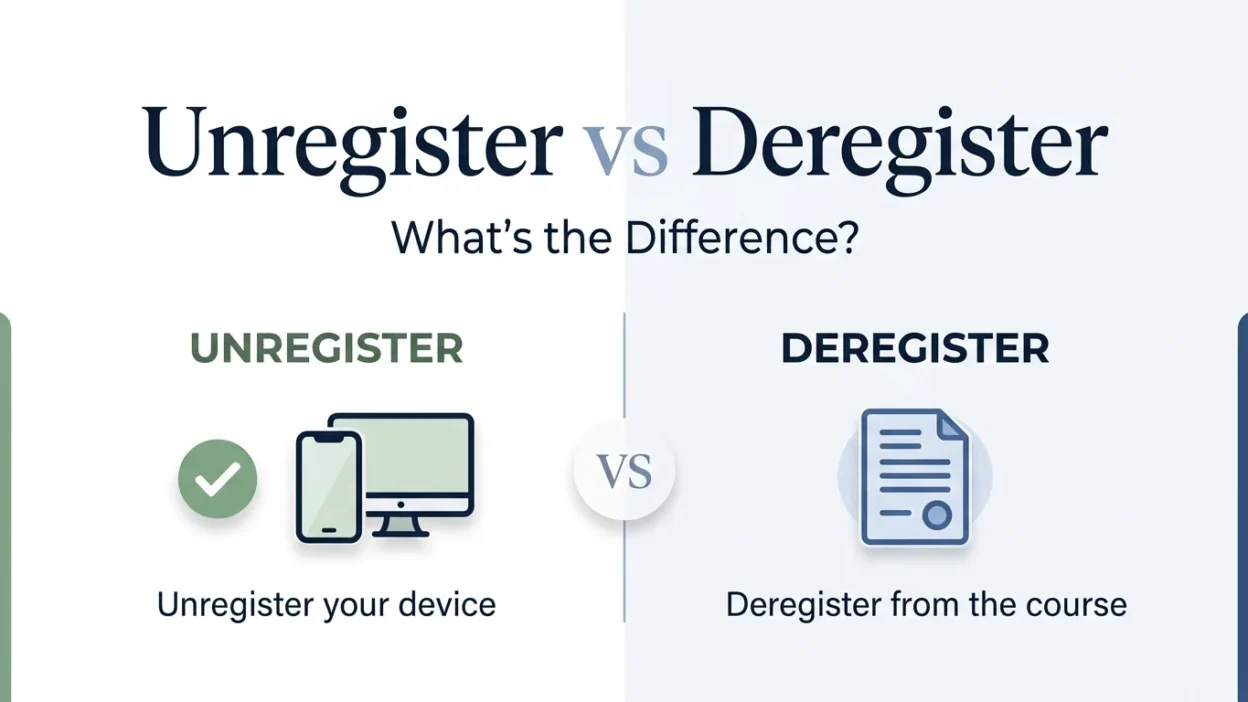
Have you ever wondered whether you should say “unregister“ or “deregister“ when someone wants to remove a name, account, device, or service from an official list? These two words are very similar, and in many situations, they can describe the same basic action. However, their usage and regional preferences can differ depending on the context.
Understanding unregister vs deregister can help you choose the right word for emails, forms, websites, software instructions, academic records, and official communication. In this guide, we’ll explain the meaning of both terms, compare their usage, provide clear examples, discuss American vs British English differences, and highlight common mistakes so you can use each word naturally and accurately.
Quick Answer
Both unregister and deregister mean to remove someone or something from a register, list, database, system, or official record.
However, there is a general difference in usage:
- Unregister → Common in technology, software, websites, devices, subscriptions, and everyday contexts.
- Deregister → More common in formal, official, administrative, legal, educational, and regulatory contexts.
Examples
The exact choice often depends on the situation and the variety of English being used.
What Does “Unregister” Mean?
Unregister is a verb that means to remove a person, device, account, service, or other item from a registration system or list.
It is particularly common in technology and digital contexts.
For example:
This means you should remove the old device from the system’s list of registered devices.
You might also see unregister in:
- Mobile apps
- Websites
- Software
- Online accounts
- Email subscriptions
- Devices
- Computer systems
- Membership platforms
Examples
- I need to unregister my phone from this account.
- How do I unregister from the newsletter?
- The software allows users to unregister a device.
- You can unregister your account at any time.
- I accidentally registered twice, so I need to unregister one account.
What Does “Deregister” Mean?
Deregister also means to remove something or someone from an official register or list.
The word often sounds more formal than unregister.
It is frequently used in contexts involving:
- Schools and universities
- Government records
- Professional organizations
- Companies
- Vehicles
- Official registrations
- Regulatory systems
- Formal memberships
Examples
- The student decided to deregister from the university.
- The company was deregistered from the official business register.
- You must deregister the vehicle before transferring ownership.
- The organization may deregister members who no longer meet the requirements.
The word deregister is especially common in British English and other varieties influenced by British usage.
Unregister vs Deregister: Comparison Table
| Feature | Unregister | Deregister |
|---|---|---|
| Basic meaning | Remove from a registration or system | Remove from a register or official record |
| Common contexts | Technology, apps, websites, devices | Official, administrative, academic, regulatory |
| Tone | General and often informal | More formal |
| American English | Common | Less common in everyday usage |
| British English | Common | Very common in formal contexts |
| Example | Unregister your device | Deregister from the course |
The two words overlap considerably, but the context usually determines which sounds more natural.
When Should You Use “Unregister”?
Use unregister when you’re talking about removing something from a digital or technical registration system.
Example 1: Technology
This sounds natural when a service has a list of registered devices.
Example 2: Email
This can be understood, although unsubscribe is often more natural for email.
Example 3: Software
Here, unregister refers to removing software from a registration or activation system.
Example 4: Online Accounts
This means removing the account’s registration, although delete your account or deactivate your account may be more appropriate depending on what actually happens.
When Should You Use “Deregister”?
Use deregister when referring to an official or formal registration.
Education
This means the student officially removed themselves from the course.
Business
Here, the company was removed from an official business register.
Government Records
This sounds formal and administrative.
Professional Registration
This suggests the person officially ended their registration.
Unregister vs Deregister in American English
In American English, unregister is generally more familiar in everyday and technology-related contexts.
For example:
However, American English also uses deregister, particularly in formal or specialized contexts.
For example:
Still, Americans may prefer other expressions depending on the situation, such as:
- Cancel your registration
- Withdraw from the course
- Remove your account
- Deactivate your account
- Cancel your membership
- Remove your name from the list
The most natural choice depends heavily on what is being removed.
Unregister vs Deregister in British English
Both words are used in British English.
Deregister is often more common when discussing official or formal registration.
For example:
Unregister is also widely understood and commonly used in technology and online contexts.
For example:
Therefore, the distinction is not absolute. British English speakers may use either word depending on the context.
Is “Unregister” the Opposite of “Register”?
Yes, in many situations.
The basic relationship is
For example:
However, deregister can also function as the opposite of register, particularly in formal contexts.
Unregister vs Deregister vs Unsubscribe
These three words are sometimes confused.
Unregister
Usually means removing something from a registration system.
Deregister
Usually means officially removing someone or something from a register.
Unsubscribe
Usually means stopping a subscription or email service.
These words may overlap in some situations, but they are not always interchangeable.
Unregister vs Deregister vs Cancel
Cancel is a much broader word.
You can cancel:
- A subscription
- An appointment
- A reservation
- A membership
- A service
For example:
You might not say:
The correct verb depends on the exact action you’re taking.
Common Mistakes to Avoid
1. Assuming the Words Are Always Interchangeable
Although unregister and deregister have similar meanings, they don’t always sound equally natural.
For example:
sounds natural in a technology context.
But:
may sound overly formal unless the system specifically uses that terminology.
2. Using “Unregister” Instead of “Unsubscribe”
If you’re talking about email, unsubscribe is usually the most natural word.
This is more idiomatic than:
3. Confusing Deregister With Delete
Deregistering something doesn’t necessarily mean deleting it permanently.
For example:
This may mean the device was removed from a registration list but still exists.
By contrast:
usually suggests that the account itself was removed or permanently erased.
4. Using “Deregister” in Casual Situations
In everyday American English, deregister can sound formal.
Instead of:
You might naturally say:
However, if the organization officially uses deregister, following its terminology is usually best.
How to Choose the Right Word
Ask yourself what you’re removing.
Removing a device from software?
Use unregister.
Leaving a formal course?
Use deregister or withdraw, depending on the institution.
Stopping email messages?
Use unsubscribe.
Ending a membership?
Use cancel or end my membership.
Removing an official registration?
Use deregister.
Related Words and LSI Keywords
If you’re researching unregister vs deregister, these related terms can help you understand the broader vocabulary:
- register
- registration
- unregister
- deregister
- deregistration
- cancel registration
- remove from a register
- withdraw
- unsubscribe
- deactivate
- delete account
- cancel membership
- official register
- registered device
- registration status
- remove registration
These words are useful when discussing accounts, memberships, education, technology, and official records.
FAQs
What is the difference between unregister and deregister?
Both mean removing someone or something from a registration or register. Unregister is common in technology and everyday contexts, while deregister often sounds more formal and official.
Is “unregister” a real English word?
Yes. Unregister is a standard English verb meaning to remove something or someone from a registration or registered system.
Is “deregister” grammatically correct?
Yes. Deregister is a standard English word, particularly common in formal, administrative, academic, and regulatory contexts.
Is unregister more common in American English?
Generally, unregister is more familiar to American English speakers, especially in technology and online contexts. Deregister is also used in formal or specialized situations.
Is deregister more common in British English?
Deregister is widely used in British English, particularly for official and administrative situations. However, unregister is also commonly understood and used in technology-related contexts.
Is “unregister” the same as “unsubscribe”?
No. Unregister means removing something from a registration system, while unsubscribe usually means stopping a subscription, such as an email newsletter.
Does deregister mean delete?
Not necessarily. Deregister usually means removing something from an official register or registration system. It does not automatically mean permanently deleting the underlying record or object.
Which is better: “unregister” or “deregister”?
Neither is universally better. Use unregister for many digital and technical contexts and deregister for formal or official registration contexts. Always consider the terminology used by the specific organization or system.
Summary
The difference between unregister vs deregister is often a matter of context, tone, and regional preference rather than a completely different meaning. Both words can describe the act of removing a person, device, account, or organization from a registration system. Unregister is particularly common in technology, apps, software, websites, and digital services, while deregister often appears in formal, administrative, academic, and regulatory situations.
American and British English both recognize these words, although their frequency can vary. In American English, unregister may sound more natural in everyday technology-related situations, while deregister can feel more formal. In British English, deregister is especially familiar in official contexts. Still, the terminology used by a particular organization or system should always be your first guide.