Have you ever typed “how are you fairing?” in a message and wondered if it was correct? You’re not alone.
The phrases how are you faring and how are you fairing are commonly confused because they sound identical when spoken. However, only one is correct in most everyday conversations.
Understanding the difference between faring and fairing can help you avoid embarrassing grammar mistakes and communicate more clearly in emails, social media posts, professional writing, and casual conversations.
In this guide, we’ll break down the meanings, provide examples, highlight common errors, and explain exactly when to use each word.
Quick Answer
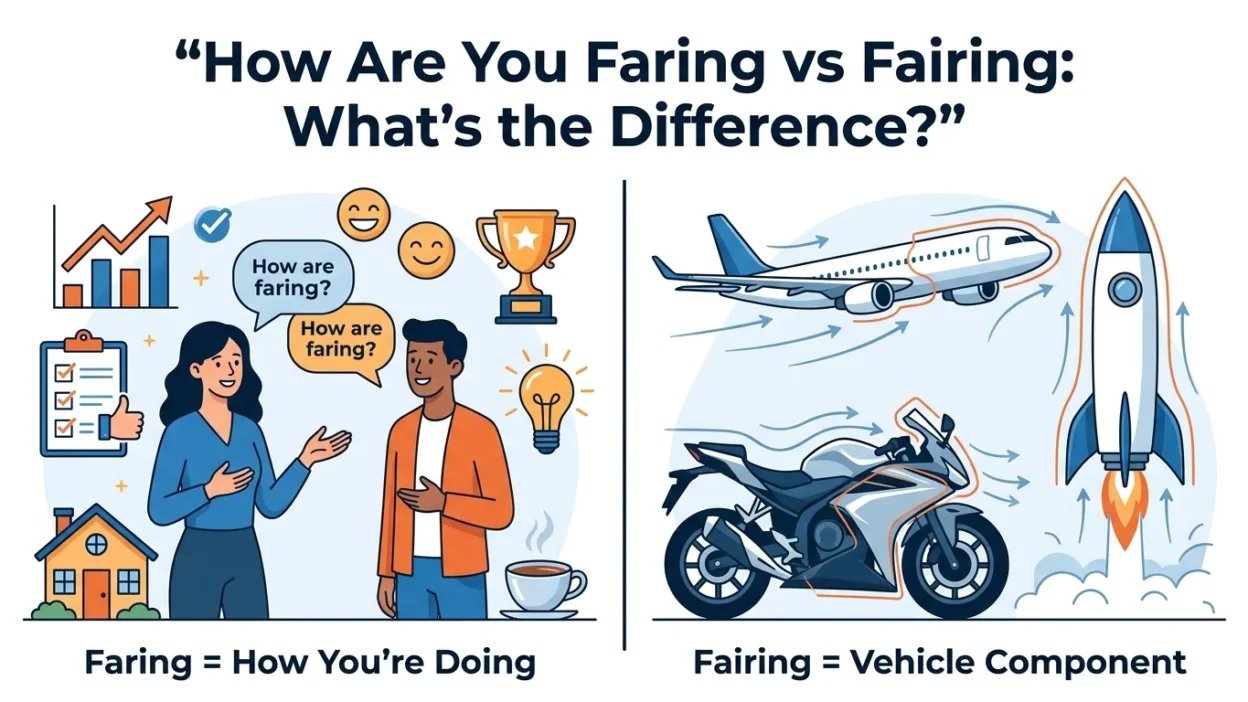
“How are you faring?” is the correct phrase when asking someone how they are doing, coping, or progressing.
“How are you fairing?” is usually incorrect in this context because fairing refers to a structure or device used in engineering, aviation, cycling, and other technical fields.
Correct Example
- How are you faring after your surgery?
Incorrect Example
- How are you fairing after your surgery?
In everyday English, when asking about someone’s well-being or progress, always use faring.
What Does “Faring” Mean?
The word faring comes from the verb fare, which means:
- To get along
- To progress
- To perform
- To manage under certain circumstances
- To experience a situation
When you ask someone, “How are you faring?”, you’re essentially asking:
- How are you doing?
- How are things going?
- How are you managing?
- How are you coping?
Examples of Faring
- How are you faring in your new job?
- The company is faring well despite economic challenges.
- Students are faring better this semester.
- How is your family faring after the move?
- The team is faring remarkably well this season.
Synonyms for Faring
- Doing
- Managing
- Coping
- Progressing
- Performing
- Getting along
- Succeeding
These related terms can help you understand the intended meaning more clearly.
What Does “Fairing” Mean?
Unlike faring, the word fairing has a specialized technical meaning.
A fairing is a structure added to improve aerodynamics, reduce drag, or create a smoother shape.
It is commonly used in:
- Aircraft
- Motorcycles
- Bicycles
- Boats
- Rockets
- Vehicles
Examples of Fairing
- The motorcycle’s front fairing reduced wind resistance.
- Engineers designed a new rocket fairing.
- The bicycle featured an aerodynamic fairing.
- The aircraft’s nose fairing improved performance.
- The damaged fairing required replacement.
As you can see, fairing has nothing to do with asking someone how they’re doing.
How Are You Faring vs Fairing: Side-by-Side Comparison
| Feature | Faring | Fairing |
|---|---|---|
| Meaning | Managing, doing, progressing | Aerodynamic covering or structure |
| Part of Speech | Verb form | Noun |
| Common Context | Daily conversation | Engineering and transportation |
| Example | How are you faring today? | The rocket fairing separated successfully. |
| Related To | Personal progress and well-being | Mechanical design and aerodynamics |
Why People Confuse Faring and Fairing
The confusion occurs because the two words are homophones.
Homophones are words that:
- Sound the same
- Have different spellings
- Have different meanings
Examples include:
- Their vs There
- Your vs You’re
- Principal vs Principle
- Faring vs Fairing
Since both words are pronounced similarly, many people accidentally choose the wrong spelling when writing.
When Should You Use “How Are You Faring?”
Use faring whenever you’re asking about someone’s condition, progress, or situation.
Common Situations
- After an illness
- During a difficult time
- In a new job
- During studies
- After a major life event
- In professional correspondence
Examples
- How are you faring after your recovery?
- How are you faring in college?
- How are your investments faring this year?
- How is the project faring?
- How are employees faring under the new policy?
Common Mistakes to Avoid
Mistake #1: Using Fairing Instead of Faring
Incorrect:
- How are you fairing these days?
Correct:
- How are you faring these days?
Mistake #2: Assuming Fairing Means Fair Treatment
Some people think fairing is related to the adjective fair.
It isn’t.
The word fairing has a separate technical origin and meaning.
Mistake #3: Spellcheck Dependence
Many spelling tools accept both words because both are legitimate English words.
That means grammar checkers may not automatically catch the mistake.
Always consider the meaning and context.
Easy Trick to Remember the Difference
A simple memory trick can save you from confusion.
Faring = Fare = Getting Along
Think:
- Fare well
- Fare badly
- Fare better
These expressions relate to progress and performance.
Therefore:
- How are you faring? = How are you doing?
Fairing = Vehicle Part
Think of:
- Motorcycle fairing
- Rocket fairing
- Aircraft fairing
If you’re not discussing transportation or engineering, you probably mean faring.
Real-Life Examples
In Personal Conversations
Correct:
- How are you faring after the exam?
- My brother is faring much better now.
Incorrect:
- How are you fairing after the exam?
In Business Communication
- Our department is faring well this quarter.
- How is the project faring against deadlines?
In Engineering
- The rocket’s protective fairing detached successfully.
- Engineers redesigned the nose fairing.
American vs British English
Good news: there is virtually no difference between American English and British English when it comes to faring and fairing.
Both varieties of English use:
- Faring to describe how someone is doing or progressing.
- Fairing to describe aerodynamic structures and coverings.
The spelling and meaning remain consistent across both regions.
Why Using the Correct Word Matters
Choosing the correct word improves:
- Professional writing
- Academic writing
- Email communication
- Social media credibility
- Search engine content quality
For example:
“How are you faring?” immediately sounds natural and grammatically correct.
Using “How are you fairing?” may distract readers and reduce confidence in your writing.
Small language details often create a stronger impression than people realize.
Frequently Asked Questions
1. Is “How are you fairing?” grammatically correct?
No. In normal conversation, the correct phrase is “How are you faring?”
2. What does “faring” mean?
It means managing, coping, progressing, or doing under certain circumstances.
3. Is fairing a real word?
Yes. A fairing is a structure used to improve aerodynamics in vehicles, aircraft, boats, and rockets.
4. Why do people confuse faring and fairing?
Because they sound almost identical when spoken but have completely different meanings.
5. How do you spell “How are you doing?”
The more formal equivalent is:
“How are you faring?”
6. Can fairing be used outside engineering?
Rarely. It is primarily a technical term associated with transportation and mechanical design.
7. Which word should I use in an email?
Use faring when asking about someone’s progress, health, work, or well-being.
8. What is a synonym for faring?
Common synonyms include:
- Doing
- Managing
- Coping
- Progressing
- Performing
- Getting along
Summary
The difference between how are you faring vs fairing is straightforward once you understand the meanings. Faring refers to how someone is doing, coping, progressing, or managing in a situation.
It is the correct word to use when asking about a person’s well-being, success, or current circumstances. In contrast, fairing is a technical noun used in engineering and transportation to describe a structure that improves aerodynamics.
Because the two words sound alike, writers frequently confuse them. However, remembering that faring relates to people and progress, while fairing relates to vehicles and engineering, can help you choose the correct spelling every time.
If you’re writing an email, a blog post, or a social media update, using the right word enhances clarity and professionalism.
Actionable Takeaway
Whenever you want to ask someone how they’re doing, remember this simple rule:
- How are you faring? ✅ Correct
- How are you fairing? ❌ Usually incorrect
If you’re talking about a motorcycle, aircraft, bicycle, boat, or rocket component, then fairing is the right word. Otherwise, choose faring with confidence.

Liam James is a language enthusiast and content writer at Verseslay, specializing in word comparisons, grammar debates, and vocabulary insights. He helps readers understand language nuances through clear, engaging, and practical explanations.