Have you ever paused while writing or speaking and wondered whether you should say “what kind of” or “what kinds of”?
You’re not alone. This is a common grammar question that confuses English learners and native speakers alike because both phrases seem very similar.
The good news is that the difference is actually quite simple once you understand the role of singular and plural nouns.
In this guide, you’ll learn the meaning of what kind of vs what kinds of, when to use each phrase, common mistakes to avoid, practical examples, and easy memory tricks to help you use them confidently in everyday English.
Quick Answer
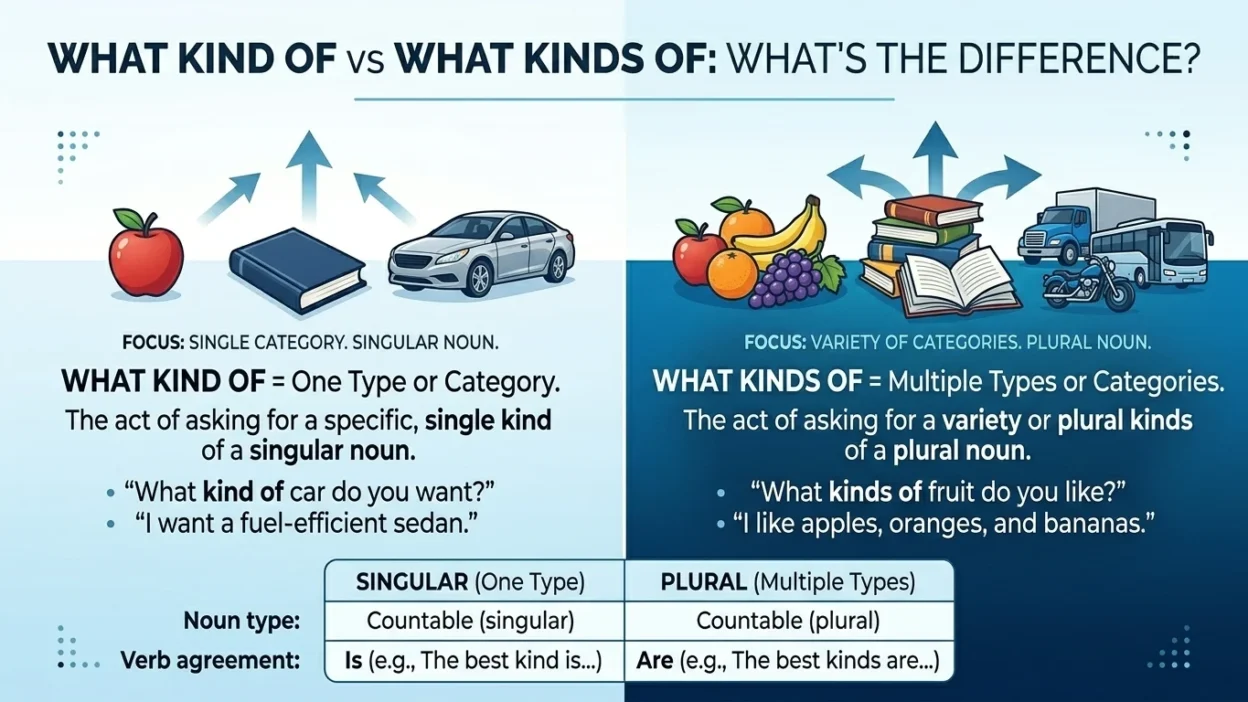
The difference between what kind of and what kinds of depends on whether you are asking about one type or multiple types.
- What kind of = asks about one type, category, or class.
- What kinds of = asks about multiple types, categories, or classes.
Examples:
- What kind of music do you like?
- What kinds of books do you read?
If you’re asking about a single category, use what kind of. If you’re asking about several categories, use what kinds of.
What Does “What Kind of” Mean?
The phrase what kind of is used when asking about a single type, category, or variety of something.
Even if the noun following it is plural, the focus remains on identifying one general category.
Examples of What Kind of
- What kind of car do you drive?
- What kind of food do you enjoy?
- What kind of movies are popular today?
- What kind of job are you looking for?
In each sentence, the speaker is asking about one broad category rather than several different categories.
Why We Use It
The word kind is singular. Therefore, what kind of refers to a single class or type.
For example:
- What kind of pet do you want?
The question seeks one category of pet, such as a dog, cat, or bird.
What Does “What Kinds of” Mean?
The phrase what kinds of is used when asking about multiple categories, varieties, or types.
The plural word kinds indicates that more than one type is being discussed.
Examples of What Kinds of
- What kinds of books do you read?
- What kinds of sports do you enjoy?
- What kinds of languages would you like to learn?
- What kinds of restaurants are available nearby?
These questions invite answers involving several categories rather than a single one.
Why We Use It
The word kinds is plural, meaning the speaker expects multiple possibilities.
For example:
- What kinds of music do you listen to?
Possible answer:
- I listen to rock, jazz, classical, and pop music.
Multiple categories are being mentioned, which makes what kinds of the correct choice.
What Kind of vs What Kinds of: Key Differences
| Feature | What Kind of | What Kinds of |
|---|---|---|
| Number | Singular | Plural |
| Focus | One category | Multiple categories |
| Word Used | Kind | Kinds |
| Expected Answer | One type | Several types |
| Example | What kind of car? | What kinds of cars? |
The main distinction is whether you’re discussing one category or several.
When to Use “What Kind of”
Use what kind of when:
- Asking about one category
- Referring to a general type
- Seeking a broad classification
- Discussing a singular concept
Examples
- What kind of weather do you prefer?
- What kind of computer do you use?
- What kind of teacher inspires students?
- What kind of exercise helps reduce stress?
Notice that each question focuses on identifying one general category.
When to Use “What Kinds of”
Use what kinds of when:
- Asking about several categories
- Exploring different varieties
- Expecting multiple answers
- Comparing different groups
Examples
- What kinds of fruits are rich in vitamin C?
- What kinds of technology do businesses use?
- What kinds of hobbies help people relax?
- What kinds of animals live in the rainforest?
These questions naturally invite multiple examples.
Can “What Kind of” Be Used with Plural Nouns?
Yes. This is where many learners become confused.
Even though kind is singular, it can be followed by a plural noun when referring to a single category.
Examples
- What kind of books do you enjoy?
- What kind of movies do teenagers watch?
- What kind of clothes are fashionable this year?
Here, the speaker is asking about one overall category rather than multiple distinct categories.
Compare
- What kind of books do you enjoy?
- Focuses on one general category.
- What kinds of books do you enjoy?
- Invites discussion of several categories.
Both can be grammatically correct depending on the intended meaning.
Everyday Examples
Let’s compare the phrases side by side.
Asking About One Type
- What kind of phone do you have?
- What kind of music do you prefer?
- What kind of coffee do you drink?
- What kind of vehicle is best for families?
Asking About Multiple Types
- What kinds of phones are popular today?
- What kinds of music do you enjoy?
- What kinds of coffee do cafés sell?
- What kinds of vehicles are available?
The difference becomes much clearer when viewed in context.
Common Mistakes to Avoid
Many English learners make predictable mistakes with these phrases.
Mistake 1: Using “Kinds” for a Single Category
Incorrect:
- What kinds of car do you drive?
Correct:
- What kind of car do you drive?
Only one category is being discussed.
Mistake 2: Using “Kind” for Multiple Categories
Incorrect:
- What kind of sports do you enjoy? (when expecting several categories)
Better:
- What kinds of sports do you enjoy?
The speaker expects multiple answers.
Mistake 3: Matching Only the Noun Number
Many people assume singular nouns require kind and plural nouns require kinds.
That’s not always true.
Consider:
- What kind of books do you read?
This is perfectly correct because the focus is on one general category.
Easy Memory Trick
A simple memory trick can help you remember the difference.
Kind = One
Think:
- One kind
- One category
- One type
Example:
- What kind of dessert would you like?
Kinds = Many
Think:
- Several kinds
- Multiple categories
- Many varieties
Example:
- What kinds of desserts do you like?
Whenever you’re unsure, ask yourself:
Am I asking about one category or several?
The answer will tell you which phrase to use.
What About Formal and Informal English?
Both expressions are acceptable in:
- Formal writing
- Academic writing
- Business communication
- Casual conversation
- Everyday speech
Neither phrase is more formal than the other.
The choice depends entirely on meaning rather than formality.
American vs British English
There is virtually no difference between American English and British English regarding what kind of and what kinds of.
Both varieties follow the same grammatical rules.
For example:
American English:
- What kind of car do you drive?
- What kinds of music do you enjoy?
British English:
- What kind of car do you drive?
- What kinds of music do you enjoy?
The usage remains consistent across both dialects.
Related Grammar Phrases
You may also encounter similar expressions such as:
- Which type of
- Which types of
- What sort of
- What sorts of
- What category of
- What categories of
These phrases follow similar singular and plural rules.
Examples:
- What sort of movie do you like?
- What sorts of movies do you watch?
The same logic applies.
Frequently Asked Questions
Is “what kind of” grammatically correct?
Yes. It is completely correct when referring to one category or type.
Is “what kinds of” grammatically correct?
Yes. It is correct when asking about multiple categories or varieties.
Can “what kind of” be followed by a plural noun?
Yes. The phrase can be followed by a plural noun if the focus remains on one general category.
Which is more common: “what kind of” or “what kinds of”?
“What kind of” is generally more common because people often ask about broad categories rather than multiple classifications.
Can I use them interchangeably?
Not always. The intended meaning may change depending on whether you’re asking about one category or several.
What is the difference between “kind” and “type”?
In most situations, they are synonyms and can often be used interchangeably.
Is “what sort of” the same as “what kind of”?
Yes. In many contexts, “sort” and “kind” have similar meanings.
Do native speakers make mistakes with these phrases?
Yes. Because the distinction can be subtle, even native speakers occasionally choose the wrong form.
Summary
Understanding what kind of vs what kinds of is easier than it first appears. The key difference lies in whether you’re asking about a single category or multiple categories.
What kind of focuses on one type, while what kinds of refers to several types or varieties. Once you understand this distinction, choosing the correct phrase becomes much more natural.
Although both expressions are common in spoken and written English, they serve different purposes. Paying attention to the number of categories being discussed—not just the noun that follows—will help you avoid mistakes and communicate more clearly.
Actionable Takeaway
Whenever you use these phrases, ask yourself one simple question:
Am I asking about one category or several categories?
- One category → What kind of
- Multiple categories → What kinds of
Using this quick rule will help you choose the correct expression confidently in conversations, writing, exams, and professional communication.