Have you ever typed reinforce and wondered whether reenforce might also be correct? You’re not alone.
These two spellings look remarkably similar, and many writers pause to double-check which version belongs in professional, academic, or everyday writing.
The confusion often comes from the word’s pronunciation and historical usage.
While both forms have appeared in English over time, modern dictionaries and style guides overwhelmingly favor one spelling.
In this guide, we’ll explore reinforce vs reenforce, explain their meanings, compare their usage, provide examples, highlight common mistakes, and help you confidently choose the correct spelling every time.
Quick Answer
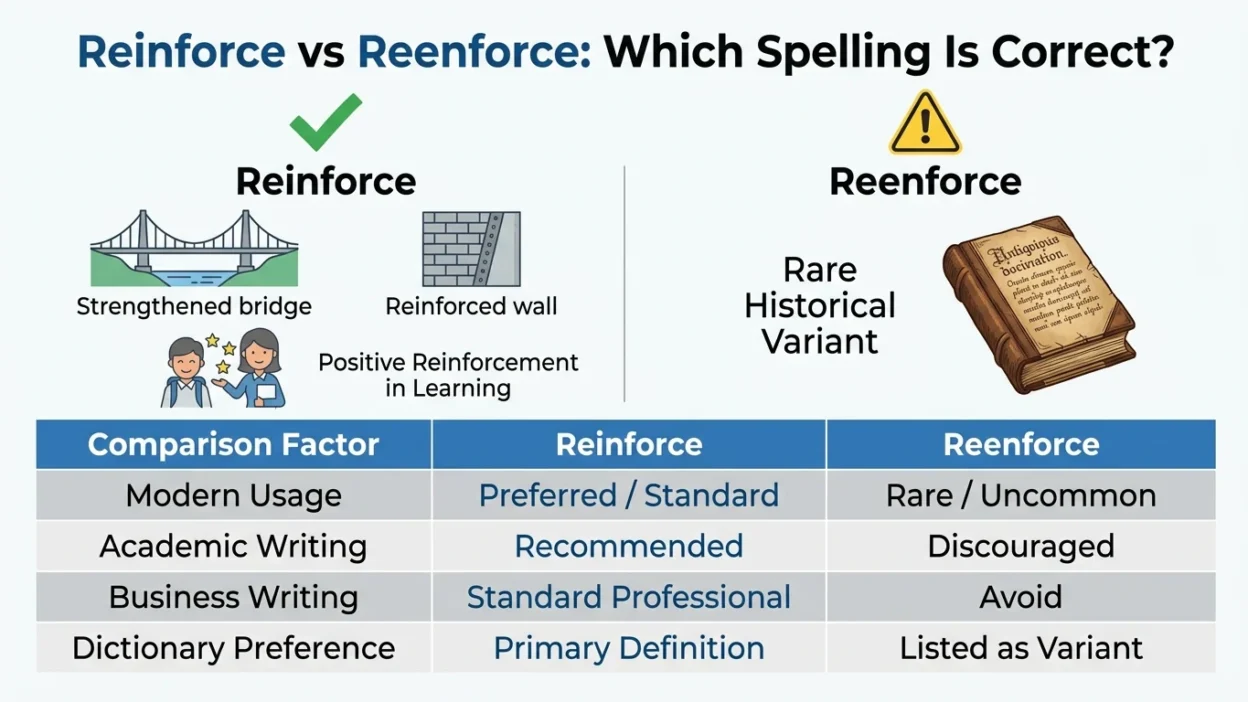
The correct and widely accepted modern spelling is reinforce.
- ✅ Reinforce = Correct modern spelling
- ⚠️ Reenforce = Rare, outdated variant spelling
Examples:
- The workers reinforced the bridge. ✅
- The workers reenforced the bridge. ⚠️
Although reenforce has historical usage, reinforce is the standard spelling used today in American English, British English, academic writing, business communication, and professional publications.
What Does Reinforce Mean?
The verb reinforce means to strengthen, support, make stronger, or provide additional assistance.
It can be used in both literal and figurative contexts.
Common Meanings of Reinforce
- Strengthen a structure
- Support an idea
- Increase effectiveness
- Add protection
- Encourage a behavior
- Provide additional resources
Examples of Reinforce
- Engineers reinforced the building after the earthquake.
- Positive feedback can reinforce good habits.
- The evidence reinforces the conclusion.
- Additional troops were sent to reinforce the army.
In all these examples, the idea involves making something stronger or more secure.
What Does Reenforce Mean?
Reenforce is an older variant spelling of reinforce.
Historically, some writers used reenforce, particularly in older English texts. However, modern dictionaries classify it as:
- Rare
- Obsolete in many contexts
- Nonstandard
- Historical variant
Today, most readers consider reinforce the correct spelling.
Example
Historical:
- The commander reenforced his troops.
Modern:
- The commander reinforced his troops.
The meaning remains the same, but the preferred spelling has changed.
Reinforce vs Reenforce: Key Differences
| Feature | Reinforce | Reenforce |
|---|---|---|
| Modern Standard Spelling | Yes | No |
| Dictionary Recognition | Yes | Limited |
| Academic Writing | Preferred | Rare |
| Business Writing | Preferred | Avoided |
| American English | Standard | Rare |
| British English | Standard | Rare |
| Historical Usage | Yes | Yes |
| Modern Popularity | Very High | Very Low |
The table clearly shows that reinforce is the spelling recommended for modern writing.
Why Is Reinforce the Preferred Spelling?
Language evolves over time.
Many English words once had multiple accepted spellings. Eventually, one version usually becomes dominant.
For reinforce, dictionaries, publishers, educators, and style guides standardized the spelling with “rein-“ rather than “reen-“.
Today, you’ll find reinforce used consistently in:
- News articles
- Books
- Academic journals
- Business documents
- Government publications
- Educational materials
As a result, most readers expect to see reinforce rather than reenforce.
The Meaning of Reinforce in Different Contexts
One reason reinforce remains popular is its versatility.
Construction and Engineering
In construction, reinforce means strengthening a structure.
Examples:
- Steel bars reinforce concrete.
- Workers reinforced the foundation.
Education
Teachers often reinforce learning.
Examples:
- Practice exercises reinforce grammar skills.
- Repetition reinforces memory.
Psychology
Reinforcement is a key concept in behavioral psychology.
Examples:
- Rewards reinforce positive behavior.
- Encouragement reinforces confidence.
Military Usage
In military contexts, reinforce often means providing additional support.
Examples:
- Troops were sent to reinforce defenses.
- Reinforcements arrived at dawn.
Business and Marketing
Companies reinforce messages and branding.
Examples:
- The campaign reinforces brand awareness.
- Consistent communication reinforces trust.
Examples of Reinforce in Sentences
Here are practical examples from everyday life.
Physical Strengthening
- The bridge was reinforced with steel beams.
- The walls were reinforced to withstand storms.
Supporting Ideas
- Research findings reinforce previous studies.
- The statistics reinforce the argument.
Encouraging Behavior
- Praise can reinforce positive habits.
- Daily practice reinforces learning.
Professional Communication
- The meeting reinforced our commitment to quality.
- Customer feedback reinforced the need for improvement.
Notice how the word works naturally across many situations.
Common Mistakes to Avoid
Many writers make avoidable errors when choosing between these spellings.
Mistake 1: Using Reenforce in Modern Writing
Incorrect:
- The teacher reenforced the lesson.
Preferred:
- The teacher reinforced the lesson.
Modern audiences expect the standard spelling.
Mistake 2: Assuming Both Are Equally Common
Although both spellings have historical roots, they are not equally accepted today.
Reinforce dominates modern usage.
Mistake 3: Thinking Reenforce Has a Different Meaning
Some people assume the spellings have separate definitions.
They do not.
Both refer to strengthening or supporting something.
The difference lies in usage and acceptance, not meaning.
Easy Memory Trick
A simple memory trick can help you remember the correct spelling.
Think of Reinforcement
Most people are familiar with words such as:
- Reinforcement
- Reinforced
- Reinforcing
All of these use the rein- spelling.
If the related forms use rein-, the base verb should too.
Think of Strengthening
Imagine:
- Reinforce = Strengthen
Whenever you want to express strengthening or support, choose reinforce.
Related Words and Synonyms
Expanding your vocabulary can improve your writing.
Synonyms for Reinforce
- Strengthen
- Support
- Fortify
- Bolster
- Enhance
- Improve
- Secure
- Back up
Related Terms
- Reinforcement
- Reinforced
- Reinforcing
- Support
- Stability
- Protection
- Encouragement
These words often appear alongside reinforce in professional and academic writing.
Reinforce in Psychology and Learning
One of the most important modern uses of reinforce comes from psychology.
Positive Reinforcement
Positive reinforcement occurs when a reward increases the likelihood of a desired behavior.
Example:
- A student receives praise for completing homework.
The praise reinforces the behavior.
Learning and Memory
Educational experts often discuss reinforcement techniques.
Examples:
- Flashcards reinforce vocabulary.
- Practice tests reinforce learning outcomes.
This usage has become especially common in schools and training programs.
Reinforce in Business and Leadership
Business leaders frequently use the word reinforce when discussing communication and organizational goals.
Examples:
- Reinforce company values.
- Reinforce customer trust.
- Reinforce workplace culture.
- Reinforce safety procedures.
Because the word conveys support and strength, it is highly effective in professional communication.
American vs British English
Unlike some English words that differ between regions, reinforce is the standard spelling in both American and British English.
American English
- Reinforce ✅
- Reenforce ⚠️ Rare
British English
- Reinforce ✅
- Reenforce ⚠️ Rare
Both varieties overwhelmingly prefer reinforce.
Therefore, there is no significant regional difference regarding modern usage.
Frequently Asked Questions
Is reinforce or reenforce correct?
Reinforce is the correct and preferred modern spelling.
Is reenforce a real word?
Yes. It is a historical variant spelling, but it is rarely used today.
Do reinforce and reenforce mean the same thing?
Yes. Both mean to strengthen or support something.
Why is reinforce more common?
Modern dictionaries, publishers, and style guides standardized reinforce as the preferred spelling.
Should I use reenforce in academic writing?
No. Academic and professional writing should use reinforce.
Is reenforce outdated?
In most modern contexts, yes. It is generally considered an old or uncommon spelling.
What is the noun form of reinforce?
The noun form is reinforcement.
Is reinforce used in psychology?
Yes. Reinforcement is a major concept in behavioral psychology and learning theory.
Final Thought
When comparing reinforce vs reenforce, the answer is clear for modern English users. Reinforce is the standard, accepted, and widely recognized spelling used in education, business, psychology, engineering, and everyday communication. It means to strengthen, support, fortify, or make something more effective.
While reenforce has historical roots and occasionally appears in older texts, it is now considered a rare variant spelling. For professional, academic, and casual writing, using reinforce ensures clarity, credibility, and alignment with modern English standards.
Actionable Takeaway
Whenever you need a word that means to strengthen or support, choose reinforce.
Remember this simple rule:
- ✅ Reinforce = Modern, correct spelling
- ⚠️ Reenforce = Rare historical variant
Using the standard spelling will help your writing appear more polished, professional, and accurate in every context.