Have you ever asked someone when something would happen and received the answer, “soon”? If so, you may have immediately wondered: How long is soon, exactly? The truth is that “soon” is one of the most commonly used yet most misunderstood time-related words in English.
If you’re waiting for a text message, a delivery, a job response, or an important update, the word soon can feel frustratingly vague. In this guide, we’ll explore the true how long is soon meaning, explain how the word is used in different situations, provide practical examples, discuss common misunderstandings, and help you interpret “soon” more accurately in everyday communication.
Quick Answer
The word soon generally means in a short time from now, but it does not specify an exact duration.
Depending on the context, soon could mean:
- A few minutes
- A few hours
- A few days
- Occasionally even a few weeks
The exact meaning depends on the situation, the speaker, and the expectations involved.
What Does “Soon” Mean?
The word soon is an adverb used to indicate that something will happen after a short period of time.
In simple terms:
Soon = not now, but in the near future.
Unlike precise time expressions such as:
- In 10 minutes
- Tomorrow
- Next week
The word soon intentionally remains flexible.
Dictionary-Style Meaning
Soon means:
- Before long
- In the near future
- After a short time
- Without much delay
Because it lacks a specific timeframe, interpretation often depends on context.
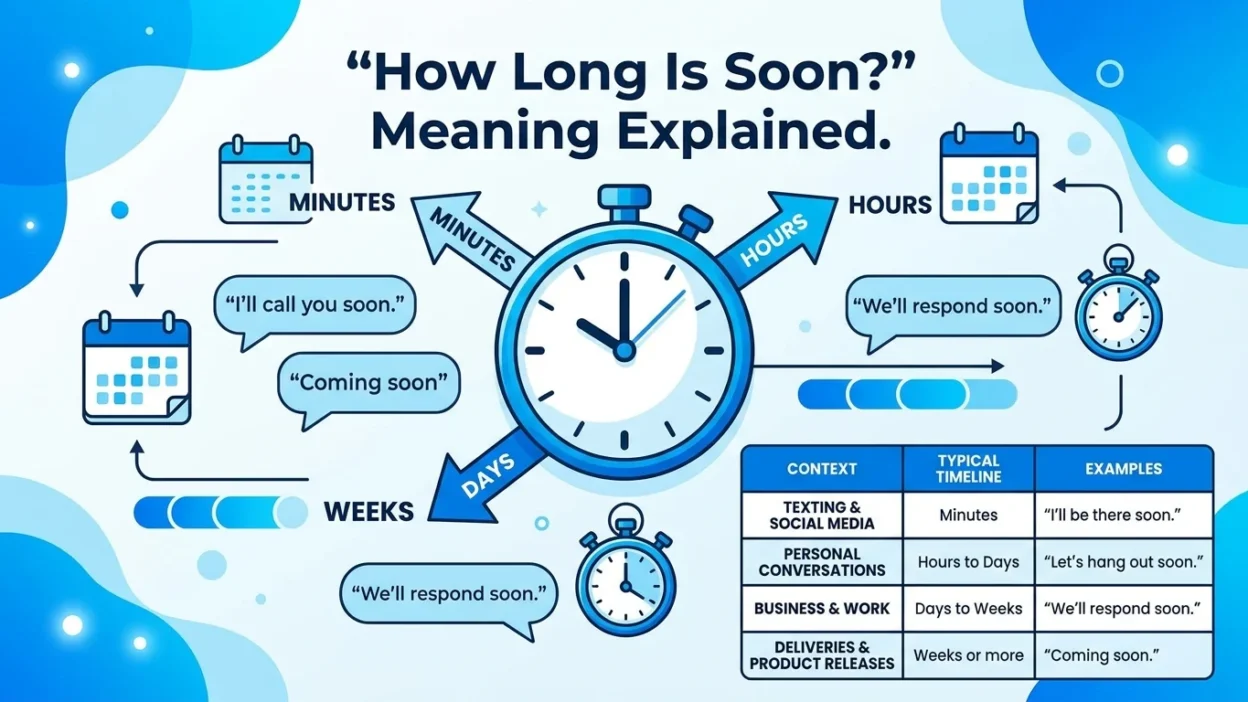
How Long Is Soon?
This is where things become interesting.
There is no universal definition of how long “soon” lasts.
Common Interpretations
| Situation | What “Soon” Usually Means |
|---|---|
| Text message | Minutes to a few hours |
| Phone call | Minutes or hours |
| Restaurant order | 5–20 minutes |
| Delivery update | Hours to days |
| Job application | Days to weeks |
| Construction project | Weeks to months |
| Medical appointment | Days to weeks |
As you can see, “soon” changes meaning depending on the circumstances.
Example
If a friend says:
“I’ll call you soon.”
Most people expect a call within:
- A few minutes
- A few hours
- Possibly the same day
However, if a company says:
“We’ll contact you soon.”
The wait may be several days or even weeks.
Why “Soon” Is So Vague
People often use the word because it sounds flexible and reassuring.
Instead of giving an exact deadline, “soon” leaves room for uncertainty.
Reasons People Say Soon
- They don’t know the exact timing.
- They want to avoid making a firm commitment.
- They expect something to happen shortly.
- They are being polite.
- They are estimating rather than promising.
Because of this flexibility, “soon” can sometimes create confusion.
Examples of Soon in Everyday Life
Let’s look at how the word appears in common situations.
Personal Conversations
- I’ll be there soon.
- I’ll text you soon.
- We’ll meet again soon.
In these cases, “soon” often means within hours or days.
Workplace Communication
- I’ll send the report soon.
- The manager will respond soon.
- We expect results soon.
Depending on workload, this may mean hours, days, or longer.
Online Shopping
- Your package will arrive soon.
- Tracking information will be updated soon.
This could mean several hours or several days.
Healthcare
- The doctor will see you soon.
- Test results will be available soon.
The timeframe varies depending on the medical situation.
Soon vs Other Time Expressions
Many people confuse “soon” with other expressions that imply different levels of urgency.
Comparison Table
| Expression | Typical Meaning |
|---|---|
| Immediately | Right now |
| Right away | Almost instantly |
| Shortly | Very soon |
| Soon | Near future |
| Later | At an unspecified future time |
| Eventually | At some point, possibly much later |
Example
- I’ll do it immediately. → Right now.
- I’ll do it shortly. → Very soon.
- I’ll do it soon. → Fairly soon, but not necessarily right away.
- I’ll do it eventually. → No specific urgency.
Understanding these differences helps avoid misunderstandings.
How Context Changes the Meaning of Soon
Context is everything when interpreting “soon.”
Waiting for a Friend
If a friend says:
“I’m leaving now. I’ll be there soon.”
You likely expect them within:
- 10–30 minutes
Waiting for a Job Offer
If a recruiter says:
“We’ll get back to you soon.”
You may need to wait:
- Several days
- One or two weeks
Waiting for a Website Update
If a company announces:
“New features coming soon.”
That could mean:
- Days
- Weeks
- Months
The larger the project, the longer “soon” tends to be.
Common Mistakes People Make
Mistake 1: Assuming Soon Means Immediately
Many people mistakenly believe “soon” means right away.
Example:
Incorrect assumption:
- He said soon, so he’ll call in five minutes.
Reality:
- He may call later today.
Mistake 2: Expecting Everyone to Define Soon the Same Way
Different people have different interpretations.
For one person:
- Soon = 15 minutes
For another:
- Soon = tomorrow
Mistake 3: Using Soon Without Clarification
Sometimes speakers create confusion by relying solely on the word.
Less clear:
- I’ll finish it soon.
More clear:
- I’ll finish it by 4 p.m.
Specific timeframes reduce misunderstandings.
Psychological Meaning of Soon
Interestingly, the perception of “soon” changes based on expectations.
Emotional Factors
When waiting for something exciting:
- Soon feels too long.
When waiting for something unpleasant:
- Soon may feel too fast.
Human Perception
Research on time perception shows that expectations influence how people interpret vague time expressions.
As a result, two people may hear the same word and imagine completely different timelines.
Soon in Business Communication
Businesses frequently use the word soon.
Examples:
- Product launching soon.
- Updates coming soon.
- We will respond soon.
Why Companies Use Soon
Companies may:
- Be uncertain about exact dates.
- Avoid making promises.
- Maintain flexibility.
- Generate anticipation.
However, customers sometimes become frustrated if “soon” extends longer than expected.
Soon in Digital Communication
The rise of smartphones and instant messaging has changed expectations.
Today, many people expect faster responses.
Texting Examples
- I’ll reply soon.
- I’ll send the file soon.
- Talk to you soon.
In texting culture, soon often implies:
- Minutes
- Hours
- The same day
Longer delays may cause confusion unless expectations are clarified.
American vs British English
There is virtually no difference between American and British English regarding the meaning of “soon.”
Both varieties define it as:
- In a short time
- Before long
- In the near future
Examples:
American English:
- I’ll see you soon.
British English:
- I’ll see you soon.
The interpretation remains largely the same.
However, cultural expectations may vary slightly depending on the situation and individual speaker.
Helpful Alternatives to Soon
If you want to be more precise, consider alternatives.
More Specific Time Phrases
Instead of:
- I’ll call you soon.
Try:
- I’ll call you in 30 minutes.
- I’ll call you this afternoon.
- I’ll call you tomorrow morning.
Other Alternatives
- Shortly
- In a few minutes
- Later today
- By the end of the day
- Within the week
Specific language reduces ambiguity.
Frequently Asked Questions
Does soon mean today?
Not always. Soon may mean today, but it can also refer to the next few days or longer depending on context.
Is soon a specific amount of time?
No. Soon is intentionally vague and does not represent a fixed duration.
How long is soon in texting?
In texting, soon often means within minutes, hours, or the same day.
Does soon mean immediately?
No. Words such as “immediately” or “right away” imply much greater urgency than “soon.”
How long is soon in business communication?
It can range from hours to several weeks depending on the situation.
Why do people use the word soon?
People often use it when they don’t know the exact timing or want flexibility.
Is shortly the same as soon?
They are similar, but “shortly” often suggests a shorter wait than “soon.”
What should I do if someone says soon?
If timing is important, politely ask for a more specific estimate.
Final Thought
Understanding how long is soon meaning requires recognizing that the word does not refer to a fixed amount of time. Instead, it generally means “in the near future” or “before long.” Depending on the situation, soon could refer to minutes, hours, days, or even weeks. Context, expectations, and the speaker’s intent all influence its interpretation.
Because soon is naturally vague, misunderstandings can occur when people assume everyone shares the same timeframe. Whether you’re communicating in personal relationships, business settings, or online conversations, understanding this flexibility can help you interpret the word more accurately and avoid unnecessary frustration.
Actionable Takeaway
Whenever someone says soon, avoid assuming a specific timeframe.
Instead, ask yourself:
- What is the context?
- Who is saying it?
- What timeline makes sense for this situation?
If timing matters, politely request a more precise estimate. Replacing vague terms with clear deadlines can improve communication and prevent confusion for everyone involved.