Have you ever wondered whether you should write itself as one word or its self as two words? This is a surprisingly common question, especially because English has many words that combine a possessive form with a noun. While itself and its self may look almost identical, they do not normally serve the same purpose in modern English.
Understanding itself vs its self is important for anyone who wants to write clear and natural English. In this guide, we’ll explain the difference between these two forms, show you when to use itself, explain the rare situations where its self may appear, provide plenty of examples, and cover common mistakes. By the end, you’ll know exactly which form to choose in everyday, academic, and professional writing.
Quick Answer
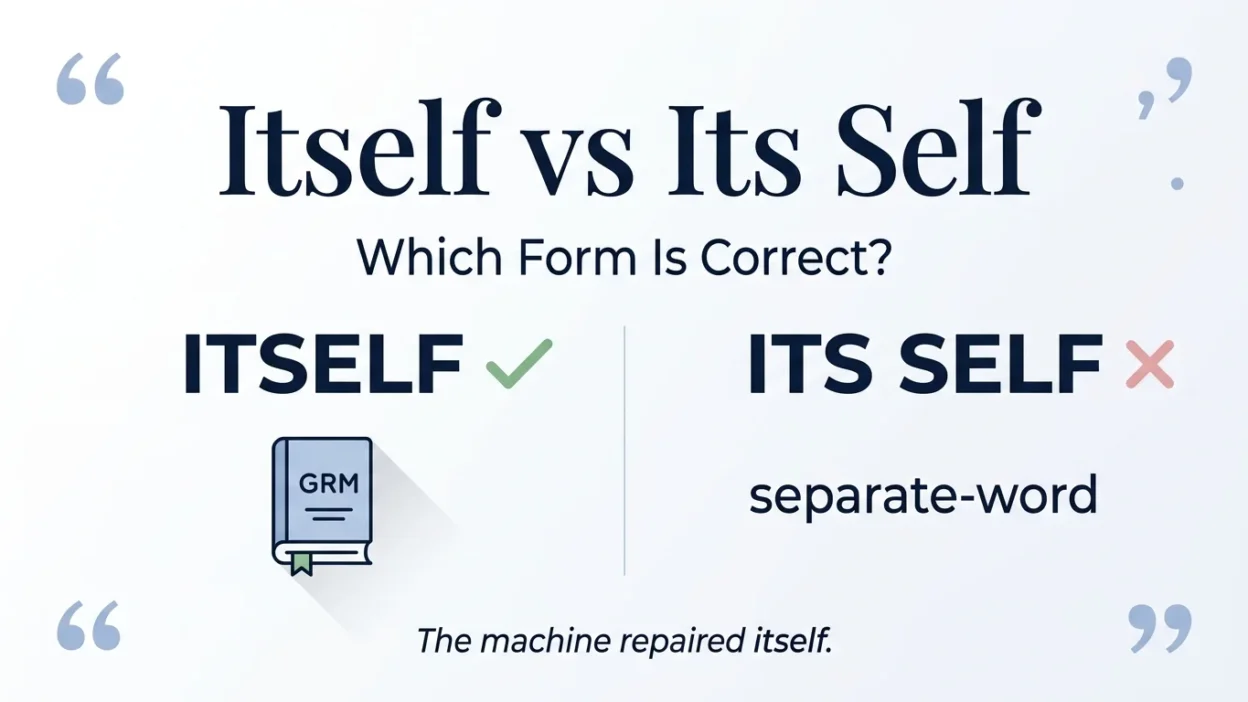
Itself (one word) is the standard and correct form in almost all ordinary situations. It is a reflexive pronoun used to refer back to a thing, animal, organization, or idea previously mentioned.
Its self (two words) is extremely uncommon and is generally used only when self is being treated as a separate noun, often in philosophical, psychological, or highly specialized writing.
Examples
- The machine turned itself off. ✅
- The company has reinvented itself. ✅
- The cat cleaned itself. ✅
- The device can repair itself. ✅
In ordinary English, you should almost always choose itself.
What Does “Itself” Mean?
Itself is a reflexive pronoun.
It is used when the subject and object of a sentence refer to the same thing.
For example:
The subject is the machine, and itself refers back to the machine.
Other reflexive pronouns include:
- myself
- yourself
- himself
- herself
- ourselves
- yourselves
- themselves
- itself
Examples
- The door opened itself.
- The computer restarted itself.
- The dog hurt itself.
- The organization challenged itself to improve.
- The system automatically updates itself.
What Does “Its Self” Mean?
Its self consists of two separate words:
- Its = a possessive determiner
- Self = a noun
The phrase can technically be used when self is being discussed as a separate concept or entity.
For example, in philosophical or theoretical writing, someone might write:
However, writing its self is much less common than itself.
In most everyday sentences, using its self would be incorrect or unnatural.
Compare
The second sentence sounds unnatural because the intended meaning is reflexive, so itself should be used.
Itself vs Its Self: Comparison Table
| Feature | Itself | Its Self |
|---|---|---|
| Spelling | One word | Two words |
| Grammatical role | Reflexive pronoun | Possessive determiner + noun |
| Common in everyday English | Very common | Extremely rare |
| Used to refer back to a thing | Yes | No, not normally |
| Example | The phone turned itself off. | Its self was discussed philosophically. |
| Recommended for normal writing | ✅ Yes | Usually avoid |
The key difference is grammatical function.
When Should You Use “Itself”?
Use itself when you want to refer back to a previously mentioned thing, animal, organization, or concept.
Example 1: A Machine
The word itself refers to the robot.
Example 2: An Animal
The word itself refers to the cat.
Example 3: An Organization
Here, itself refers to the company.
Example 4: A System
Here, itself refers to the software.
Itself as an Emphatic Pronoun
Itself can also be used for emphasis.
For example:
However, because president usually refers to a person, himself or herself would normally be appropriate.
For things or organizations, itself can emphasize that the thing in question is responsible.
This means the company directly issued the statement, rather than an employee or outside organization doing so.
Other examples:
- The machine itself is not the problem.
- The idea itself is interesting.
- The building itself is over 100 years old.
- The software itself works perfectly.
“Itself” for Emphasis vs Reflexive Use
There are two important uses of itself.
Reflexive Use
The dog is both the subject and the object.
Emphatic Use
Here, itself adds emphasis. It highlights the dog as the surprising or important subject.
Understanding this distinction can help you use the word more precisely.
Why Is “Its Self” Usually Incorrect?
The confusion happens because its is a possessive word and self is a noun.
However, itself is a fixed reflexive pronoun.
You wouldn’t normally separate other reflexive pronouns.
For example:
- myself → not “my self”
- yourself → not “your self”
- himself → not “his self”
- herself → not “her self”
- themselves → not “their selves”
In the same way:
- itself → not normally “its self”
This is why itself is the correct choice in ordinary reflexive sentences.
Common Mistakes to Avoid
1. Writing “Its Self” Instead of “Itself”
Incorrect:
Correct:
2. Confusing “Its” With “It’s”
Remember:
- Its = possessive
- It’s = it is or it has
Examples:
Neither should be confused with itself.
3. Using “Itself” for People
Generally, use:
- himself
- herself
- themselves
for people, depending on the context and the person’s preferred pronouns.
Use itself for things, animals in some contexts, organizations, systems, and abstract concepts.
Itself vs Its Own
Another common point of confusion is itself versus its own.
Itself
The machine repaired itself.
The machine performed the action on itself.
Its Own
The machine has its own power source.
Here, its own expresses possession or emphasizes ownership.
You cannot always substitute one for the other.
Itself vs It Self
The spelling it self as two separate words is generally incorrect when you mean the reflexive pronoun.
Correct:
The system manages itself.
Incorrect:
The system manages it self.
The only time self should be separate is when it is functioning as a genuine noun in a specific context.
American vs British English
There is no meaningful difference between American and British English regarding the standard spelling itself.
Both varieties use:
itself
as the normal reflexive pronoun.
Examples:
American English:
The computer restarted itself.
British English:
The computer restarted itself.
The spelling and grammatical function are the same.
When Might “Its Self” Be Used?
Although unusual, its self may appear in specialized writing.
For example, a philosophical discussion might examine the concept of an object’s identity:
The distinction between the machine and its self is difficult to define.
Here, self is being treated as a separate noun.
This type of usage is uncommon and may sound abstract or theoretical.
In everyday writing, however, you should almost always use itself.
Related Words and LSI Keywords
If you’re learning about itself vs its self, these related grammar terms may help:
- reflexive pronoun
- possessive determiner
- pronoun usage
- English grammar
- reflexive pronouns examples
- self-pronouns
- possessive words
- itself meaning
- its meaning
- common grammar mistakes
- English writing tips
- confusing English words
Learning these related concepts can make it easier to understand why itself and its self have different grammatical roles.
FAQs
Is “itself” one word or two?
Itself is normally written as one word. It is a reflexive pronoun.
Is “its self” ever correct?
It can technically appear when self is used as a separate noun, especially in philosophical or specialized writing. However, this usage is very rare.
Which is correct: “The machine fixed itself” or “The machine fixed its self”?
The correct sentence is:
The machine fixed itself.
What is the difference between “itself” and “its self”?
Itself is a reflexive pronoun. Its self consists of a possessive determiner (its) and a separate noun (self).
Is “it self” correct?
Not when you intend to use the reflexive pronoun. The correct form is itself.
Is “itself” used in American and British English?
Yes. Itself is the standard form in both American and British English.
Can “itself” be used for animals?
Yes. When an animal is referred to with it, the reflexive form is itself.
For example:
The bird cleaned itself.
What is the difference between “itself” and “its own”?
Itself is a reflexive pronoun, while its own expresses possession or emphasizes ownership.
Summary
The difference between itself vs its self is primarily grammatical. Itself, written as one word, is the standard reflexive pronoun used to refer back to a thing, animal, organization, system, or idea. It can also be used for emphasis, as in “The company itself announced the change.” In normal English writing and conversation, itself is overwhelmingly the correct choice.
The two-word form its self is extremely uncommon and is generally reserved for situations where self is being treated as a separate noun, particularly in philosophical or specialized discussions. For everyday communication, professional writing, and academic work, you should use itself whenever you need the reflexive pronoun. American and British English follow the same standard usage.