Have you ever wondered whether to say “when I can” or “when can I“? These two phrases contain exactly the same words, but their word order changes depending on how they are used. For English learners, this small difference can be confusing, especially when asking questions or talking about future possibilities.
The good news is that both when I can and when can I are correct. The key is understanding whether you’re making a statement or asking a direct question. In this guide, we’ll explain the difference between when I can vs when can I, provide clear examples, discuss common mistakes, and show you how to use each phrase naturally in everyday English.
Quick Answer
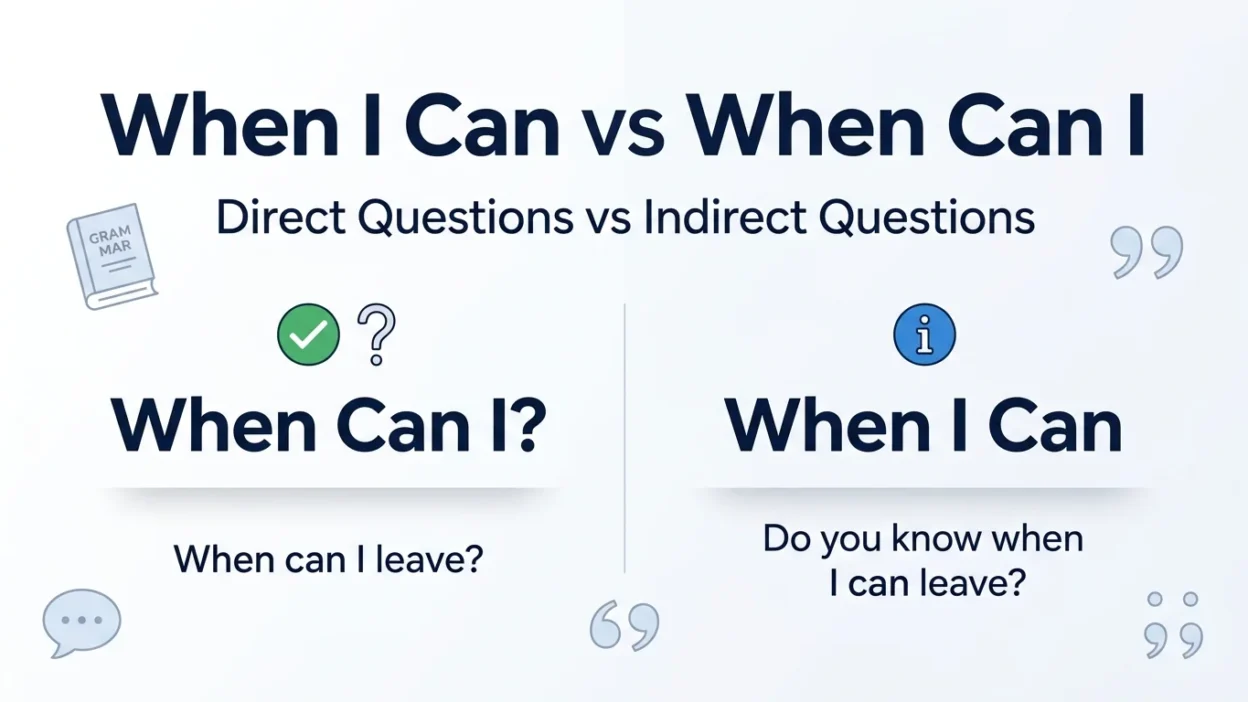
Both “when I can” and “when can I” are grammatically correct, but they are used differently.
- When can I…? → Used to ask a direct question about when something is possible or allowed.
- When I can… → Usually used as part of a statement or an indirect question.
Examples
Direct question:
Statement:
Indirect question:
A simple rule to remember is:
What Does “When Can I” Mean?
When can I is normally used to begin a direct question.
The speaker wants to know the appropriate time or opportunity to do something.
Examples
- When can I visit you?
- When can I start?
- When can I apply?
- When can I see the doctor?
- When can I expect a response?
In each example, the speaker is directly asking for information.
The structure is:
For example:
This is a standard question structure in English.
What Does “When I Can” Mean?
When I can is commonly used inside a statement or an indirect question.
It can mean:
For example:
This means the speaker will help whenever they are able to.
It can also appear in an indirect question:
Here, the speaker is not directly asking, “When can I leave?” Instead, the question is introduced by Do you know.
When I Can vs When Can I: Comparison Table
| Phrase | Main Use | Example | Meaning |
|---|---|---|---|
| When can I…? | Direct question | When can I leave? | Asking directly about the time |
| When I can… | Statement | I’ll leave when I can. | When I am able to leave |
| When I can… | Indirect question | Do you know when I can leave? | Asking indirectly |
| When can I…? | Request for permission | When can I use the computer? | Asking when something is allowed |
The biggest difference is word order.
Direct Questions: “When Can I?”
When asking a direct question, English usually places the modal verb can before the subject.
Correct
Incorrect
The second version is not normally correct as a direct question in standard English.
More examples:
- When can I start the course?
- When can I submit my application?
- When can I come over?
- When can I talk to the manager?
- When can I get my results?
These are all direct questions.
Indirect Questions: “When I Can”
The word order changes when you ask an indirect question.
Direct Question
Indirect Question
Notice what happens.
In the direct question, we say:
In the indirect question, we say:
This is an important English grammar rule.
More Examples
Direct:
Indirect:
Direct:
Indirect:
Direct:
Indirect:
“When I Can” in Statements
The phrase when I can can also appear in ordinary statements.
For example:
This means the speaker will visit at a time when they are able to do so.
Other examples include:
- I’ll call you when I can.
- I’ll finish the work when I can.
- I’ll help you when I can.
- I’ll come to see you when I can.
- I’ll reply when I can.
In these sentences, when I can is not a direct question.
“When I Can” vs “When I Am Able To”
In many contexts, when I can means the same thing as when I am able to.
For example:
Means:
The shorter version sounds more natural in everyday English.
Example
This could mean:
Common Mistakes to Avoid
1. Using “When I Can?” as a Direct Question
Incorrect:
Correct:
For a direct question, use the inverted word order:
2. Using “When Can I” Inside an Indirect Question
Incorrect:
Correct:
After phrases such as Do you know, Could you tell me, or I’d like to know, use normal statement word order.
3. Confusing Direct and Indirect Questions
Compare:
The first is direct.
The second is indirect.
Understanding this difference will help you avoid one of the most common word-order mistakes in English.
How to Remember the Rule
Here’s a simple trick.
Direct Question
Ask directly:
Indirect Question
Put the question inside another sentence:
Think of it this way:
Indirect question = Statement word order
This rule applies to many other question structures as well.
More Examples in Everyday English
At Work
Direct:
Indirect:
At School
Direct:
Indirect:
At a Hospital
Direct:
Indirect:
With Friends
Direct:
Statement:
American vs British English
There is no meaningful difference between American and British English in the basic grammar rule.
Both varieties use:
for direct questions.
Both also use:
in statements and indirect questions.
For example:
American English:
British English:
The grammar is identical.
There may be slight differences in vocabulary or politeness depending on the situation, but the word-order rule remains the same.
“When Can I” and Politeness
When can I…? is grammatically correct, but the tone can vary depending on the context.
For a more polite question, you can use:
- Could you tell me when I can…?
- Would you mind telling me when I can…?
- Do you know when I can…?
- I’d like to know when I can…
Example
Direct:
More polite:
The second version may be more appropriate in professional situations.
Related English Grammar Terms
Understanding these related concepts can help you master the difference:
- direct questions
- indirect questions
- question word order
- modal verbs
- auxiliary verbs
- English sentence structure
- subject-verb inversion
- embedded questions
- polite questions
- everyday English grammar
The modal verb can is especially important because it is used to talk about ability, possibility, and permission.
FAQs
Which is correct: “when I can” or “when can I”?
Both are correct. When can I is used for direct questions, while when I can is usually used in statements or indirect questions.
Is “When I can go?” grammatically correct?
Not as a standard direct question. The correct form is:
However, when I can go is correct inside an indirect question, such as:
Is “Do you know when can I leave?” correct?
No. The correct form is:
Indirect questions use normal statement word order.
What is the difference between “When can I” and “when I can”?
When can I introduces a direct question. When I can usually appears in a statement or indirect question.
Can I say “I’ll do it when I can”?
Yes. This is a natural and grammatically correct sentence meaning that you’ll do something when you’re able to.
Are “when I can” and “when I am able to” the same?
They often have the same meaning. When I can is shorter and more natural in many everyday situations.
Is the rule different in American and British English?
No. Both American and British English use the same word order for direct and indirect questions.
How can I remember the difference?
Remember: Direct question → When can I?
Indirect question → when I can.
Summary
The difference between when I can vs when can I is mainly about sentence structure and word order. When can I is used when you are asking a direct question, such as “When can I leave?” or “When can I apply?” In these questions, the modal verb can comes before the subject I.
On the other hand, when I can is used in statements and indirect questions. You might say, “I’ll call you when I can” or “Do you know when I can leave?” The word order changes because the phrase is no longer a direct question. This distinction is the key to using both expressions correctly.