Have you ever heard someone say “I didn’t do nothing“ and wondered if it was grammatically correct? This phrase is common in movies, songs, everyday conversations, and some regional dialects, yet many English learners are taught that they should say “I didn’t do anything” instead. So, which one is actually correct?
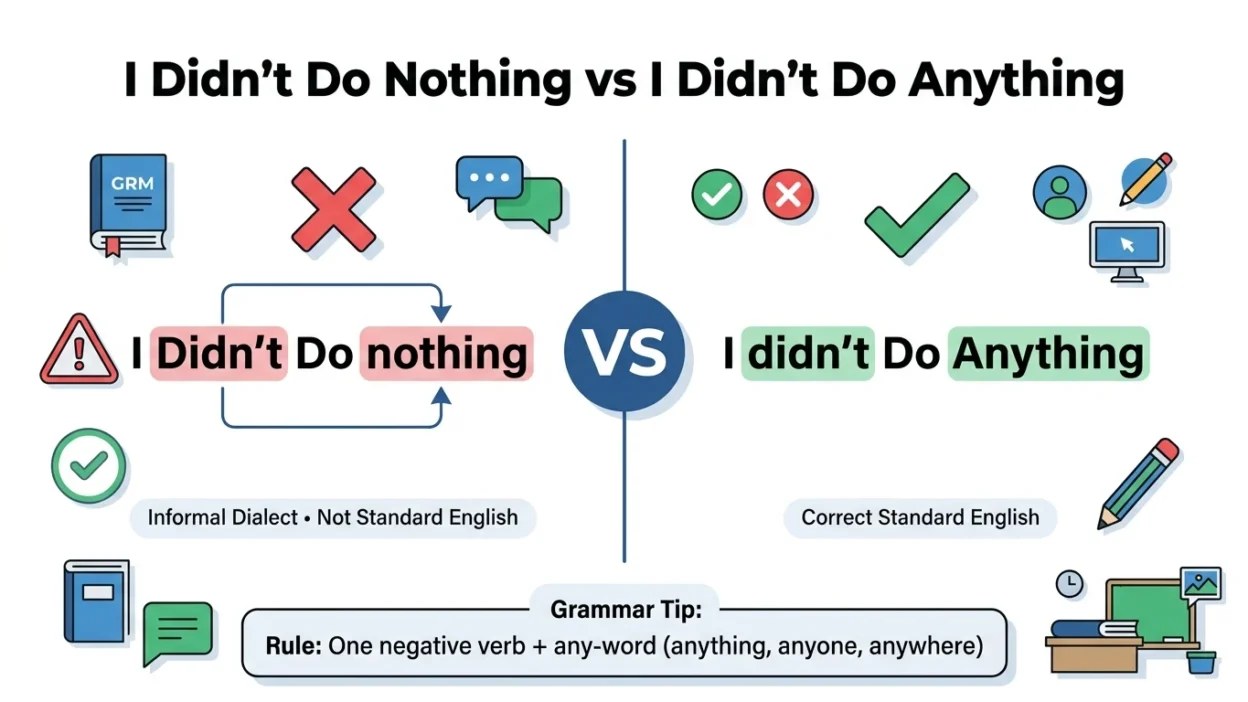
The answer depends on the context and the type of English you’re using. In standard English grammar, I didn’t do anything is the correct form.
However, I didn’t do nothing is commonly used in certain dialects and informal speech for emphasis.
In this guide, you’ll learn the difference between I didn’t do nothing vs I didn’t do anything, understand the grammar behind each expression, see plenty of examples, and avoid common mistakes.
Quick Answer
In standard English, the correct sentence is:
- I didn’t do anything. ✅
The sentence:
- I didn’t do nothing. ❌
is considered a double negative, which is grammatically incorrect in formal English. However, it is commonly used in some regional dialects and informal speech to emphasize innocence or denial.
If you’re writing essays, emails, reports, or speaking in professional situations, always use I didn’t do anything.
What Does “I Didn’t Do Anything” Mean?
I didn’t do anything means:
It clearly expresses that no action was taken.
Examples
- I didn’t do anything wrong.
- She asked me what happened, but I didn’t do anything.
- We didn’t do anything during the holiday.
- He didn’t do anything to cause the accident.
- I honestly didn’t do anything.
This is the standard form taught in schools and used in formal writing.
What Does “I Didn’t Do Nothing” Mean?
Grammatically, I didn’t do nothing contains two negatives:
- didn’t
- nothing
According to standard grammar rules, two negatives cancel each other out, creating a positive meaning.
Taken literally, the sentence could imply:
However, native speakers who use this expression don’t usually mean that.
Instead, they intend it to mean:
In many dialects, double negatives are used for emphasis rather than logical negation.
I Didn’t Do Nothing vs I Didn’t Do Anything: Key Difference
Although both expressions often communicate the same idea in conversation, they differ grammatically.
| Expression | Standard English | Meaning | Formal Writing |
|---|---|---|---|
| I didn’t do anything | ✅ Correct | I did nothing | Yes |
| I didn’t do nothing | ❌ Double negative | Often intended to mean “I did nothing” | No |
If your goal is correct grammar, choose I didn’t do anything.
Why Is “I Didn’t Do Nothing” Considered Incorrect?
Standard English generally avoids double negatives.
A double negative occurs when two negative words appear in the same clause.
Examples include:
- didn’t + nothing
- don’t + nobody
- can’t + never
- isn’t + no one
In standard grammar, only one negative word should appear.
Correct:
- I didn’t see anyone.
- She doesn’t know anything.
- We haven’t met anyone.
Incorrect:
- I didn’t see nobody.
- She doesn’t know nothing.
- We haven’t met nobody.
Why Do Native Speakers Still Say “I Didn’t Do Nothing”?
Language isn’t always the same as grammar textbooks.
Many native speakers use double negatives because they are part of:
- Regional dialects
- Family speech patterns
- Cultural identity
- Informal conversation
- Music lyrics
- Movies
- Television dialogue
In these settings, I didn’t do nothing is often used to add emotion or emphasis rather than to follow formal grammar rules.
Examples of “I Didn’t Do Anything”
These examples follow standard English.
- I didn’t do anything to upset her.
- They didn’t do anything illegal.
- We didn’t do anything special yesterday.
- I didn’t do anything wrong.
- The children didn’t do anything dangerous.
- He didn’t do anything without permission.
- She didn’t do anything unusual.
- I honestly didn’t do anything.
These sentences are appropriate in school, work, and professional communication.
Examples of “I Didn’t Do Nothing”
These examples reflect informal or dialectal speech.
- I didn’t do nothing!
- He didn’t do nothing wrong.
- We didn’t do nothing all day.
- She didn’t do nothing to deserve that.
- They didn’t do nothing.
While common in casual speech, these forms should generally be avoided in formal writing.
Common Double Negative Examples
Understanding similar mistakes can help reinforce the rule.
Incorrect:
- I don’t know nothing.
- We can’t find nobody.
- She never said nothing.
- He doesn’t need no help.
- They haven’t done nothing.
Correct:
- I don’t know anything.
- We can’t find anybody.
- She never said anything.
- He doesn’t need any help.
- They haven’t done anything.
Common Mistakes to Avoid
Many English learners accidentally use double negatives because they translate directly from their first language or imitate casual speech.
1. Using Two Negatives Together
Incorrect:
- I didn’t do nothing.
Correct:
- I didn’t do anything.
2. Mixing Formal and Informal Grammar
Avoid writing:
- I didn’t tell nobody.
Instead write:
- I didn’t tell anybody.
3. Copying Song Lyrics
Many songs intentionally use double negatives.
Remember:
Lyrics often follow artistic style rather than grammar rules.
4. Assuming Native Speakers Always Follow Grammar Rules
Native speakers frequently use informal grammar in conversation.
Professional writing follows different standards.
American vs British English
One common question is whether British English accepts double negatives more than American English.
The answer is:
No.
Both American English and British English consider I didn’t do anything the standard grammatical form.
However, both varieties include regional dialects where double negatives are common.
American English
Double negatives appear in:
- Southern dialects
- African American Vernacular English (AAVE)
- Some rural communities
- Casual speech
British English
Double negatives may appear in:
- Cockney English
- Some regional dialects
- Informal conversation
Despite this, schools and formal writing in both countries teach:
- I didn’t do anything.
Similar Correct Expressions
Depending on the situation, you can also say:
- I did nothing.
- I wasn’t responsible.
- I didn’t touch it.
- I wasn’t involved.
- I didn’t cause it.
- I wasn’t the one.
- I didn’t participate.
- I didn’t make any changes.
These alternatives can make your writing more varied and natural.
Tips to Remember the Rule
A simple trick makes this easy.
Count the negatives.
If your sentence already has:
- didn’t
then use:
- anything
- anyone
- anywhere
- ever
Not:
- nothing
- nobody
- nowhere
- never
One negative is enough in standard English.
FAQs
Which is grammatically correct: “I didn’t do nothing” or “I didn’t do anything”?
I didn’t do anything is grammatically correct in standard English.
Why do people say “I didn’t do nothing”?
Many native speakers use it as part of regional dialects or informal speech to add emphasis.
Is “I didn’t do nothing” always wrong?
It is considered incorrect in formal English but may be acceptable in certain dialects or creative writing.
Do American and British English both avoid double negatives?
Yes. Standard American and British English both recommend avoiding double negatives in formal communication.
Can I use “I didn’t do nothing” in an essay?
No. Academic and professional writing should use I didn’t do anything.
Why do songs use double negatives?
Songwriters often prioritize rhythm, emotion, authenticity, or regional speech over strict grammar rules.
Is “I did nothing” correct?
Yes. I did nothing is another grammatically correct way to express the same idea.
Summary
Understanding I didn’t do nothing vs I didn’t do anything becomes simple once you know the grammar behind double negatives. In standard English, I didn’t do anything is the correct choice because it uses only one negative word. This form is appropriate for school assignments, professional writing, business communication, and everyday situations where standard grammar is expected.
Although I didn’t do nothing is common in some dialects, songs, and casual conversations, it is considered a double negative and should generally be avoided in formal contexts. Recognizing the difference will help you communicate more clearly and confidently in both spoken and written English.
Actionable Takeaway
Whenever you use a negative verb like didn’t, don’t, can’t, or won’t, pair it with words such as anything, anyone, or anywhere—not nothing, nobody, or nowhere. Following this simple rule will help you avoid double negatives and make your English sound natural, accurate, and professional.