Expressing gratitude is one of the most important parts of effective communication.
If you’re thanking friends, coworkers, teachers, clients, or family members, choosing the right phrase can make your appreciation sound more natural and sincere. One common question English learners and native speakers alike ask is: Should I say “thank you both” or “thanks to both of you”?
The good news is that both expressions are correct. However, they are not always interchangeable. Each phrase has a slightly different tone, structure, and purpose.
Understanding the difference between thank you both vs thanks to both of you will help you communicate more clearly and confidently in both personal and professional situations.
Quick Answer
Both phrases are grammatically correct, but they are used differently.
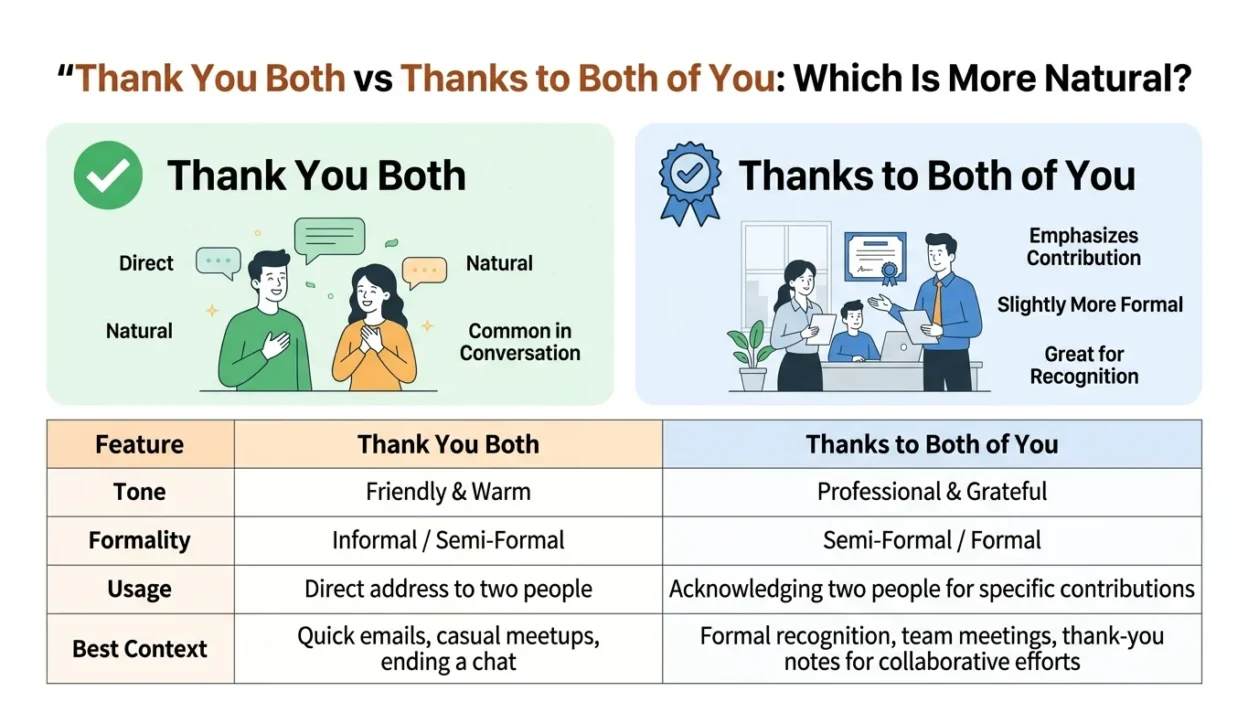
- Thank you both = Directly expressing gratitude to two people.
- Thanks to both of you = Expressing appreciation while emphasizing the contribution of two people.
Examples
- Thank you both for your help. ✅
- Thanks to both of you for your support. ✅
In most everyday conversations, thank you both sounds more natural and direct.
What Does “Thank You Both” Mean?
Thank you both is a direct expression of gratitude addressed to two people.
The word both refers specifically to two individuals, making it clear that your appreciation is directed at each person equally.
Examples
- Thank you both for attending.
- Thank you both for your kindness.
- Thank you both for helping me move.
- Thank you both for your patience.
This phrase is simple, warm, and commonly used in everyday English.
Why It Sounds Natural
When speaking directly to two people, native English speakers often prefer concise expressions.
For example:
- Thank you both.
- Thanks, you two.
- I appreciate you both.
These feel personal and conversational.
What Does “Thanks to Both of You” Mean?
Thanks to both of you also expresses gratitude, but it places slightly more emphasis on the people being acknowledged.
The phrase often sounds a bit more formal or deliberate.
Examples
- Thanks to both of you for your assistance.
- Thanks to both of you for making this possible.
- Thanks to both of you for your hard work.
The meaning is still gratitude, but the structure highlights the contribution made by the two people.
Thank You Both vs Thanks to Both of You: Key Differences
| Feature | Thank You Both | Thanks to Both of You |
|---|---|---|
| Direct Gratitude | Yes | Yes |
| Everyday Conversation | Very Common | Common |
| Formality Level | Neutral | Slightly More Formal |
| Brevity | Shorter | Longer |
| Natural Spoken English | Very Natural | Natural |
| Emphasis on Contribution | Moderate | Stronger |
| Professional Writing | Appropriate | Appropriate |
Both expressions are correct, but the context often determines which sounds better.
When to Use “Thank You Both”
This phrase works best when speaking directly to two people.
Common Situations
- Personal conversations
- Text messages
- Emails
- Meetings
- Family interactions
- Friendships
Examples
- Thank you both for coming today.
- Thank you both for your support during a difficult time.
- Thank you both for the wonderful gift.
- Thank you both for being here.
The phrase feels sincere without sounding overly formal.
When to Use “Thanks to Both of You”
This expression often works well when emphasizing the role that two people played in a success or achievement.
Common Situations
- Workplace recognition
- Formal speeches
- Public acknowledgments
- Team celebrations
- Appreciation messages
Examples
- Thanks to both of you, the project was completed on time.
- Thanks to both of you for your dedication.
- Thanks to both of you, we achieved our goals.
Notice how the phrase naturally highlights contribution and impact.
Examples in Everyday Communication
Understanding real-life examples can make the distinction easier.
Family
- Thank you both for dinner.
- Thanks to both of you for making me feel welcome.
Friends
- Thank you both for helping me move.
- Thanks to both of you for always being there for me.
Workplace
- Thank you both for your professionalism.
- Thanks to both of you, the presentation was a success.
School
- Thank you both for your guidance.
- Thanks to both of you for helping me complete the assignment.
In most cases, either phrase works, but one may sound more natural depending on the context.
Which Phrase Sounds More Natural?
For direct communication, thank you both is usually the more natural option.
Native speakers frequently use it because it is:
- Short
- Direct
- Warm
- Conversational
Examples:
- Thank you both.
- Thank you both for helping.
- Thank you both for coming.
These sound effortless and natural.
By contrast, thanks to both of you may sound slightly more formal or explanatory.
Common Mistakes to Avoid
Mistake 1: Thinking One Phrase Is Wrong
Some learners assume only one expression is correct.
This is not true.
Both are grammatically correct and widely used.
Mistake 2: Using “Thanks to” Incorrectly
The phrase thanks to can sometimes indicate cause rather than gratitude.
Example:
- Thanks to the rain, the game was canceled.
Here, it means “because of,” not appreciation.
Because of this alternative meaning, context matters.
Mistake 3: Overcomplicating Gratitude
Sometimes simple language works best.
Instead of:
- My deepest and sincerest thanks to both of you.
You can simply say:
- Thank you both.
The shorter version often sounds more genuine.
Thank You Both vs Thanks Both
You may also hear:
- Thanks both.
This is common in some informal settings, especially in British English.
Examples:
- Thanks both.
- Thanks, both.
While understandable, it is less common in formal writing.
Comparison
| Expression | Formality |
|---|---|
| Thank you both | Neutral |
| Thanks to both of you | Slightly formal |
| Thanks both | Informal |
Alternative Ways to Thank Two People
Sometimes variety improves communication.
Friendly Alternatives
- Thanks, you two.
- I appreciate you both.
- I’m grateful to both of you.
- Many thanks to both of you.
- Thank you both so much.
Professional Alternatives
- I sincerely appreciate both of your efforts.
- Thank you both for your contributions.
- My gratitude to both of you.
- I appreciate the support from both of you.
These alternatives can help avoid repetition.
American vs British English
Both American and British English use:
- Thank you both
- Thanks to both of you
There is no significant grammatical difference between the two varieties.
American English
Common:
- Thank you both.
- Thanks to both of you.
British English
Common:
- Thank you both.
- Thanks to both of you.
- Thanks both.
British speakers may use thanks both slightly more often than Americans.
Otherwise, usage is largely identical.
Why Gratitude Matters in Communication
Expressing thanks effectively strengthens relationships.
Benefits include:
- Building trust
- Showing appreciation
- Improving teamwork
- Strengthening friendships
- Encouraging cooperation
Whether you choose thank you both or thanks to both of you, sincere gratitude creates positive connections.
FAQs
Is thank you both grammatically correct?
Yes. It is a perfectly correct and natural way to thank two people.
Is thanks to both of you correct?
Yes. It is also grammatically correct and commonly used.
Which phrase is more natural?
In everyday conversation, thank you both usually sounds more natural and direct.
Can I use thank you both in professional emails?
Absolutely. It is professional, polite, and widely accepted.
Is thanks to both of you more formal?
Generally, yes. It can sound slightly more formal or emphasize contribution.
What is the difference between thank you both and thanks both?
Thank you both is more standard and formal, while thanks both is more informal.
Do Americans and British people use both phrases?
Yes. Both expressions are common in American and British English.
Which phrase should I use in a speech?
Either works, but thanks to both of you may sound more formal in public acknowledgments.
Conclusion
When comparing thank you both vs thanks to both of you, both expressions are correct and widely used. The main difference is tone and emphasis.
Thank you both is shorter, more direct, and often sounds more natural in everyday conversations. Thanks to both of you places a little more emphasis on the contribution or support provided by two people.
Neither phrase is inherently better than the other. The best choice depends on your audience, context, and communication style.
In casual conversations, emails, and personal interactions, thank you both is often the preferred option.
In formal acknowledgments or situations where you want to emphasize someone’s role in an achievement, thanks to both of you can be especially effective.
Actionable Takeaway
Use this simple rule:
- Thank you both = Best for direct, natural gratitude.
- Thanks to both of you = Best when highlighting contribution or support.
When you’re unsure, choose thank you both. It’s concise, warm, professional, and works in almost every situation where you’re thanking two people.