Have you ever heard someone say, “This is my first priority,” and wondered whether the phrase is grammatically correct? You’re not alone.
Many English learners, students, professionals, and even native speakers question the first priority usage because the word priority already suggests something that comes first.
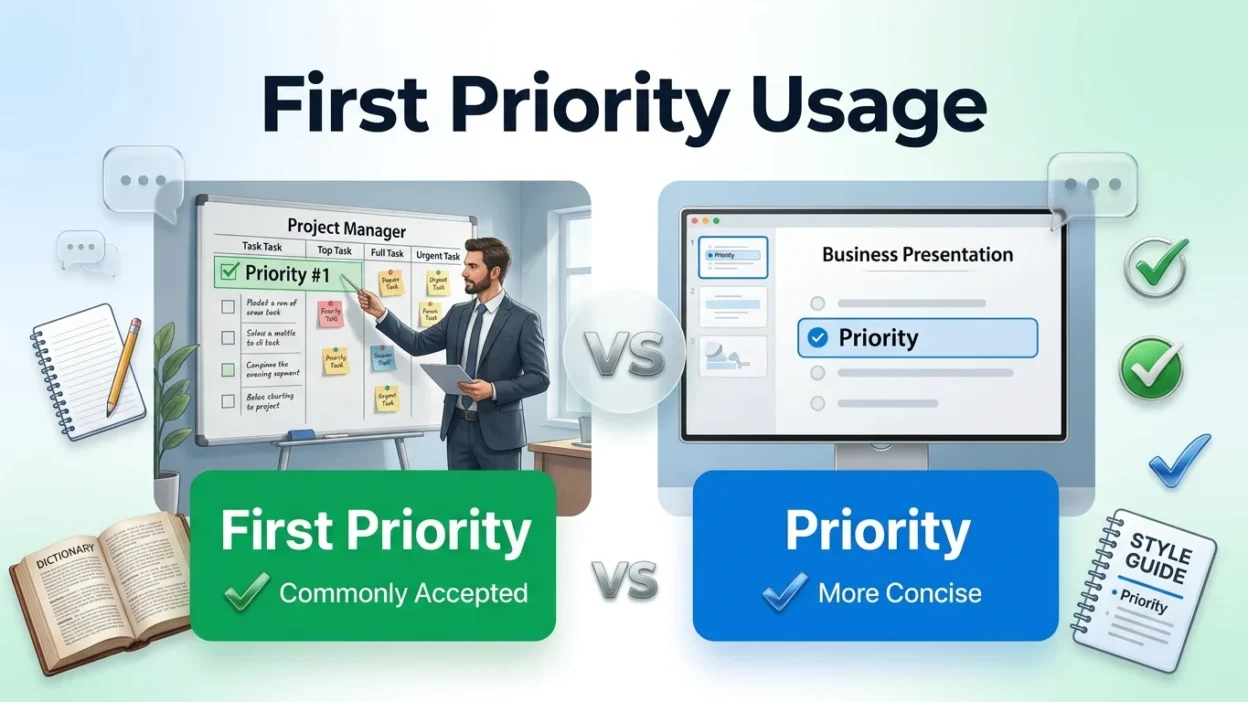
The answer isn’t as simple as “right” or “wrong.” While first priority is widely used in everyday English, business communication, and public speaking, some grammar experts consider it redundant because priority itself means something of the highest importance.
In this guide, you’ll learn the meaning of first priority usage, when it’s acceptable, when it’s better to avoid it, practical examples, common mistakes, and the best alternatives.
Quick Answer
First priority is widely accepted in modern English, especially in business, education, and everyday conversation.
However, some style guides and grammar experts consider it redundant because priority already means the most important thing.
Both of these sentences are common:
- ✅ Safety is our first priority.
- ✅ Safety is our top priority.
Many editors prefer top priority or simply priority for clearer and more concise writing.
What Does “Priority” Mean?
The noun priority refers to something that is more important than other things and deserves attention first.
It comes from the Latin word prior, meaning earlier or first.
Examples:
- Education is my priority.
- Public safety remains the government’s priority.
- Customer satisfaction is our highest priority.
The idea of coming first is already built into the meaning of the word.
What Does “First Priority” Mean?
The phrase first priority emphasizes that one task, goal, or responsibility is more important than all others.
People commonly use it to:
- Stress urgency
- Clarify importance
- Rank multiple priorities
- Strengthen a statement
Examples:
- My first priority is my family.
- Patient safety is our first priority.
- Completing the project is the team’s first priority.
Although some consider it repetitive, most readers immediately understand its meaning.
First Priority Usage: Comparison Table
| Expression | Grammatically Acceptable | Notes |
|---|---|---|
| Priority | ✅ Yes | Clear and concise |
| First Priority | ✅ Yes | Common but considered redundant by some |
| Top Priority | ✅ Yes | Very common in business and formal writing |
| Highest Priority | ✅ Yes | Strong emphasis |
| Main Priority | ✅ Yes | Natural in everyday English |
| Number One Priority | ✅ Yes | Emphatic and conversational |
Is “First Priority” Grammatically Correct?
The short answer is yes.
Modern dictionaries and English usage recognize first priority as an acceptable phrase.
However, whether you should use it depends on your writing style.
Why Some People Avoid It
Traditional grammar experts argue that:
- Priority already means first in importance.
- Adding first creates unnecessary repetition.
This is similar to phrases like:
- Final outcome
- Advance planning
- Unexpected surprise
- Free gift
These expressions are often called redundancies.
Why Many Writers Still Use It
In real-world communication, people often use extra words for emphasis.
Examples include:
- My first choice
- First impression
- First responsibility
- First concern
Similarly, first priority highlights importance rather than simply repeating meaning.
When Should You Use “First Priority”?
The phrase works well in many situations.
Business Communication
- Customer satisfaction is our first priority.
- Employee safety remains our first priority.
Education
- Student learning is our first priority.
Healthcare
- Patient care is our first priority.
Personal Conversations
- My first priority is spending time with my family.
These examples sound natural and are widely accepted.
When Should You Avoid “First Priority”?
In formal or highly edited writing, some style guides recommend simpler wording.
Instead of:
- Our first priority is quality.
You can write:
- Our priority is quality.
- Quality is our top priority.
- Quality remains our highest priority.
These alternatives sound concise and polished.
Better Alternatives to “First Priority”
Depending on the context, you may prefer one of these expressions.
Top Priority
Very common in business.
Example:
- Safety is our top priority.
Highest Priority
Suitable for formal writing.
Example:
- Security remains our highest priority.
Main Priority
Common in everyday English.
Example:
- My main priority is finishing the report.
Number One Priority
Adds emphasis.
Example:
- Customer service is our number one priority.
Primary Focus
Useful in professional communication.
Example:
- Our primary focus is customer satisfaction.
Examples of First Priority Usage
Here are some natural examples.
- My first priority is my children’s education.
- Your health should be your first priority.
- The company’s first priority is customer satisfaction.
- Public safety remains the government’s first priority.
- Completing the assignment is my first priority today.
These examples are grammatically acceptable and commonly used.
Common Mistakes to Avoid
Here are the mistakes people often make.
1. Thinking the Phrase Is Always Wrong
Some believe first priority is incorrect.
In reality, it is widely accepted in modern English.
2. Overusing It
If every paragraph contains first priority, your writing becomes repetitive.
Use alternatives occasionally.
3. Mixing Multiple Rankings
Confusing:
- First priority
- Top priority
- Highest priority
Choose one phrase consistently.
4. Using It Without Context
Instead of saying:
- That’s my first priority.
Clarify:
- Completing the report is my first priority.
Specific writing is stronger.
Easy Memory Trick
Remember this simple rule.
If you want concise writing:
Use:
Priority
If you want emphasis:
Use:
First priority
If you want polished business English:
Use:
Top priority
This simple guideline works in nearly every situation.
American vs British English
There is no significant difference between American and British English regarding first priority usage.
Both varieties commonly use:
- First priority
- Top priority
- Highest priority
Examples:
American English:
- Safety is our first priority.
British English:
- Safety is our first priority.
The phrase is understood and accepted on both sides of the Atlantic.
Why Writers Debate First Priority
The debate comes from two different approaches to language.
Traditional Grammar
Focuses on avoiding redundancy.
Recommendation:
- Use priority.
Modern Usage
Focuses on clarity and emphasis.
Recommendation:
- First priority is acceptable when emphasis helps readers.
Most modern style guides favor clarity over rigid rules.
Related Words and Synonyms
Here are useful alternatives.
- Priority
- Importance
- Focus
- Concern
- Objective
- Goal
- Mission
- Preference
- Main objective
- Principal concern
- Chief aim
Using synonyms makes your writing more engaging and avoids repetition.
FAQs
Is first priority grammatically correct?
Yes. It is widely accepted in modern English, although some style experts consider it redundant.
Why do some people say first priority is wrong?
Because the word priority already implies first importance, making first seem unnecessary.
Is top priority better than first priority?
In many formal and business contexts, top priority is often preferred because it sounds concise and natural.
Can I use first priority in professional writing?
Yes. It is common in business reports, company policies, healthcare, and education.
Is there a difference between first priority and highest priority?
Both emphasize importance. Highest priority may sound slightly more formal, while first priority is more conversational.
Do American and British English use first priority?
Yes. Both varieties commonly use the phrase.
What is the best alternative to first priority?
Good alternatives include top priority, highest priority, main priority, and simply priority, depending on the context.
Summary
Understanding first priority usage is less about strict grammar and more about style and context.
While priority already carries the meaning of something most important, the phrase first priority has become a widely accepted expression in modern English.
It appears regularly in business communication, education, healthcare, government statements, and everyday conversations because it adds emphasis and makes the speaker’s intention clear.
If you’re aiming for concise or highly formal writing, using priority or top priority may be the better choice.
However, if you want to emphasize that one task stands above all others, first priority is perfectly acceptable and easily understood by readers.
The key is to use it thoughtfully and avoid unnecessary repetition within the same piece of writing.
Actionable Takeaway
The next time you’re writing, ask yourself whether you need clarity or emphasis. If a simple statement is enough, use priority. If you want to highlight what matters most, first priority or top priority are both excellent choices. Choosing the phrase that best fits your audience and purpose will make your writing more natural, effective, and professional.