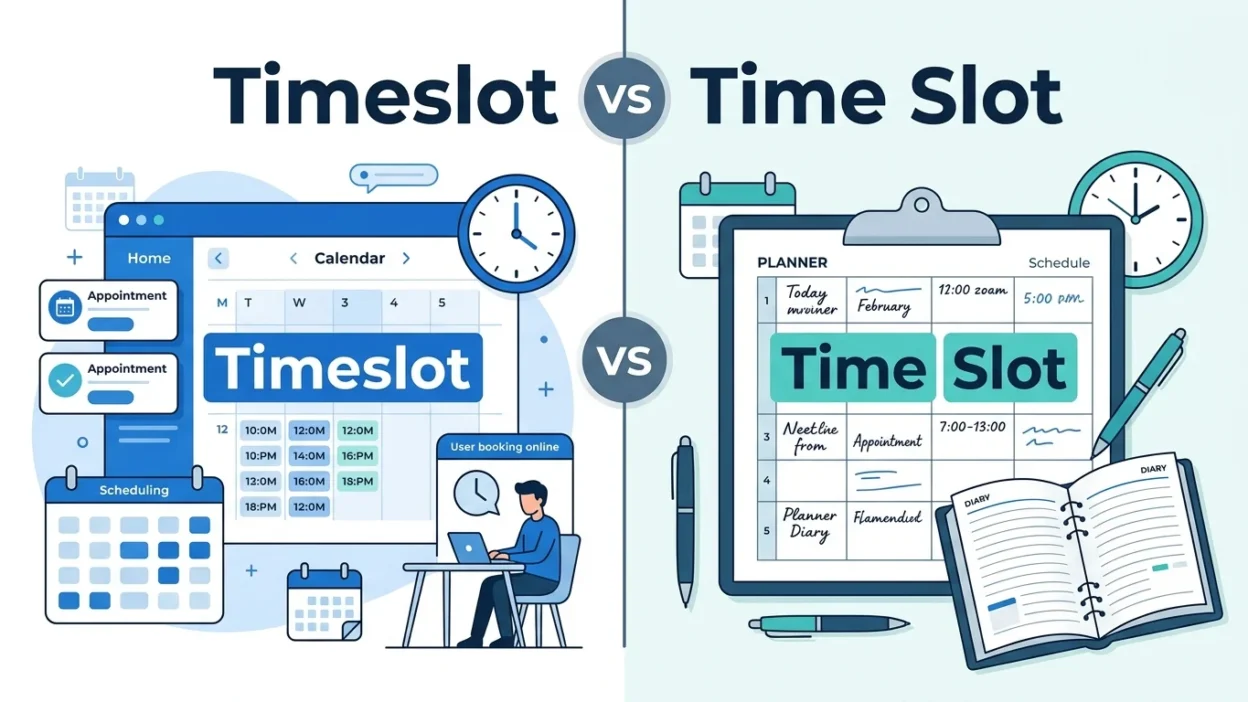
If you have ever wondered whether you should write timeslot or time slot, you are not alone. These two forms appear in emails, booking systems, schedules, calendars, websites, and business documents every day.
While they look similar, many writers are unsure which version is more accurate or professional.
The good news is that both timeslot and time slot are used in modern English. However, one form is generally considered more standard than the other.
In this guide, you’ll learn the difference, when to use each version, examples, common mistakes, and whether American or British English prefers one spelling over the other.
Quick Answer
Time slot (two words) is the standard and most widely accepted spelling in both American and British English.
Timeslot (one word) is also used, especially in technology, software, booking platforms, and some company style guides. However, if you’re writing for general audiences, schools, businesses, or formal documents, time slot is usually the safer and more recommended choice.
What Does “Time Slot” Mean?
A time slot is a specific period of time reserved or assigned for a particular activity, event, appointment, meeting, television program, or service.
It helps organize schedules and prevents conflicts by giving each activity its own designated period.
Simple Definition
Time slot means:
Examples
- Please choose a time slot for your doctor’s appointment.
- The interview time slot is scheduled for 10:30 AM.
- Every speaker has a 20-minute time slot.
- The TV show’s evening time slot attracts millions of viewers.
- Book your preferred time slot before they are full.
What Does “Timeslot” Mean?
Timeslot has exactly the same meaning as time slot.
The only difference is the spelling.
Many online scheduling systems, software applications, and booking platforms combine the words into a single compound noun because it fits their interface or branding style.
Examples include:
- Select a timeslot for pickup.
- Your preferred timeslot is unavailable.
- Available timeslots appear in green.
Although this spelling is increasingly common in digital products, many dictionaries and style guides still list time slot as the primary spelling.
Timeslot vs Time Slot: What’s the Difference?
The meaning is identical.
The main distinction lies in spelling preference and writing style.
| Feature | Time Slot | Timeslot |
|---|---|---|
| Meaning | Fixed period of time | Same meaning |
| Standard spelling | Yes | Less common |
| Formal writing | Preferred | Less preferred |
| Business documents | Recommended | Sometimes accepted |
| Websites and apps | Common | Very common |
| Academic writing | Preferred | Usually avoided |
| Everyday English | Most common | Becoming more common |
Which Is Correct: Timeslot or Time Slot?
For most situations, time slot is considered the correct and preferred spelling.
Choose time slot when writing:
- School assignments
- Blog articles
- Business emails
- Professional reports
- News articles
- Academic papers
- Official documents
Choose timeslot only when:
- Following a company’s style guide
- Writing UI text for an app
- Matching software terminology
- Referring to a product that officially uses the one-word spelling
American vs British English
One common question is whether one version belongs to American English and the other to British English.
The answer is simple.
Both American English and British English generally prefer time slot.
However, modern technology companies in both countries increasingly use timeslot in apps and online booking systems.
American English
More commonly uses:
- time slot
Occasionally:
- timeslot
British English
More commonly uses:
- time slot
Occasionally:
- timeslot
Unlike words such as color/colour or organize/organise, there is no significant regional spelling difference here.
Why Do Some Websites Use “Timeslot”?
English naturally creates compound words over time.
Examples include:
- website
- notebook
- keyboard
- username
- password
Many words began as two separate words before gradually becoming one word.
Some writers believe timeslot is following the same trend.
Technology companies often shorten compound nouns because:
- They save screen space.
- They look cleaner in buttons and menus.
- They create consistent branding.
- They simplify interface design.
This explains why booking systems often display:
- Choose a timeslot
- Available timeslots
- Reserve your timeslot
Examples of “Time Slot” in Sentences
Here are natural examples using the preferred spelling.
- I booked a morning time slot.
- Every customer receives a 30-minute time slot.
- The conference assigned each speaker a separate time slot.
- Our delivery time slot is between 2 PM and 4 PM.
- Please arrive before your scheduled time slot.
- We missed our interview time slot because of traffic.
- Choose a convenient time slot online.
- The afternoon time slot is fully booked.
Examples of “Timeslot” in Sentences
These examples are also acceptable, especially in digital environments.
- Select your preferred timeslot.
- Your chosen timeslot is unavailable.
- All morning timeslots have been booked.
- The app automatically assigns a timeslot.
- New timeslots become available every hour.
Common Mistakes to Avoid
Many writers make small errors when using these words.
1. Assuming Only One Is Correct
Many people believe timeslot is always wrong.
It is not.
It is simply less common in formal English.
2. Mixing Both Spellings
Avoid switching between them in the same article or document.
Incorrect:
- Choose a time slot online.
- Your preferred timeslot is confirmed.
Better:
Use one style consistently throughout the document.
3. Using “Time-Slot”
Adding a hyphen is usually unnecessary.
Incorrect:
- time-slot
Preferred:
- time slot
- timeslot
4. Ignoring Your Audience
Formal readers generally expect time slot.
Software users are more familiar with timeslot.
Choose the version that matches your audience.
Related Words and Synonyms
Depending on the context, you can also use:
- appointment
- booking window
- scheduled time
- reservation period
- available slot
- booking slot
- meeting time
- schedule
- allocated time
- reserved period
- appointment slot
- calendar slot
- available appointment
- scheduled session
- booking period
Using these naturally can improve readability and support SEO without overusing the main keyword.
When Should You Use Each Version?
Use time slot if you are writing:
- Articles
- Business communication
- Academic papers
- School assignments
- Professional websites
- User guides
- Marketing content
Use timeslot if you are writing:
- Mobile apps
- Scheduling software
- Booking systems
- Technical interfaces
- Product documentation that follows company terminology
FAQs
Is timeslot one word or two?
Both forms exist, but time slot is the standard spelling and is preferred in most formal writing.
Which spelling is more professional?
Time slot generally appears more professional because it is widely accepted by dictionaries and editorial style guides.
Is timeslot grammatically correct?
Yes. It is grammatically correct and commonly used in software, booking platforms, and digital products.
Does American English use timeslot?
American English usually prefers time slot, although timeslot also appears in technology and business software.
Does British English prefer time slot?
Yes. British English also generally favors time slot in formal and everyday writing.
Can I use both spellings in one article?
It is better to choose one spelling and use it consistently. For most articles, time slot is the safer choice.
Why do booking websites use timeslot?
Many digital platforms combine the words to create shorter labels, improve interface design, and maintain consistent branding.
Summary
Choosing between timeslot vs time slot is mainly a matter of spelling preference rather than meaning. Both refer to a specific period reserved for an activity, appointment, meeting, or event.
In most formal, academic, and professional writing, time slot remains the standard and most widely accepted spelling across both American and British English.
At the same time, timeslot is becoming more common in digital products, scheduling software, and booking platforms.
If you’re writing for a broad audience, using time slot will usually be the safest option.
If you’re following a company’s branding or creating user interface text, timeslot may be the better fit. The key is to stay consistent throughout your writing.
Actionable Takeaway
Whenever you’re unsure which spelling to use, ask yourself who your readers are. For blogs, emails, reports, educational content, and business communication, choose time slot. For apps, booking systems, and software interfaces that already use the compound form, timeslot is perfectly acceptable. Consistency and clarity will always make your writing stronger.