Have you ever paused while writing or speaking and wondered whether you should say at the house or in the house? Although these phrases seem similar, they are used in different situations.
Choosing the right one makes your English sound more natural and helps you communicate your meaning clearly.
If you’re learning English, improving your grammar, or writing professionally, understanding the difference between at the house vs in the house is essential.
In this guide, you’ll learn what each phrase means, when to use it, common mistakes to avoid, practical examples, and whether American and British English use these expressions differently.
Quick Answer
Both at the house and in the house are grammatically correct, but they are not interchangeable.
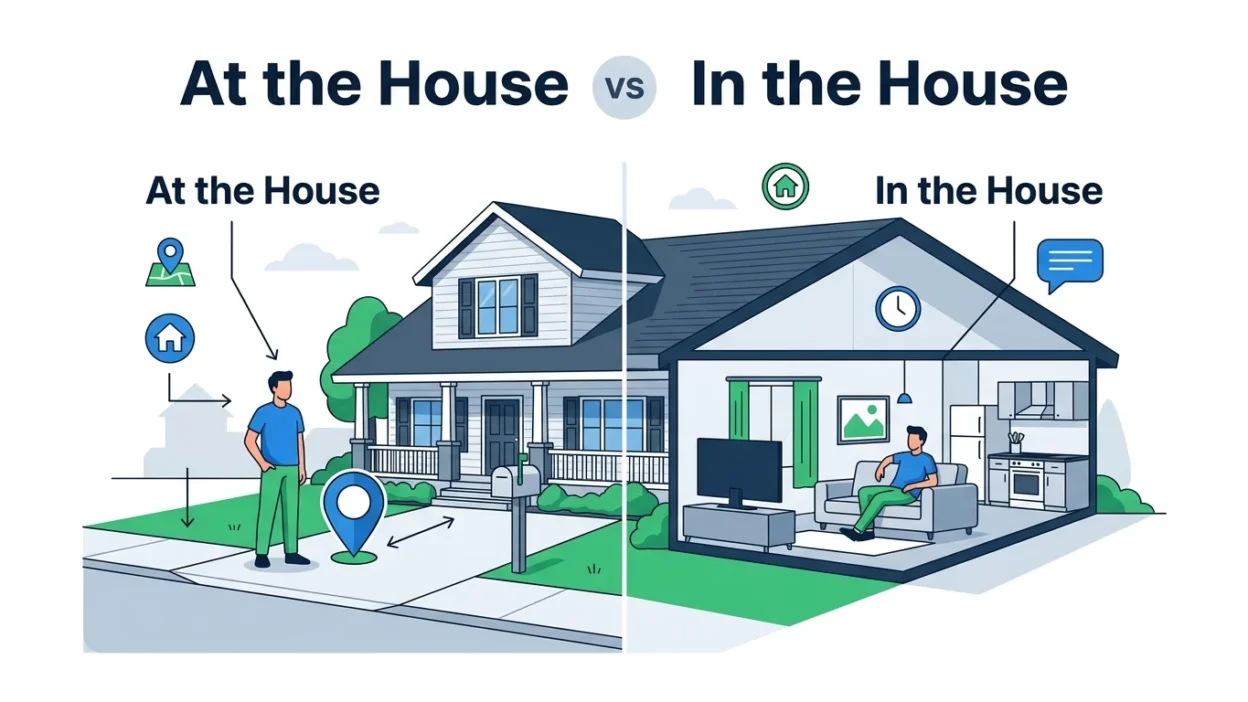
- At the house refers to someone’s location or destination. It means a person is at a particular property or home, without emphasizing whether they are inside or outside.
- In the house specifically means inside the building.
If you’re talking about someone’s location in general, use at the house. If you’re emphasizing that someone or something is inside the home, use in the house.
What Does “At the House” Mean?
At the house means someone is at a particular home or property. It focuses on the location rather than the person’s exact position.
The person may be:
- Inside the house
- In the yard
- On the porch
- In the driveway
- Somewhere on the property
The exact position doesn’t matter. The important point is that they are at that location.
Examples
- I’m at the house waiting for the plumber.
- She’s at the house cleaning before the guests arrive.
- We met at the house before driving to the wedding.
- The delivery driver is at the house now.
- Everyone gathered at the house after the ceremony.
Notice that these sentences focus on the location rather than being inside the building.
What Does “In the House” Mean?
In the house means someone or something is inside the building.
This phrase specifically refers to being within the walls of the house.
Examples
- The children are in the house watching television.
- There’s nobody in the house right now.
- Please don’t smoke in the house.
- The cat is hiding in the house.
- We stayed in the house because it was raining.
Here, the emphasis is clearly on being indoors.
At the House vs In the House: Key Difference
Although both phrases mention a house, they answer different questions.
| Feature | At the House | In the House |
|---|---|---|
| Meaning | At the property or location | Inside the building |
| Focus | General location | Interior of the house |
| Exact position known? | Not necessarily | Yes |
| Common use | Meeting places, visits, arrivals | Activities happening indoors |
| Formal writing | Common | Common |
The biggest difference is simple:
- At the house = location.
- In the house = inside.
When Should You Use “At the House”?
Use at the house whenever you’re talking about someone’s location without specifying whether they are indoors.
Common situations include:
- Arriving somewhere
- Visiting someone
- Waiting outside
- Being on the property
- Meeting at someone’s home
Examples
- I’ll meet you at the house at 6 PM.
- The electrician is already at the house.
- We spent the afternoon at the house preparing for the party.
- Everyone was at the house before sunset.
- She stayed at the house while we went shopping.
When Should You Use “In the House”?
Use in the house when you’re specifically referring to being indoors.
Common situations include:
- Talking about family members
- Describing indoor activities
- Giving instructions
- Discussing safety
- Talking about objects located indoors
Examples
- Everyone stayed in the house during the storm.
- We ate dinner in the house.
- There’s a strange noise in the house.
- Keep your shoes off in the house.
- Nobody was in the house when I arrived.
Understanding the Difference Through Context
Sometimes both expressions can appear in similar conversations, but the meaning changes slightly.
Example 1
“I’m at the house.”
This means:
The speaker is at the property.
They could be inside, outside, or even standing in the driveway.
Example 2
“I’m in the house.”
This means:
The speaker is definitely inside the building.
The focus is on being indoors.
Everyday Situations
Here are some real-life examples.
Visiting Friends
✔ I’m at the house now.
This tells someone you’ve arrived.
During Bad Weather
✔ Stay in the house until the storm passes.
This emphasizes staying indoors.
Waiting for Someone
✔ I’ll wait at the house.
The exact place doesn’t matter.
Looking for Someone
✔ Is anyone in the house?
You’re asking if someone is inside.
Common Mistakes to Avoid
Many English learners confuse these phrases because both refer to a house.
1. Using “In the House” for Arrival
Incorrect:
- I’m in the house waiting outside.
Correct:
- I’m at the house waiting outside.
If you’re outside, don’t use in the house.
2. Using “At the House” for Indoor Activities
Less natural:
- We had dinner at the house.
More natural:
- We had dinner in the house.
Since dinner happened indoors, in the house sounds clearer.
3. Assuming They Mean the Same Thing
Although both are correct, they describe different ideas.
Always think about whether you’re referring to:
- the location (at), or
- the interior (in).
American vs British English
One common question is whether these phrases differ between American and British English.
The answer is reassuring:
Both American English and British English use at the house and in the house in the same way.
There is no major grammatical difference between the two varieties.
However, in everyday conversation, American English sometimes prefers:
- at my place
- at our house
British English may more often use:
- at home
- in the house
Even so, both expressions are perfectly natural in both dialects.
Similar Expressions
Understanding related phrases can also help.
| Expression | Meaning |
|---|---|
| At home | At one’s residence |
| In the home | Inside the home |
| At my place | At my residence |
| Inside the house | Within the building |
| Outside the house | Outside the building |
| Around the house | Near or surrounding the house |
| On the property | Somewhere on the land |
These expressions often appear in everyday conversations alongside at the house and in the house.
Tips to Remember the Difference
A simple memory trick can make this easy.
Think of at as pointing to a location on a map.
Think of in as going inside a box.
Ask yourself:
Am I talking about where someone is?
Use at the house.
Am I talking about being inside?
Use in the house.
This simple question will help you choose the correct phrase almost every time.
FAQs
Is “at the house” grammatically correct?
Yes. It is completely correct and commonly used to describe someone’s location at a particular home or property.
Is “in the house” grammatically correct?
Yes. It means someone or something is physically inside the building.
Can I use them interchangeably?
Not always. At the house focuses on location, while in the house specifically refers to being indoors.
Which phrase is more common?
Both are common. The right choice depends on the context rather than frequency.
Is there a difference in American and British English?
No significant difference exists. Both varieties use these expressions with the same meanings.
Should I say “I’m at the house” or “I’m in the house”?
If you’ve arrived at the property, I’m at the house is appropriate. If you want to emphasize that you’re indoors, say I’m in the house.
Why do native speakers use “at the house”?
Because they are referring to the general location instead of the exact position inside or outside the building.
Summary
Understanding at the house vs in the house is easier once you focus on the meaning rather than the words themselves.
At the house refers to a person’s location at a property and doesn’t specify whether they’re indoors or outdoors.
In the house, on the other hand, clearly indicates that someone or something is inside the building. Both expressions are correct, but they serve different purposes.
If you’re speaking, writing, or learning English, choosing the right phrase helps your communication sound more natural and accurate.
This distinction is the same in both American and British English, making it a useful grammar rule for English learners worldwide.
Actionable Takeaway
The next time you’re deciding between at the house and in the house, ask yourself one simple question: Am I talking about a location or being inside? If it’s about the property’s location, choose at the house. If it’s about being indoors, choose in the house. Keeping this rule in mind will help you speak and write with greater confidence and clarity.