Have you ever wondered whether you should say “have fun” or “enjoy”? These two expressions often appear in similar situations, such as wishing someone a good time or talking about pleasant experiences.
Because they both relate to happiness and positive feelings, many English learners mistakenly think they are interchangeable.
The truth is that have fun and enjoy have different grammatical roles and are used in different ways.
Knowing the difference between have fun vs enjoy will help you sound more natural in conversations, emails, social media posts, and everyday English.
In this guide, you’ll learn what each expression means, how to use it correctly, common mistakes to avoid, and practical examples you can start using today.
Quick Answer
The difference between have fun and enjoy is simple:
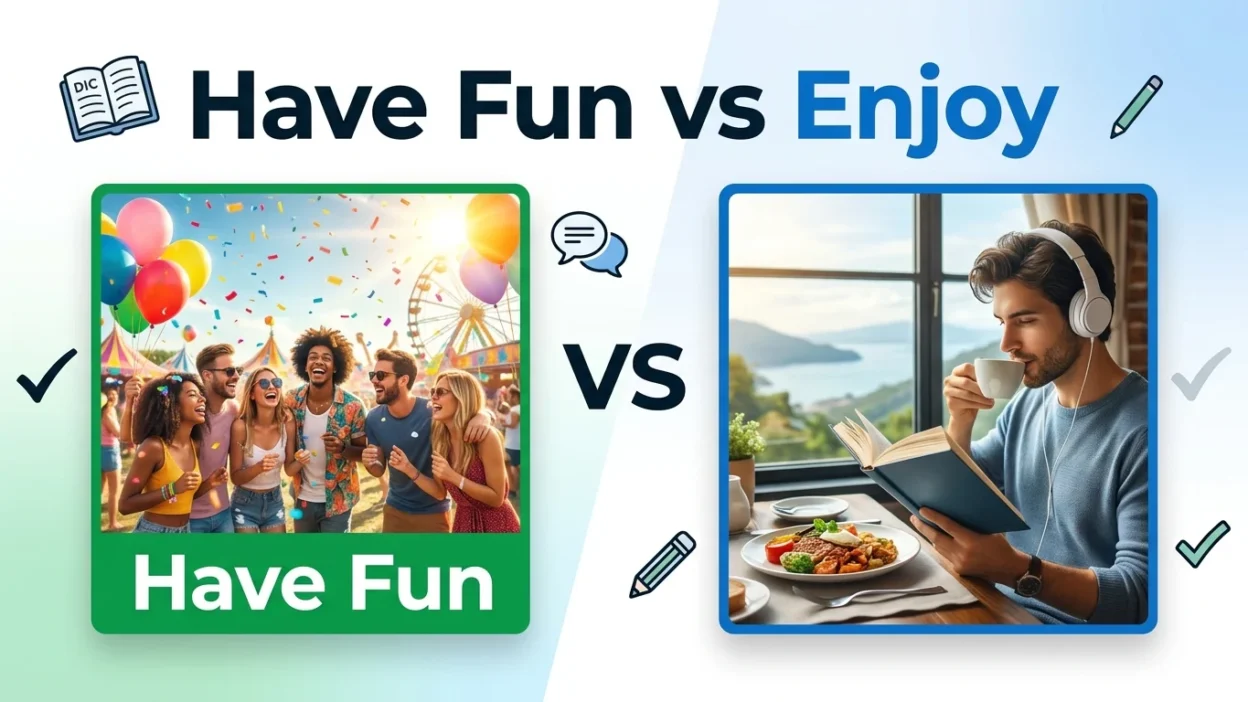
- Have fun means to experience enjoyment or have a good time, often used as a friendly wish or invitation.
- Enjoy means to take pleasure in something, and it is usually followed by a noun, pronoun, or verb ending in -ing.
Examples:
- ✅ Have fun at the party!
- ✅ I enjoy reading books.
- ✅ Enjoy your vacation.
- ❌ Have fun your vacation.
- ❌ Enjoy at the party.
Both expressions are correct, but they are used differently.
What Does “Have Fun” Mean?
Have fun is an expression that means to enjoy yourself, have a good time, or experience pleasure while doing something.
People commonly use it when:
- Saying goodbye
- Wishing someone well
- Encouraging others to enjoy an activity
- Talking about enjoyable experiences
It is informal, friendly, and extremely common in everyday English.
Examples of Have Fun
- Have fun at the concert!
- We had fun at the beach.
- I hope you have fun tonight.
- The children had fun playing outside.
- Have fun on your trip!
Notice that have fun often appears with places, events, or activities.
What Does “Enjoy” Mean?
Enjoy is a verb meaning to take pleasure in, like, or appreciate something.
Unlike have fun, enjoy requires an object. You must enjoy something.
That object may be:
- A noun
- A pronoun
- A verb ending in -ing
Examples of Enjoy
- I enjoy music.
- She enjoys swimming.
- They enjoyed the movie.
- Please enjoy your meal.
- We enjoyed spending time together.
Without an object, enjoy usually sounds incomplete.
Have Fun vs Enjoy: Comparison Table
| Feature | Have Fun | Enjoy |
|---|---|---|
| Meaning | Experience a good time | Take pleasure in something |
| Part of Speech | Expression | Verb |
| Needs an Object | Usually no | Yes |
| Common Usage | Wishes and casual conversation | Everyday speech and writing |
| Formality | Informal | Neutral (works in both formal and informal English) |
| Example | Have fun at school! | Enjoy your class! |
When Should You Use “Have Fun”?
Use have fun when encouraging someone to enjoy an event or activity.
It is common in:
- Friendly conversations
- Text messages
- Invitations
- Farewells
- Family communication
Correct Examples
- Have fun at the wedding!
- We had fun camping.
- The kids had fun in the park.
- Have fun with your friends.
- I hope you have fun on vacation.
The emphasis is on the overall experience.
When Should You Use “Enjoy”?
Use enjoy whenever you’re talking about taking pleasure in a specific thing.
Common objects include:
- Food
- Music
- Sports
- Books
- Vacations
- Movies
- Activities
- Time together
Correct Examples
- Enjoy your dinner.
- I enjoy learning English.
- She enjoys photography.
- They enjoyed the concert.
- Please enjoy the show.
The emphasis is on appreciating something specific.
Key Difference Between Have Fun and Enjoy
Although both relate to happiness, their grammar is different.
Have fun focuses on experiencing enjoyment during an activity.
Enjoy focuses on liking or appreciating something.
Compare these examples:
- Have fun at the party.
- Enjoy the party.
Both are correct.
However:
Have fun wishes someone a pleasant experience.
Enjoy tells someone to appreciate the event itself.
The meanings overlap, but the grammar differs.
Common Situations Where Each Expression Is Used
Use “Have Fun”
- Birthday parties
- Vacations
- School trips
- Family outings
- Holidays
- Concerts
- Festivals
Examples:
- Have fun at Disneyland!
- Have fun skiing.
- Have fun with your cousins.
Use “Enjoy”
- Meals
- Books
- Music
- Movies
- Learning
- Sports
- Work
- Free time
Examples:
- Enjoy your coffee.
- I enjoy painting.
- Enjoy your holiday.
- She enjoys cooking.
Common Mistakes to Avoid
Here are the mistakes English learners make most often.
1. Using Enjoy Without an Object
❌ Enjoy!
Although native speakers sometimes say this as a farewell, grammatically it is understood as short for “Enjoy yourself” or “Enjoy it.”
Better examples include:
- Enjoy your trip.
- Enjoy the concert.
2. Saying “Enjoy To Do”
❌ I enjoy to read.
✅ I enjoy reading.
After enjoy, use a noun or -ing form.
3. Using Have Fun Incorrectly
❌ Have fun your vacation.
✅ Have fun on your vacation.
4. Thinking They’re Always Interchangeable
Sometimes both work.
For example:
- Have fun at the concert.
- Enjoy the concert.
But they are not identical in every sentence.
Easy Memory Trick
Here’s a simple way to remember.
Have Fun = Good Time
Think:
Have fun = Have a good time.
Enjoy = Like Something
Think:
Enjoy + Something
Examples:
- Enjoy the movie.
- Enjoy reading.
- Enjoy your meal.
If you remember this pattern, you’ll rarely make mistakes.
Similar Expressions
English offers several alternatives.
Instead of Have Fun
- Have a great time
- Have a blast
- Enjoy yourself
- Make the most of it
- Have an amazing day
Instead of Enjoy
- Appreciate
- Like
- Love
- Take pleasure in
- Delight in
- Relish
These alternatives make your writing more varied and engaging.
American vs British English
There is almost no difference between American and British English regarding these expressions.
American English
Common:
- Have fun!
- Enjoy your meal.
- Enjoy your vacation.
British English
Also common:
- Have fun!
- Enjoy your holiday.
- Enjoy yourself.
One small vocabulary difference is:
Americans often say:
- Vacation
Britons usually say:
- Holiday
So you may hear:
American:
- Enjoy your vacation.
British:
- Enjoy your holiday.
The grammar remains exactly the same.
Example Sentences
Have Fun
- Have fun at the amusement park!
- We had fun together.
- I hope you have fun this weekend.
- They had fun playing games.
- Have fun with your classmates.
Enjoy
- Enjoy your lunch.
- She enjoys hiking.
- We enjoyed the performance.
- He enjoys reading novels.
- Please enjoy your stay.
FAQs
What is the difference between have fun and enjoy?
Have fun means to experience a good time, while enjoy means to take pleasure in something specific.
Can I say enjoy instead of have fun?
Sometimes, yes.
For example:
- Have fun at the party.
- Enjoy the party.
Both are natural.
Does enjoy need an object?
Yes. Enjoy is normally followed by a noun, pronoun, or verb ending in -ing.
Is have fun formal?
No. It is friendly and informal, though it is widely accepted in everyday English.
Which expression is more common?
Both are very common but used in different situations.
Is there a British and American difference?
Only in vocabulary like holiday versus vacation. The grammar is the same.
Can I say enjoy yourself?
Yes. Enjoy yourself is a complete and natural expression that is very similar to have fun.
Summary
Understanding have fun vs enjoy becomes easy once you recognize their different roles in English.
Have fun is a friendly expression used to wish someone a good time or describe an enjoyable experience, while enjoy is a verb that means taking pleasure in a specific activity, object, or experience.
Although both expressions relate to happiness and enjoyment, they follow different grammatical patterns and are not always interchangeable.
If you’re speaking with friends, writing emails, or learning English, using the correct expression will make your communication sound more natural and fluent.
Remember that have fun emphasizes the overall experience, while enjoy focuses on appreciating something specific. Mastering this small distinction can make a big difference in your confidence and accuracy.
Actionable Takeaway
Before choosing between have fun and enjoy, ask yourself one question: Am I wishing someone a good time or talking about enjoying a specific thing? If it’s about the overall experience, use have fun. If it’s about a meal, activity, book, movie, or another specific object, use enjoy. Practicing this simple rule will help you sound like a more confident English speaker.