
Have you ever typed “payed” in an email or document only to see your spell checker underline it? If so, you’re not alone.
Many English learners—and even native speakers—wonder about the difference between paid vs payed because both words seem like they could be correct.
The truth is that paid and payed are both real English words, but they are not interchangeable.
In almost every everyday situation, paid is the correct choice. However, payed has a very specific meaning used in nautical contexts.
In this guide, you’ll learn when to use each word, avoid common grammar mistakes, and understand why the confusion happens.
Quick Answer
The difference between paid and payed is simple:
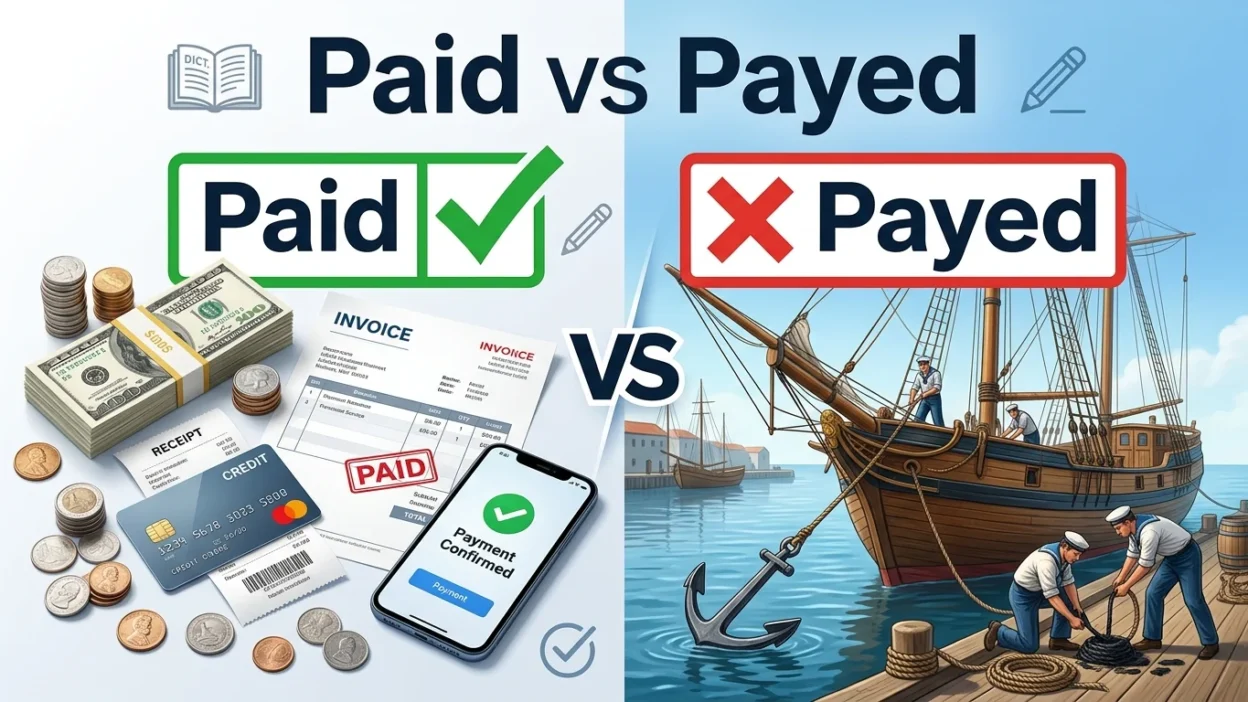
- Paid is the correct past tense and past participle of the verb pay when referring to money, wages, bills, debts, or giving someone what is owed.
- Payed is a rare word used only in nautical contexts, meaning to coat a ship with tar or to let out a rope or cable.
For nearly all everyday writing, paid is the correct spelling.
What Does “Paid” Mean?
Paid is the standard past tense and past participle of the verb pay.
It refers to giving money, settling a debt, receiving wages, or providing something that is owed.
You’ll use paid in business, education, shopping, banking, travel, employment, and daily conversations.
Examples of Paid
- I paid the electricity bill yesterday.
- She paid for lunch.
- They paid their taxes on time.
- The company paid employees every Friday.
- We have paid the membership fee.
These are the situations where almost everyone uses the word.
What Does “Payed” Mean?
Payed is also a legitimate English word, but it has a specialized maritime meaning.
It is used to describe:
- Coating the seams of a wooden ship with tar or pitch to make it waterproof.
- Letting out a rope, cable, or chain in a controlled manner.
Outside of sailing and nautical writing, payed is rarely used.
Examples of Payed
- The sailors payed the deck seams with tar.
- The crew carefully payed out the anchor rope.
- They payed out several meters of cable.
If you’re writing about money, salaries, or bills, payed is incorrect.
Paid vs Payed: Comparison Table
| Feature | Paid | Payed |
|---|---|---|
| Meaning | Gave money or settled a debt | Coated with tar or let out rope |
| Part of Speech | Past tense and past participle of pay | Specialized nautical verb |
| Everyday Usage | Extremely common | Very rare |
| Business Writing | Correct | Incorrect |
| Financial Context | Correct | Incorrect |
| Maritime Context | Incorrect | Correct |
Why Is “Paid” Usually Correct?
The verb pay is an irregular verb.
Instead of adding -ed to form the past tense, English changes it to paid.
Just like:
- Say → Said
- Lay → Laid
- Pay → Paid
Because this pattern is irregular, many people mistakenly assume payed should be the normal past tense.
It isn’t.
When Should You Use “Paid”?
Use paid whenever you’re talking about:
- Money
- Bills
- Salaries
- Purchases
- Fees
- Debts
- Taxes
- Rewards
- Compensation
Correct Examples
- He paid cash.
- I paid the rent.
- She paid her credit card bill.
- We’ve paid all our invoices.
- They paid for the repairs.
These are the kinds of sentences you’ll encounter every day.
When Should You Use “Payed”?
Use payed only if you’re discussing ships, boats, or sailing.
It appears in:
- Maritime history
- Naval manuals
- Sailing guides
- Historical fiction
- Boating instructions
Correct Examples
- The crew payed out the mooring line.
- Workers payed the hull with pitch.
- Sailors payed the rope carefully.
Unless you’re writing about ships or sailing, you almost certainly don’t need this word.
Common Mistakes to Avoid
Here are the errors writers make most often.
1. Writing “Payed” Instead of “Paid”
❌ I payed the bill.
✅ I paid the bill.
2. Assuming Every Verb Ends in “-ed”
English contains many irregular verbs.
Examples:
- Go → Went
- Buy → Bought
- Pay → Paid
Not every verb simply adds -ed.
3. Ignoring Spell Check Warnings
Most spell checkers flag payed because it’s rare.
Don’t automatically ignore the warning.
Instead, ask yourself:
“Am I talking about money or a ship?”
4. Using Payed in Business Writing
Professional writing should always use paid when referring to financial transactions.
Easy Memory Trick
Here’s an easy way to remember.
Paid = Payment
Both words contain “Pai”.
Think:
Paid = Payment
If money is involved, use paid.
Payed = Pirate
Imagine an old pirate ship.
If ropes, anchors, or ships are involved, payed may be correct.
Otherwise, choose paid.
American vs British English
There is no significant difference between American and British English regarding paid vs payed.
American English
Americans use paid for financial situations and payed only in specialized nautical writing.
British English
British English follows exactly the same rule.
In both varieties of English:
- ✅ Paid the bill
- ✅ Paid the rent
- ✅ Paid the employee
The spelling payed remains limited to maritime usage.
Related Words and Synonyms
Synonyms for Paid
- Compensated
- Settled
- Remitted
- Reimbursed
- Rewarded
- Purchased
- Cleared
- Disbursed
Related Financial Terms
- Payment
- Salary
- Wage
- Invoice
- Bill
- Fee
- Debt
- Expense
- Compensation
- Earnings
These related terms often appear alongside paid in business and financial writing.
Example Sentences
Paid Examples
- I paid for the groceries.
- She paid her tuition.
- They paid the contractor.
- We have paid the invoice.
- He paid in cash.
Payed Examples
- The sailors payed out the rope.
- They payed the ship’s seams.
- The captain ordered the cable to be payed slowly.
Why Do People Confuse Paid and Payed?
The confusion usually happens because English learners expect every regular-looking verb to form its past tense by adding -ed.
For example:
- Walk → Walked
- Jump → Jumped
- Open → Opened
So naturally, many assume:
Pay → Payed
However, pay is irregular, making paid the standard form for financial contexts.
Learning common irregular verbs helps eliminate this mistake.
FAQs
Which is correct: paid or payed?
For almost all situations involving money, paid is correct. Payed is reserved for specialized nautical meanings.
Is payed a real English word?
Yes. Payed is a legitimate word, but it is rarely used outside maritime language.
Why is paid spelled differently?
Because pay is an irregular verb. Its past tense and past participle are paid, not payed.
Can I write “I payed for dinner”?
No. The correct sentence is:
“I paid for dinner.”
Do British people use payed?
Only in nautical contexts. Otherwise, British English uses paid, just like American English.
What does payed out mean?
In sailing, payed out means gradually releasing a rope, cable, or chain.
Why does spell check correct payed?
Because paid is correct in almost every everyday situation, while payed is extremely uncommon.
Summary
Understanding paid vs payed is easier than it first appears. Paid is the standard past tense and past participle of pay and should be used whenever you’re talking about money, salaries, bills, purchases, or debts.
Payed, while technically correct, has a specialized meaning related to ships, ropes, and maritime activities, making it extremely rare in everyday English.
If you’re writing emails, reports, school assignments, blog posts, or business documents, you’ll almost always need paid.
Keeping this distinction in mind will help you avoid a common spelling mistake and make your writing clearer, more accurate, and more professional.
Actionable Takeaway
Whenever you’re unsure which spelling to use, ask yourself one simple question: Am I talking about money or a ship? If money is involved, choose paid. Reserve payed only for nautical topics such as ships, ropes, or maritime history. This quick check will help you use the correct word every time.