Have you ever written “interested on” and wondered if it sounded right? You’re not alone.
Choosing the correct preposition after interested is one of the most common grammar challenges for English learners because many languages use different prepositions for similar expressions.
The good news is that the rule is simple once you know it. In almost every situation, interested in is the correct expression, while interested on is generally incorrect in standard English.
This guide explains the difference between interested in vs interested on, provides clear examples, highlights common mistakes, and helps you use the right phrase with confidence.
Quick Answer
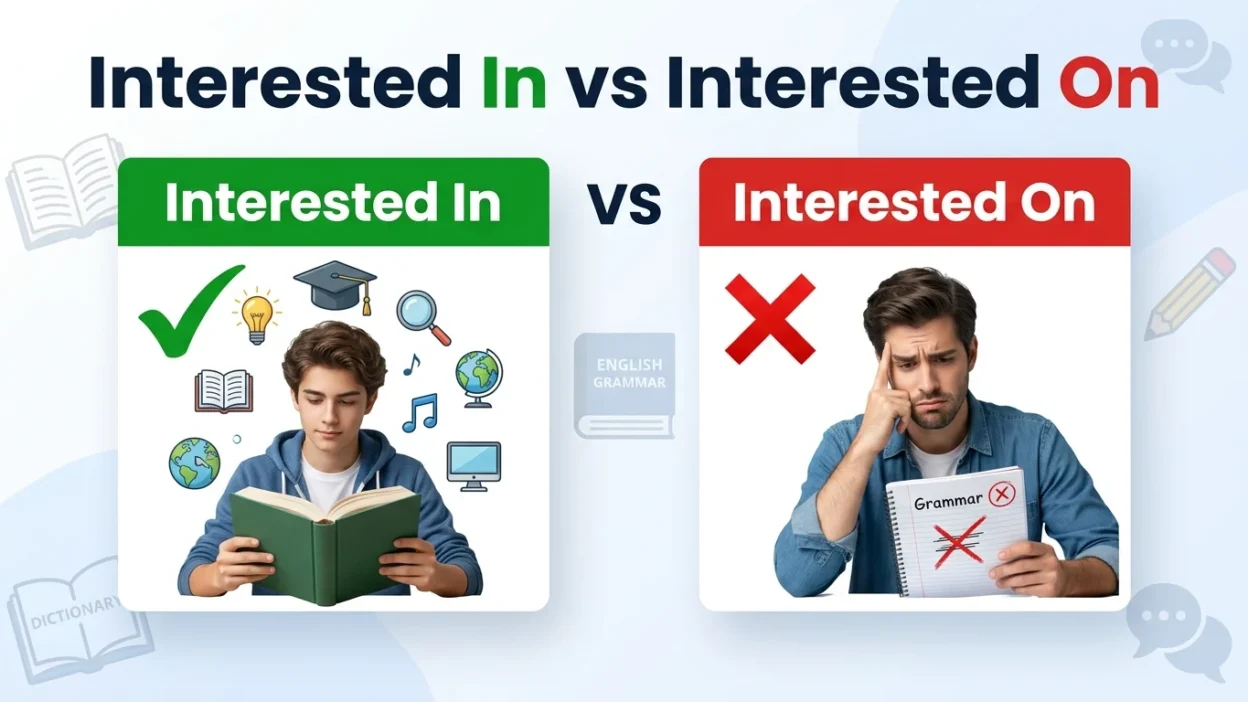
The correct phrase is interested in.
- ✅ Interested in is the standard and grammatically correct expression when talking about hobbies, subjects, activities, people, or ideas.
- ❌ Interested on is generally incorrect in English and should be avoided.
Correct: I’m interested in photography.
Incorrect: I’m interested on photography.
If you’re talking about something that catches your attention or curiosity, always use interested in.
What Does “Interested In” Mean?
Interested in means having curiosity, enthusiasm, or a desire to learn more about someone or something.
It is the standard expression used in both spoken and written English.
You can be interested in:
- A subject
- A hobby
- A person
- A job
- A course
- A book
- A business opportunity
- A sport
- A language
Examples of Interested In
- I’m interested in learning Spanish.
- She’s interested in art history.
- They are interested in buying a house.
- He has always been interested in science.
- We’re interested in your proposal.
In every example, in introduces the thing that attracts interest.
What Does “Interested On” Mean?
In standard English, interested on is not considered grammatically correct.
It usually appears because learners translate directly from another language or confuse it with expressions such as:
- Focus on
- Work on
- Depend on
- Concentrate on
However, interested does not pair with on.
Incorrect Examples
- ❌ I’m interested on football.
- ❌ She’s interested on your idea.
- ❌ They’re interested on the project.
- ❌ He is interested on technology.
Each of these sentences should use in instead.
Interested In vs Interested On: Comparison Table
| Feature | Interested In | Interested On |
|---|---|---|
| Grammar | Correct | Incorrect in standard English |
| Everyday Usage | Very common | Rare and considered an error |
| Formal Writing | Correct | Incorrect |
| Spoken English | Correct | Non-standard |
| Academic Writing | Correct | Incorrect |
| Business English | Correct | Incorrect |
Why Is “Interested In” Correct?
The adjective interested naturally collocates with the preposition in.
In English, certain adjectives are always followed by specific prepositions.
Examples include:
- Good at
- Afraid of
- Famous for
- Responsible for
- Interested in
These combinations are fixed expressions that native speakers use automatically.
Because of this grammatical pattern, interested in is the only correct choice in standard English.
When Should You Use “Interested In”?
Use interested in whenever you’re expressing curiosity, attraction, enthusiasm, or willingness to know more.
Common Situations
- Hobbies
- Careers
- School subjects
- Sports
- Books
- Movies
- Business opportunities
- Investments
- Relationships
- Skills
Correct Examples
- She is interested in music.
- I’m interested in your opinion.
- They’re interested in investing.
- He’s interested in computer programming.
- We are interested in joining the club.
Is “Interested On” Ever Correct?
In modern standard English, interested on is almost never correct.
However, you may occasionally encounter it:
- In translations
- In learner English
- In non-native writing
- In outdated or non-standard usage
Professional writers, teachers, dictionaries, and grammar guides overwhelmingly recommend interested in.
Common Mistakes to Avoid
Many learners make similar errors with this expression.
1. Using On Instead of In
❌ I’m interested on history.
✅ I’m interested in history.
2. Translating Directly from Your Native Language
Some languages use prepositions equivalent to on, leading learners to write:
❌ Interested on mathematics.
Instead, English requires:
✅ Interested in mathematics.
3. Mixing Common Prepositions
People sometimes confuse:
- Interested in
- Focus on
- Depend on
- Work on
- Keen on
Each adjective or verb has its own correct preposition.
4. Forgetting Fixed Expressions
Remember that English contains many adjective-preposition combinations that simply need to be memorized.
Easy Memory Trick
Here’s a simple trick.
Think:
Interest goes IN your mind.
So:
Interested IN
Another helpful reminder:
You can be:
- Interested in science.
- Interested in music.
- Interested in people.
You’ll never need interested on in normal English.
Interested In vs Other Similar Expressions
Many learners also confuse interested in with similar phrases.
Interested In
Means having curiosity.
Example:
- I’m interested in photography.
Keen On
Means enjoying something.
Example:
- She’s keen on tennis.
Focus On
Means paying attention to something.
Example:
- We need to focus on quality.
Work On
Means improving or developing something.
Example:
- He’s working on a new project.
Notice that only keen, focus, and work naturally use on.
American vs British English
There is no difference between American and British English regarding this expression.
American English
Correct:
- Interested in sports.
Incorrect:
- Interested on sports.
British English
Exactly the same rule applies.
British English also uses:
- Interested in history.
- Interested in politics.
- Interested in gardening.
Whether you’re writing for American or British readers, interested in is always the correct choice.
Related Words and Synonyms
Depending on context, you can replace interested with:
- Curious about
- Fascinated by
- Enthusiastic about
- Passionate about
- Engaged in
- Attracted to
- Drawn to
- Intrigued by
These alternatives make writing more varied and natural.
Example Sentences
Correct Examples
- I’m interested in photography.
- She’s interested in learning French.
- They’re interested in joining our team.
- He’s interested in artificial intelligence.
- We are interested in your services.
Incorrect Examples
- ❌ Interested on photography.
- ❌ Interested on science.
- ❌ Interested on your proposal.
- ❌ Interested on cooking.
- ❌ Interested on technology.
Why Do English Learners Make This Mistake?
There are several reasons.
Many languages use different prepositions after adjectives, so learners naturally transfer those patterns into English.
Others confuse interested in with expressions like:
- Based on
- Working on
- Concentrating on
- Depending on
The best solution is to learn adjective-preposition combinations as complete phrases rather than individual words.
FAQs
Which is correct: interested in or interested on?
Interested in is correct. Interested on is generally considered incorrect in standard English.
Why do we say interested in?
Because interested is an adjective that naturally pairs with the preposition in according to standard English grammar.
Is interested on ever acceptable?
Only in rare cases of non-standard or translated English. Professional writing should always use interested in.
Is interested in formal or informal?
It works in both formal and informal English, making it suitable for conversations, emails, academic writing, and business communication.
What preposition follows interested?
The correct preposition is in.
Is there a British and American difference?
No. Both American and British English use interested in.
What are similar expressions?
Common alternatives include:
- Curious about
- Fascinated by
- Keen on
- Passionate about
- Enthusiastic about
Summary
Understanding interested in vs interested on is straightforward once you know the standard grammar rule.
Interested in is the correct expression for showing curiosity, enthusiasm, or attraction toward a person, subject, activity, or idea. It is accepted in both spoken and written English across formal and informal contexts.
In contrast, interested on is generally considered incorrect and usually results from direct translation or confusion with other English expressions.
If you’re writing an email, preparing for an English exam, or improving your everyday communication, using interested in will make your language sound more natural and accurate.
Learning common adjective-preposition combinations like this one is an excellent way to build fluency and avoid frequent grammar mistakes.
Actionable Takeaway
Whenever you use the adjective interested, automatically pair it with in. Remember the simple rule: interested in a subject, interested in a hobby, interested in a person, interested in an opportunity. Practicing this fixed expression regularly will help you speak and write English with greater confidence.