Have you ever finished an email, text message, or invitation and wondered whether “looking forward to seeing you” was the right phrase to use? If so, you’re not alone.
This expression is one of the most common and friendly ways to show excitement about meeting someone in the future, whether in a personal or professional setting.
Because it’s used so frequently, many English learners and native speakers alike have questions about its meaning, grammar, and proper usage.
In this guide, you’ll learn exactly what looking forward to seeing you means, when to use it, common mistakes to avoid, examples for different situations, and alternative phrases that sound natural and professional.
Quick Answer
Looking forward to seeing you is a polite and friendly expression used to show that you are happy, excited, or eager about meeting someone in the future.
Example
- I’m looking forward to seeing you next week.
- We’re looking forward to seeing you at the event.
- Looking forward to seeing you soon!
The phrase is appropriate for emails, text messages, invitations, business communication, and personal conversations.
What Does “Looking Forward to Seeing You” Mean?
The phrase looking forward to seeing you means:
- Anticipating a future meeting with pleasure
- Feeling excited about meeting someone
- Expressing positive expectations
- Showing friendliness and enthusiasm
When you say it, you’re letting the other person know that you’re happy about the upcoming interaction.
Simple Meaning
In everyday English:
Looking forward to seeing you = I’m excited to meet you soon.
The expression creates a warm and positive tone.
Breaking Down the Phrase
Understanding the grammar helps explain why the phrase works.
Looking Forward To
The expression look forward to means:
- To anticipate something positively
- To eagerly await something
Examples:
- I look forward to hearing from you.
- We look forward to your response.
- She looks forward to her vacation.
Seeing You
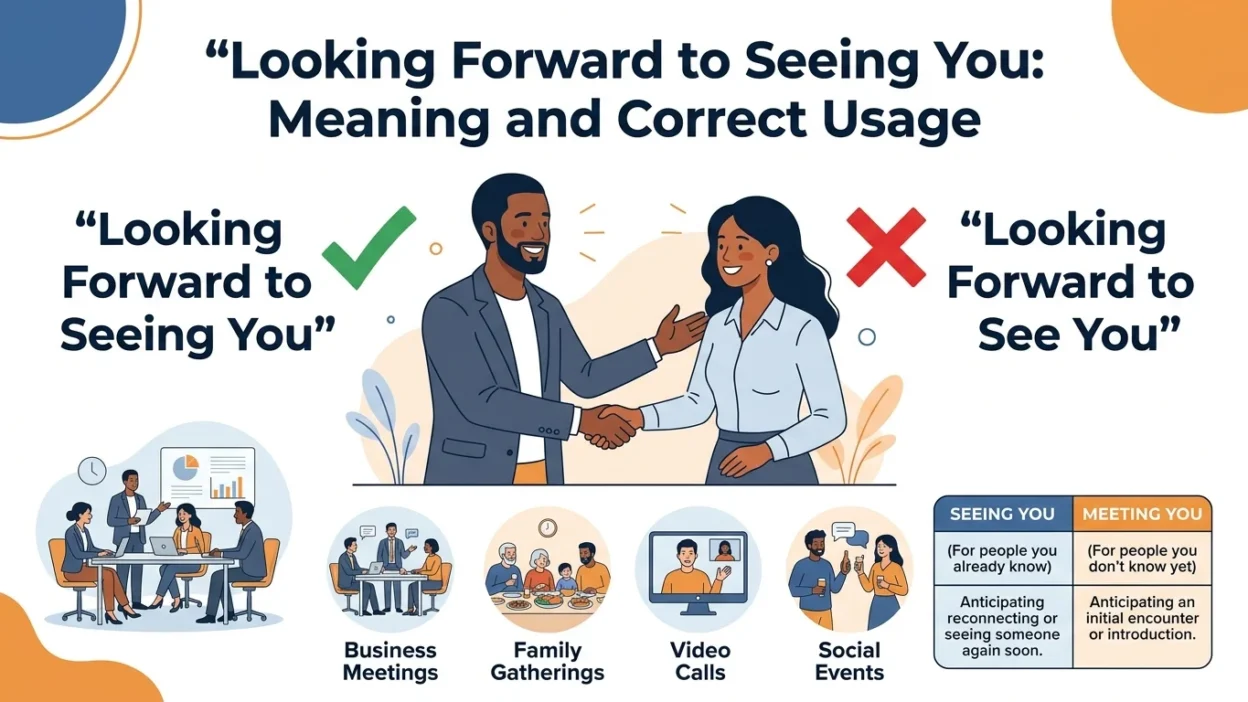
After look forward to, English grammar requires a noun or a gerund (verb ending in -ing).
Correct:
- Looking forward to seeing you.
- Looking forward to meeting you.
- Looking forward to hearing from you.
Incorrect:
- Looking forward to see you.
- Looking forward to meet you.
This is one of the most common grammar mistakes.
When to Use “Looking Forward to Seeing You”
This phrase works in many situations.
Personal Conversations
Examples:
- Looking forward to seeing you this weekend.
- I’m looking forward to seeing you at the family gathering.
- Looking forward to seeing you soon.
Business Communication
Examples:
- We are looking forward to seeing you at the conference.
- Looking forward to seeing you at tomorrow’s meeting.
- I am looking forward to seeing you in person.
Invitations
Examples:
- Looking forward to seeing you at the wedding.
- Looking forward to seeing you at our celebration.
- We’re looking forward to seeing you at the event.
The phrase sounds warm without being overly emotional.
Examples of Looking Forward to Seeing You
Here are practical examples in different contexts.
Friendly Examples
- Looking forward to seeing you this Friday.
- I’m really looking forward to seeing you again.
- We can’t wait and are looking forward to seeing you.
Professional Examples
- Thank you for your time. Looking forward to seeing you next week.
- Looking forward to seeing you at the conference.
- Our team is looking forward to seeing you at the presentation.
Family Examples
- Grandma is looking forward to seeing you.
- We’re all looking forward to seeing you during the holidays.
Event Examples
- Looking forward to seeing you at the reunion.
- We’re looking forward to seeing everyone at the party.
Why This Phrase Is So Popular
The expression remains popular because it is:
- Polite
- Professional
- Friendly
- Versatile
- Easy to understand
Unlike overly formal expressions, it sounds natural in most situations.
It also helps strengthen relationships by expressing enthusiasm and appreciation.
Looking Forward to Seeing You vs Looking Forward to Meeting You
Many people confuse these phrases.
Comparison Table
| Phrase | Meaning | Best Use |
|---|---|---|
| Looking forward to seeing you | Meeting someone again or seeing them soon | Existing relationship |
| Looking forward to meeting you | Meeting someone for the first time | New relationship |
Examples
Correct:
- Looking forward to meeting you tomorrow. (First meeting)
- Looking forward to seeing you tomorrow. (Already know the person)
While the phrases are similar, the distinction can be important.
Looking Forward to Seeing You vs Can’t Wait to See You
Both expressions communicate excitement.
Comparison
| Expression | Tone |
|---|---|
| Looking forward to seeing you | Professional and friendly |
| Can’t wait to see you | More enthusiastic and informal |
Examples
Professional:
- Looking forward to seeing you next week.
Informal:
- Can’t wait to see you next week!
Choose the expression that matches the relationship and situation.
Common Mistakes to Avoid
Mistake 1: Using “See” Instead of “Seeing”
Incorrect:
- Looking forward to see you.
Correct:
- Looking forward to seeing you.
Remember that to belongs to the phrasal expression look forward to, not the infinitive verb.
Mistake 2: Using It for First Meetings
Incorrect:
- Looking forward to seeing you tomorrow. (When you’ve never met)
Better:
- Looking forward to meeting you tomorrow.
Mistake 3: Overusing the Phrase
While the expression is useful, repeating it in every email can sound repetitive.
Mix it with alternatives occasionally.
Alternative Ways to Say Looking Forward to Seeing You
Variety can make your communication more engaging.
Professional Alternatives
- I look forward to our meeting.
- I’m eager to meet with you.
- I look forward to connecting soon.
- I look forward to speaking with you.
Friendly Alternatives
- Can’t wait to see you.
- Excited to see you.
- See you soon.
- Looking forward to catching up.
Formal Alternatives
- We anticipate your visit.
- We look forward to welcoming you.
- We await your arrival.
Each option carries a slightly different tone.
Looking Forward to Seeing You in Emails
This phrase is especially common in email communication.
Example Closing
Dear Sarah,
Thank you for confirming the meeting.
Looking forward to seeing you next Tuesday.
Best regards,
John
This type of closing sounds polite, professional, and approachable.
Looking Forward to Seeing You in Text Messages
The phrase also works well in casual communication.
Examples:
- Looking forward to seeing you tonight!
- Looking forward to seeing you this weekend.
- Really looking forward to seeing you again.
Adding an exclamation point can make it feel warmer and more enthusiastic.
Emotional Impact of the Phrase
One reason this expression remains popular is its positive emotional effect.
When someone hears:
“Looking forward to seeing you”
they often feel:
- Appreciated
- Welcomed
- Valued
- Anticipated
Small expressions of positivity can strengthen personal and professional relationships.
American vs British English
There is virtually no difference between American and British English regarding this phrase.
American English
- Looking forward to seeing you.
British English
- Looking forward to seeing you.
Both varieties use the expression frequently in spoken and written communication.
The grammar, spelling, and meaning remain the same.
FAQs
Is looking forward to seeing you grammatically correct?
Yes. It is completely correct and widely used.
Why is it “seeing” and not “see”?
Because look forward to is followed by a noun or gerund, making seeing the correct form.
Can I use looking forward to seeing you in professional emails?
Yes. It is one of the most common professional email closings.
Is looking forward to seeing you formal?
It is generally considered polite and semi-formal, making it suitable for both professional and personal communication.
What is the difference between seeing and meeting?
Use seeing for someone you already know and meeting for someone you’re meeting for the first time.
Can I say looking forward to seeing you soon?
Absolutely. This is a very common and natural expression.
Is can’t wait to see you more informal?
Yes. It sounds more enthusiastic and casual.
Do Americans and British people use this phrase differently?
No. The phrase is commonly used in both American and British English.
Summary
The phrase looking forward to seeing you is a warm, polite, and versatile way to express excitement about an upcoming meeting.
If you’re writing a professional email, sending a text message, inviting someone to an event, or reconnecting with a friend, the expression communicates positive anticipation and friendliness.
Understanding the grammar behind the phrase is equally important. Because look forward to is followed by a gerund, the correct form is always looking forward to seeing you, not looking forward to see you.
Using it correctly can make your communication sound more natural, confident, and professional.
Actionable Takeaway
Whenever you want to express excitement about an upcoming meeting, remember this simple formula:
Looking forward to + verb-ing
Examples:
- Looking forward to seeing you.
- Looking forward to meeting you.
- Looking forward to hearing from you.
This simple grammar pattern will help you communicate clearly and professionally in emails, messages, invitations, and everyday conversations.