If you’re learning English, teaching grammar, preparing for a spelling bee, or simply looking to expand your vocabulary, discovering verbs that start with B is a great place to begin.
Verbs are the heart of every sentence because they express actions, occurrences, or states of being. Learning them alphabetically makes it easier to remember new words and use them naturally in everyday communication.
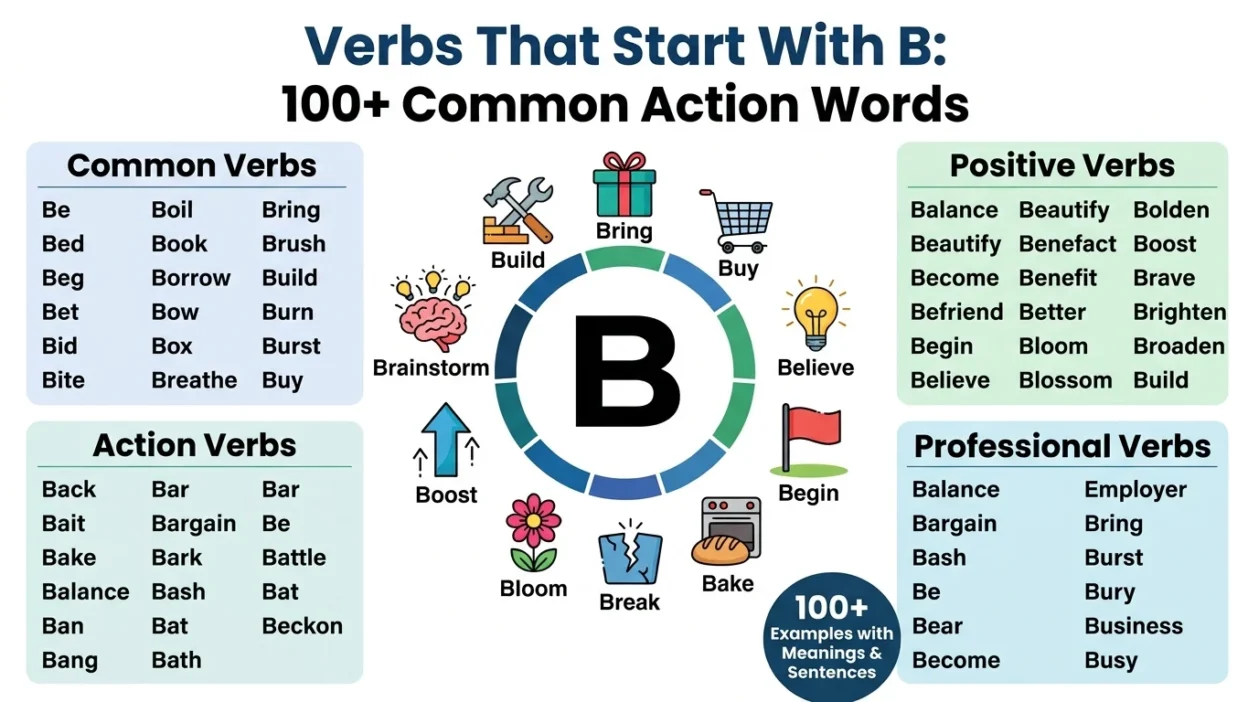
From simple verbs like bring, build, and buy to more advanced ones such as broaden, balance, and brainstorm, the letter B offers a wide variety of useful action words.
In this guide, you’ll explore common and advanced B verbs, their meanings, practical examples, grammar tips, and common mistakes.
If you’re a student, writer, teacher, or English learner, this article will help you use these verbs with confidence.
Quick Answer
Verbs that start with B are action or state-of-being words that begin with the letter B.
Some of the most common examples include:
- Bake
- Balance
- Bathe
- Beat
- Become
- Begin
- Believe
- Bend
- Bite
- Blow
- Borrow
- Break
- Bring
- Build
- Buy
These verbs are used in everyday conversations, academic writing, business communication, and creative storytelling.
What Is a Verb?
A verb is a word that describes an action, an event, or a state of being. Without verbs, sentences would have no action or meaning.
Examples
- She bought a new laptop.
- They built a beautiful house.
- We believe in hard work.
- The flowers bloom every spring.
In each sentence, the highlighted word tells us what the subject is doing or experiencing.
Common Verbs That Start With B
Here are some of the most frequently used verbs beginning with the letter B.
| Verb | Meaning |
|---|---|
| Bake | To cook food using dry heat |
| Balance | To keep steady or stable |
| Bathe | To wash oneself or someone |
| Be | To exist |
| Bear | To carry or tolerate |
| Beat | To strike repeatedly or win |
| Become | To begin to be |
| Begin | To start |
| Behave | To act appropriately |
| Believe | To accept as true |
| Belong | To be owned by or fit in |
| Bend | To curve or make crooked |
| Bet | To wager |
| Bite | To cut with the teeth |
| Bleed | To lose blood |
| Bless | To ask for divine favor |
| Blink | To close and open the eyes quickly |
| Bloom | To produce flowers or flourish |
| Blow | To move air or wind |
| Boil | To heat a liquid until it bubbles |
| Borrow | To take something temporarily |
| Bounce | To spring back after hitting a surface |
| Bow | To bend forward as a sign of respect |
| Break | To separate into pieces |
| Breathe | To inhale and exhale air |
| Breed | To produce offspring |
| Bring | To carry something toward someone |
| Broadcast | To transmit information |
| Brush | To clean or smooth with a brush |
| Build | To construct |
| Burn | To be on fire or cause to burn |
| Burst | To break open suddenly |
| Buy | To purchase |
These verbs are among the most useful in everyday English.
100+ Verbs That Start With B
Expanding your vocabulary becomes easier when words are grouped by category.
Everyday B Verbs
- Bake
- Balance
- Bathe
- Beat
- Become
- Begin
- Behave
- Believe
- Belong
- Bend
- Bet
- Bite
- Blink
- Blow
- Boil
- Borrow
- Bounce
- Bow
- Break
- Bring
School and Work Verbs
- Brainstorm
- Brief
- Build
- Budget
- Book
- Broadcast
- Balance
- Back up
- Benchmark
- Budgetize
Creative and Professional Verbs
- Beautify
- Broaden
- Brand
- Blend
- Brighten
- Boost
- Broadcast
- Brainstorm
- Build
- Benefit
Advanced B Verbs
- Bolster
- Bypass
- Befriend
- Bewilder
- Banish
- Bestow
- Balance
- Bind
- Branch
- Buffer
Learning these words can strengthen both your spoken and written English.
Examples of Verbs That Start With B in Sentences
Seeing verbs used in context helps you remember them more effectively.
Bake
- My grandmother loves to bake fresh bread every weekend.
Begin
- Let’s begin the meeting on time.
Believe
- I believe honesty is the foundation of trust.
Build
- Engineers build bridges that connect communities.
Bring
- Please bring your notebook to class tomorrow.
Break
- Be careful not to break the glass.
Buy
- We bought groceries on the way home.
Bloom
- The roses bloom beautifully in early summer.
Boost
- Regular exercise can boost your energy levels.
Brainstorm
- Our team will brainstorm new marketing ideas this afternoon.
These examples demonstrate how versatile B verbs are across different situations.
Verbs That Start With B by Category
Grouping verbs into themes makes learning easier and more memorable.
Communication Verbs
These verbs help express ideas and interact with others.
- Broadcast
- Brief
- Beg
- Boast
- Blame
- Bargain
- Bless
Example:
- The manager briefed the team before the meeting.
Movement Verbs
These describe physical actions.
- Bounce
- Bend
- Bow
- Bring
- Break
- Bolt
- Bounce
Example:
- The children bounced happily on the trampoline.
Thinking and Learning Verbs
These involve the mind and decision-making.
- Believe
- Brainstorm
- Balance
- Broaden
- Benchmark
Example:
- We need to brainstorm creative solutions before making a decision.
Creative Verbs
Perfect for writing, design, and artistic expression.
- Build
- Blend
- Beautify
- Brand
- Brighten
Example:
- The designer beautified the website with modern graphics.
Powerful Action Verbs That Start With B
Strong action verbs make your writing more engaging and persuasive.
Some excellent choices include:
- Build
- Boost
- Bolster
- Broaden
- Brainstorm
- Breakthrough
- Balance
- Benefit
- Bind
- Broadcast
These verbs are especially valuable in resumes, business reports, presentations, and persuasive writing.
For example:
Weak sentence:
- She helped improve sales.
Stronger sentence:
- She boosted sales through innovative marketing strategies.
Choosing precise action verbs helps your writing sound more professional and impactful.
Positive Verbs That Start With B
Positive verbs can make your communication more encouraging, motivational, and engaging. They’re useful in everyday conversations, leadership, teaching, and professional writing.
Here are some uplifting verbs that start with B:
- Benefit
- Believe
- Bless
- Bloom
- Boost
- Brighten
- Beautify
- Build
- Befriend
- Balance
Example Sentences
- Kind words can brighten someone’s day.
- Good habits build confidence over time.
- Volunteers benefit the community through their service.
- Parents should believe in their children’s abilities.
- Flowers bloom beautifully in spring.
These verbs often create a positive and inspiring tone.
Common Mistakes When Using Verbs That Start With B
Learning new verbs is exciting, but it’s also important to use them correctly. Here are some mistakes to avoid.
Mistake 1: Confusing Similar Verb Forms
Many learners confuse the present and past forms.
Incorrect:
- Yesterday, I begin my homework.
Correct:
- Yesterday, I began my homework.
Another example:
Incorrect:
- I have broke the vase.
Correct:
- I have broken the vase.
Remember:
- Begin → Began → Begun
- Break → Broke → Broken
Learning irregular verb forms is essential for accurate English.
Mistake 2: Using the Wrong Verb
Some B verbs have similar meanings but different uses.
For example:
Borrow means to take something temporarily.
- I borrowed a book from the library.
Bring means to carry something toward someone.
- Please bring your ID to the meeting.
Choosing the correct verb makes your message clearer.
Mistake 3: Overusing Simple Verbs
Instead of using the same verb repeatedly, vary your vocabulary.
Instead of:
- The company made improvements.
You could write:
- The company boosted efficiency.
- The company broadened its services.
- The company built stronger customer relationships.
Specific verbs make your writing more interesting and professional.
Comparison Table: Common B Verbs
Some verbs beginning with B are frequently confused. This table highlights the differences.
| Verb | Meaning | Example |
|---|---|---|
| Bring | Carry something toward someone | Please bring your passport. |
| Borrow | Take temporarily | I borrowed her pen. |
| Buy | Purchase something | She bought a new phone. |
| Build | Construct or create | They built a new school. |
| Begin | Start something | Let’s begin the lesson. |
| Believe | Accept as true | I believe your story. |
| Break | Separate into pieces | Don’t break the glass. |
| Balance | Keep steady | She balanced the tray carefully. |
Understanding these differences will help you choose the right verb every time.
Why Learning B Verbs Improves Your Writing
Expanding your vocabulary isn’t just about memorizing words. It’s about expressing yourself more clearly and effectively.
Using a variety of verbs that start with B can help you:
- Write more naturally
- Avoid repetition
- Improve storytelling
- Strengthen essays and reports
- Create more engaging conversations
For example:
Instead of:
- The business did well.
Try:
- The business boomed last year.
Instead of:
- She helped her team.
Try:
- She boosted her team’s confidence.
These small changes make a noticeable difference in writing quality.
Verbs That Start With B for Students
Students often learn vocabulary alphabetically because it’s easier to organize and remember.
Here are some beginner-friendly B verbs:
- Be
- Bake
- Bathe
- Begin
- Believe
- Bend
- Bite
- Blow
- Bounce
- Bring
- Build
- Buy
Teachers can encourage students to practice these verbs by writing simple sentences such as:
- Birds build nests.
- I buy fruit every Sunday.
- We begin school at 8 a.m.
Regular practice helps these verbs become part of everyday vocabulary.
Verbs That Start With B for Resume Writing
Strong action verbs make resumes more persuasive and professional.
Consider using these verbs to describe your accomplishments:
- Built
- Boosted
- Balanced
- Budgeted
- Brainstormed
- Briefed
- Branded
- Benefited
- Bolstered
- Broadcast
Resume Examples
- Built a customer support team from the ground up.
- Boosted sales by 30% in one year.
- Balanced multiple projects while meeting deadlines.
- Brainstormed innovative marketing strategies.
- Briefed senior management on project progress.
These verbs clearly communicate achievements and leadership.
American vs British English
Most verbs that start with B have the same spelling and meaning in both American and British English.
Examples include:
- Build
- Bring
- Buy
- Believe
- Balance
- Borrow
- Begin
- Break
However, some related words or spellings may differ.
Example
American English:
- Breathalyze
British English:
- Breathalyse
Another example involves pronunciation rather than spelling:
- Basil (though not a verb) is pronounced differently in American and British English, reminding learners that pronunciation can vary even when spelling remains the same.
Overall, the verbs themselves are used similarly across both varieties of English, making them easy to apply regardless of your audience.
FAQs
What are verbs that start with B?
Verbs that start with B are action or state-of-being words beginning with the letter B, such as begin, build, bring, buy, and believe.
What is the most common verb that starts with B?
Some of the most frequently used B verbs include:
- Be
- Begin
- Bring
- Build
- Buy
- Break
- Believe
- Become
These words appear regularly in both spoken and written English.
Why should I learn verbs alphabetically?
Learning verbs alphabetically helps you:
- Expand your vocabulary systematically
- Improve memory retention
- Strengthen reading and writing skills
- Prepare for spelling tests and language exams
- Build confidence in English communication
What are some positive verbs that start with B?
Here are a few positive examples:
- Believe
- Benefit
- Bless
- Bloom
- Boost
- Brighten
- Beautify
- Befriend
- Build
- Balance
These verbs are useful in motivational writing, speeches, and everyday conversations.
What are some strong action verbs that start with B?
Powerful action verbs include:
- Build
- Boost
- Bolster
- Brainstorm
- Broaden
- Break
- Broadcast
- Balance
- Bind
- Benefit
These words can make your writing more engaging and impactful.
Are verbs that start with B useful in professional writing?
Absolutely. Business professionals frequently use verbs such as:
- Built
- Boosted
- Budgeted
- Balanced
- Brainstormed
- Briefed
- Branded
- Bolstered
These verbs clearly communicate accomplishments and responsibilities.
How can I remember more B verbs?
Try these practical strategies:
- Learn five new verbs each day.
- Group verbs by category (movement, communication, work, etc.).
- Read books and articles regularly.
- Practice writing sentences using each new verb.
- Use flashcards or vocabulary apps for revision.
Consistent practice is the key to long-term retention.
Are there irregular verbs that start with B?
Yes. Several common B verbs are irregular.
Examples include:
| Base Form | Past Tense | Past Participle |
|---|---|---|
| Be | Was/Were | Been |
| Begin | Began | Begun |
| Break | Broke | Broken |
| Bite | Bit | Bitten |
| Blow | Blew | Blown |
Because these verbs don’t follow the standard -ed pattern, it’s important to memorize their different forms.
Summary
Learning verbs that start with B is an excellent way to build a stronger English vocabulary and become a more confident communicator.
From everyday verbs like bring, buy, begin, and build to advanced choices such as bolster, brainstorm, and broaden, these action words can improve your conversations, essays, business writing, and creative projects.
Strong verbs make your writing more descriptive, engaging, and precise.
Instead of relying on general words, choosing specific B verbs helps readers understand your ideas more clearly and keeps your sentences lively.
If you’re a student, teacher, job seeker, or English learner, mastering these verbs is a valuable step toward better communication.
Actionable Takeaway
Start by learning these 10 essential verbs that start with B:
- Be
- Bake
- Begin
- Believe
- Bend
- Bite
- Break
- Bring
- Build
- Buy
Then challenge yourself to write one original sentence using each verb every day. As your confidence grows, add more advanced verbs like boost, brainstorm, broaden, and bolster to make your vocabulary richer and your writing more effective.
The more you practice using these verbs in real-life situations, the more naturally they’ll become part of your everyday English.