If you’ve ever wondered if to write “align to” or “align with,” you’re not alone.
These two phrases often appear in business communication, academic writing, technical documentation, and everyday conversations. While they may seem interchangeable, they aren’t always used in the same way.
Choosing the correct phrase can make your writing sound more natural, professional, and grammatically accurate.
In this guide, you’ll learn the difference between align to vs align with, when each expression is appropriate, common mistakes to avoid, and plenty of real-life examples.
If you’re writing an email, preparing a report, or improving your English skills, this article will help you use these phrases with confidence.
Quick Answer
The phrase “align with” is the most common and widely accepted choice in modern English. It means to agree with, support, match, or be consistent with someone or something.
“Align to” is less common and is mainly used in technical, engineering, manufacturing, or design contexts where something is physically adjusted to match a specific reference point or standard.
In most everyday and professional writing, “align with” is the better option.
What Does “Align” Mean?
The verb align means to place things in the correct position, arrange them properly, or make them agree with each other.
Depending on the context, align can describe:
- Physical positioning
- Agreement with ideas or goals
- Matching standards
- Supporting a strategy
- Coordinating actions
Examples
- Our marketing strategy aligns with the company’s goals.
- Please align the picture frame before hanging it.
- The software automatically aligns the text.
- Their opinions align with ours.
Although the core meaning remains similar, the preposition that follows align changes the nuance.
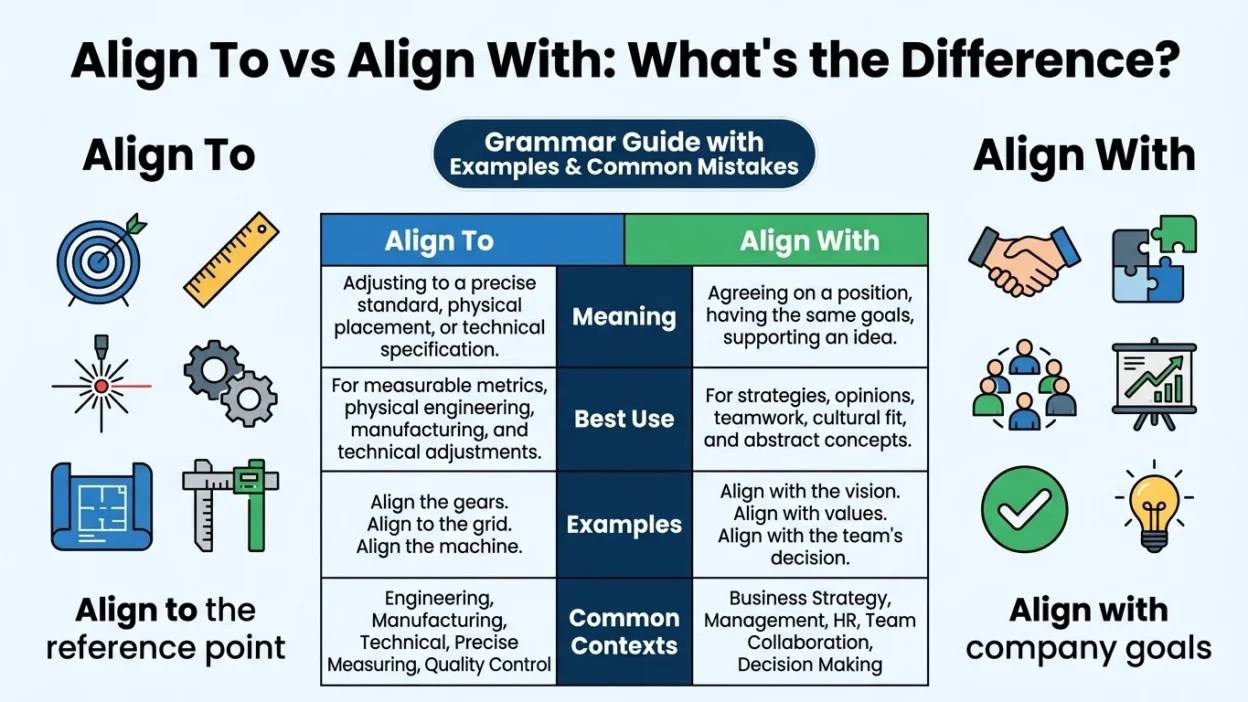
Align To vs Align With: The Main Difference
The biggest difference lies in how the relationship is expressed.
- Align with emphasizes agreement, consistency, or compatibility.
- Align to emphasizes positioning or adjusting something toward a fixed standard or reference.
Here’s a simple way to remember it:
- Ideas, values, goals, people, strategies → align with
- Measurements, machines, objects, technical standards → align to
Comparison Table: Align To vs Align With
| Feature | Align To | Align With |
|---|---|---|
| Primary meaning | Adjust toward a target or standard | Agree, match, or be consistent |
| Most common use | Technical and engineering contexts | Business, education, and everyday English |
| Sounds natural in conversation | Sometimes | Yes |
| Used for ideas and opinions | Rarely | Very common |
| Used for physical positioning | Yes | Sometimes |
| Preferred in professional writing | Occasionally | Usually |
This comparison shows why align with is generally the safer and more natural choice.
When to Use “Align With”
Use align with when discussing agreement, compatibility, shared goals, values, plans, opinions, or expectations.
It suggests that two or more things work together harmoniously.
Examples
- Our project aligns with the client’s expectations.
- Her values align with the company’s mission.
- The proposal aligns with current industry standards.
- My schedule doesn’t align with yours.
- Their recommendations align with the latest research.
In these examples, nothing is being physically adjusted. Instead, the focus is on agreement and consistency.
Common Business Examples
You’ll frequently see align with in professional communication.
Examples include:
- Align with company goals
- Align with business objectives
- Align with customer needs
- Align with our strategy
- Align with market trends
- Align with best practices
- Align with legal requirements
- Align with organizational values
These phrases are common in emails, presentations, reports, and meetings because they clearly express compatibility and shared direction.
When to Use “Align To”
Use align to when something is adjusted or positioned according to a specific reference point, measurement, or technical standard.
This usage is more common in engineering, manufacturing, architecture, software development, and scientific writing.
Examples
- Align the laser to the target.
- The wheels must align to the guide rails.
- Adjust the sensor so it aligns to the reference mark.
- The machine automatically aligns to the calibration point.
- The camera should align to the center marker.
In these cases, the object is physically positioned relative to a fixed point.
Technical Contexts
You may encounter align to in:
- Engineering manuals
- Manufacturing instructions
- CAD design documentation
- Robotics
- Scientific equipment
- Software interfaces
- Mechanical maintenance guides
Outside these technical settings, however, align with is usually the more natural choice.
Examples in Everyday English
Understanding real-life examples makes the distinction much easier.
Correct Uses of “Align With”
- My goals align with yours.
- Their values align with our mission.
- The lesson aligns with the curriculum.
- This policy aligns with government regulations.
- Her explanation aligns with the available evidence.
Correct Uses of “Align To”
- Carefully align the mirror to the center line.
- The printer head should align to the guide marks.
- The antenna must align to the satellite.
- Position the lens so it aligns to the measurement scale.
Notice that align to usually involves a physical object or technical adjustment, while align with focuses on agreement or consistency.
Which One Sounds More Natural?
If you’re unsure which phrase to choose, align with is usually the safest option.
Native English speakers overwhelmingly use align with when discussing:
- Business strategies
- Goals
- Policies
- Opinions
- Values
- Plans
- Research
- Expectations
- Teamwork
- Decision-making
Using align to in these situations may sound overly technical or slightly unnatural.
For example:
Less natural:
- Our marketing plan aligns to customer expectations.
More natural:
- Our marketing plan aligns with customer expectations.
In professional and everyday English, align with is the preferred expression because it communicates agreement clearly and naturally.
Common Mistakes When Using “Align To” and “Align With”
Although both phrases use the same verb, they aren’t always interchangeable. Here are some common mistakes and how to avoid them.
Mistake 1: Using “Align To” for Ideas or Opinions
Many English learners use align to when discussing goals, values, or opinions because it seems logical. However, native speakers almost always prefer align with in these situations.
❌ Incorrect:
- Our mission aligns to your vision.
✅ Correct:
- Our mission aligns with your vision.
Another example:
❌ Incorrect:
- His opinion aligns to mine.
✅ Correct:
- His opinion aligns with mine.
Remember: ideas, beliefs, strategies, and opinions generally align with, not align to.
Mistake 2: Using “Align With” for Technical Positioning
When physically adjusting equipment or objects toward a specific point, align to is often the more accurate choice.
Less precise:
- Align the sensor with the calibration point.
More precise in technical documentation:
- Align the sensor to the calibration point.
Both may be understood, but technical manuals often favor align to because it emphasizes positioning toward a reference.
Mistake 3: Overusing One Phrase Everywhere
Some writers use only align with or only align to, regardless of context.
Instead, choose the phrase that matches your meaning.
Ask yourself:
- Is this about agreement? → Align with
- Is this about physical adjustment? → Align to
Similar Expressions You Can Use Instead
If you want to avoid repeating the word align, several alternatives work well depending on the context.
Alternatives to “Align With”
- Agree with
- Match
- Correspond with
- Be consistent with
- Be compatible with
- Support
- Reflect
- Complement
- Fit
- Go along with
Example:
Instead of:
- Our goals align with yours.
You can write:
- Our goals match yours.
Alternatives to “Align To”
In technical writing, you can also use:
- Position
- Adjust
- Calibrate
- Orient
- Set
- Arrange
- Fit
- Place
Example:
Instead of:
- Align the camera to the marker.
You can write:
- Position the camera at the marker.
Choosing the right synonym can make your writing more varied and engaging.
Professional Examples
The phrase align with is especially common in business and workplace communication.
Email Examples
- This proposal aligns with our long-term objectives.
- The new policy aligns with industry regulations.
- Please ensure your presentation aligns with the project brief.
- Our recommendations align with customer feedback.
Resume Example
- Successfully aligned cross-functional teams with organizational goals.
Project Management Example
- The timeline aligns with the client’s expectations.
These examples sound natural and professional because they describe agreement rather than physical positioning.
Everyday Conversation Examples
Outside the workplace, align with is also common in daily English.
Examples include:
- My schedule doesn’t align with yours this week.
- His explanation aligns with what I witnessed.
- Your priorities align with mine.
- Their lifestyle aligns with their values.
- The results align with our predictions.
These expressions are widely used by native speakers.
Academic Writing Examples
Students and researchers frequently use align with in essays and research papers.
Examples:
- The findings align with previous studies.
- This theory aligns with modern educational practices.
- The results align with the original hypothesis.
- Our observations align with existing research.
Because academic writing often discusses evidence, ideas, and theories, align with is almost always the preferred choice.
American vs British English
One helpful aspect of this grammar topic is that American English and British English generally use “align with” and “align to” in the same way.
In both varieties:
- Align with is the standard choice for agreement, consistency, and compatibility.
- Align to is mainly reserved for technical, engineering, manufacturing, or scientific contexts.
For example:
American English
- Our strategy aligns with customer expectations.
- Align the machine to the reference point.
British English
- Our strategy aligns with customer expectations.
- Align the machine to the reference point.
Unlike some grammar topics, there is no significant regional difference in preference. Writers in both American and British English overwhelmingly favor align with in business, education, journalism, and everyday communication.
Tips to Remember the Difference
If you’re still unsure, these simple memory tricks can help.
- Think “people and ideas align with.”
- Think “machines and measurements align to.”
- When discussing goals, values, opinions, or strategies, choose align with.
- When adjusting equipment toward a fixed point, align to is often more appropriate.
- If you’re writing for a general audience, align with is usually the safest and most natural option.
With regular practice, choosing the correct phrase will become second nature.
FAQs
Is “align with” or “align to” correct?
Both are correct, but they are used in different contexts. Align with is the standard choice when talking about agreement, consistency, or compatibility. Align to is mainly used in technical, engineering, or manufacturing contexts where something is physically adjusted to a reference point.
Which is more common: “align to” or “align with”?
Align with is much more common in modern English. It’s widely used in business communication, academic writing, professional emails, and everyday conversations because it naturally expresses agreement or shared direction.
Can I use “align to” in business writing?
In most business situations, align with is the better choice.
For example:
- ✅ Our goals align with the company’s vision.
- ✅ The proposal aligns with customer expectations.
Using align to in these examples may sound overly technical or unnatural.
What does “align with” mean?
Align with means to agree with, support, match, correspond to, or be consistent with someone or something.
Examples:
- My values align with yours.
- The new policy aligns with industry standards.
- Their recommendations align with the latest research.
What does “align to” mean?
Align to means to adjust or position something so it matches a fixed point, target, or standard.
Examples:
- Align the camera to the center marker.
- The sensor should align to the calibration point.
- Carefully align the wheel to the guide rail.
This phrase is most common in technical instructions and engineering documentation.
Are “align with” and “agree with” the same?
They are similar but not identical.
- Agree with focuses on sharing the same opinion.
- Align with has a broader meaning and can describe compatibility, consistency, shared goals, values, strategies, or standards.
For example:
- I agree with your opinion.
- Our business strategy aligns with market trends.
Is there a difference between American and British English?
Not significantly. Both American and British English prefer align with for ideas, goals, opinions, and strategies. Likewise, both use align to mainly in technical and engineering contexts.
How can I remember the difference?
A simple rule is:
- People, ideas, values, goals, and strategies → align with
- Machines, equipment, measurements, and reference points → align to
If you’re ever uncertain, align with is usually the safest and most natural choice for general English.
Summary
Understanding the difference between align to vs align with can make your English sound more natural and professional.
While both expressions are grammatically correct, they serve different purposes. Align with is the preferred choice when discussing agreement, shared goals, compatibility, values, opinions, policies, or strategies. It’s the phrase you’ll encounter most often in business writing, academic work, and everyday conversations.
On the other hand, align to is primarily used in technical fields such as engineering, manufacturing, software development, and scientific documentation, where it refers to physically adjusting something to match a reference point or standard.
Knowing this distinction will help you choose the right expression with confidence and communicate your ideas more clearly.
Actionable Takeaway
Whenever you’re writing about people, ideas, goals, values, plans, research, or business strategies, use align with. It is the more natural, widely accepted, and reader-friendly choice in modern English.
Reserve align to for situations involving physical positioning, measurements, machinery, or technical instructions. By remembering this simple guideline and practicing with real-world examples, you’ll avoid common mistakes and write with greater accuracy and confidence.