Expanding your vocabulary is one of the best ways to become a more confident English speaker and writer.
If you’re looking for verbs that start with F, you may be preparing for a spelling test, teaching students, improving your grammar, or simply searching for new action words.
Learning verbs alphabetically is an effective way to organize vocabulary and make it easier to remember.
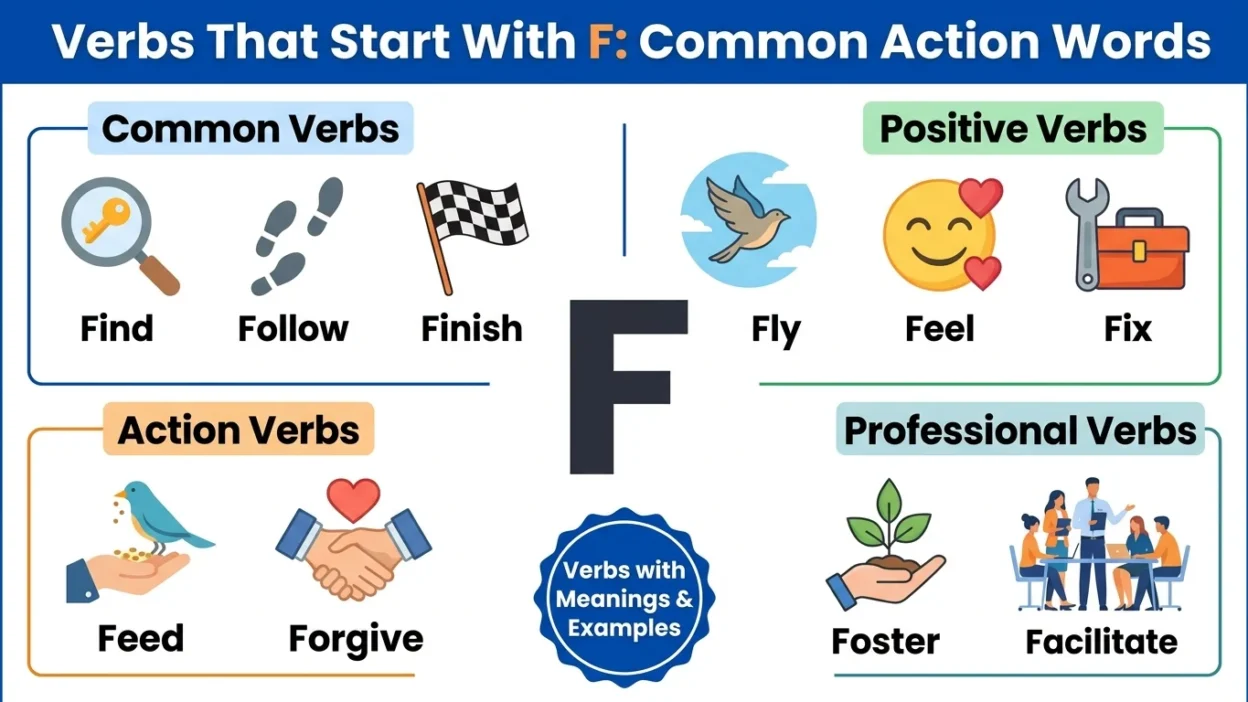
From everyday verbs like find, finish, and follow to advanced words such as facilitate, formulate, and flourish, the letter F offers many useful verbs for conversations, academic writing, business communication, and creative storytelling.
In this guide, you’ll discover over 100 verbs that start with F, along with their meanings, examples, and practical tips for using them correctly.
Quick Answer
Verbs that start with F are action or state-of-being words beginning with the letter F.
Some of the most common examples include:
- Face
- Fade
- Fail
- Fall
- Feed
- Feel
- Fight
- Fill
- Find
- Finish
- Fix
- Fly
- Fold
- Follow
- Form
These verbs describe actions, emotions, movement, communication, and everyday activities.
What Is a Verb?
A verb is a word that describes an action, an event, or a state of being. Every complete sentence contains a verb because it tells us what the subject is doing or experiencing.
Examples
- She found her missing keys.
- We finished our homework early.
- Birds fly across the sky.
- They followed the instructions carefully.
The highlighted words are verbs because they express actions.
Common Verbs That Start With F
Here are some frequently used verbs beginning with the letter F.
| Verb | Meaning |
|---|---|
| Face | To confront or deal with |
| Fade | To lose brightness or strength |
| Fail | To be unsuccessful |
| Fall | To move downward |
| Feed | To give food |
| Feel | To experience an emotion or sensation |
| Fetch | To go and bring back |
| Fight | To struggle or battle |
| Fill | To make full |
| Find | To discover |
| Finish | To complete |
| Fix | To repair |
| Flash | To shine briefly |
| Float | To stay on the surface |
| Flood | To cover with water |
| Flow | To move smoothly |
| Fly | To move through the air |
| Fold | To bend |
| Follow | To go after |
| Fool | To trick |
| Force | To make someone do something |
| Forget | To fail to remember |
| Forgive | To stop feeling angry |
| Form | To create |
| Foster | To encourage growth |
| Freeze | To become very cold |
| Fry | To cook in hot oil |
| Fulfill | To achieve or complete |
These verbs appear regularly in everyday English and professional communication.
100+ Verbs That Start With F
Grouping verbs into categories makes them easier to learn and remember.
Everyday F Verbs
- Face
- Fade
- Fail
- Fall
- Fasten
- Feed
- Feel
- Fetch
- Fight
- Fill
- Find
- Finish
- Fix
- Flash
- Float
- Flood
- Flow
- Fly
- Fold
- Follow
School and Work Verbs
- Focus
- Form
- Formulate
- Function
- Forecast
- File
- Facilitate
- Furnish
- Finalize
- Familiarize
Professional and Business Verbs
- Facilitate
- Finalize
- Forecast
- Formulate
- Fund
- Furnish
- Function
- Fortify
- Foster
- Fulfill
Advanced F Verbs
- Fabricate
- Fascinate
- Fortify
- Formalize
- Fertilize
- Frustrate
- Fragment
- Fuse
- Fluctuate
- Foresee
These advanced verbs are especially useful in academic, scientific, and professional writing.
Examples of Verbs That Start With F in Sentences
Using verbs in sentences helps you understand their meanings and remember them more easily.
Find
- I finally found my lost wallet.
Follow
- Please follow the safety instructions.
Finish
- She finished reading the novel yesterday.
Forgive
- It’s important to forgive others after honest mistakes.
Facilitate
- Good communication facilitates teamwork.
Formulate
- Scientists formulate new theories through research.
Fly
- Birds fly south during the winter.
Focus
- Students should focus during the lesson.
Fulfill
- She worked hard to fulfill her dream.
Foster
- Parents should foster creativity in children.
These examples demonstrate how F verbs are used in everyday conversations and formal writing.
Verbs That Start With F by Category
Grouping verbs by purpose makes vocabulary easier to understand.
Communication Verbs
These verbs help express ideas and interact with others.
- Follow
- Forgive
- Fool
- Familiarize
- Formulate
- Facilitate
Example:
- The trainer facilitated an engaging discussion.
Movement Verbs
These verbs describe physical actions.
- Fall
- Fly
- Float
- Flow
- Follow
- Fetch
Example:
- Leaves floated gently across the lake.
Thinking and Learning Verbs
These verbs relate to reasoning, planning, and understanding.
- Focus
- Foresee
- Formulate
- Figure
- Familiarize
- Find
Example:
- Engineers formulate solutions to complex problems.
Improvement and Growth Verbs
These verbs describe development and positive change.
- Foster
- Fortify
- Fulfill
- Facilitate
- Flourish
- Free
Example:
- Reading daily helps foster critical thinking skills.
Powerful Action Verbs That Start With F
Strong action verbs make your writing more persuasive, descriptive, and professional.
Here are some powerful F verbs:
- Facilitate
- Flourish
- Fortify
- Foster
- Formulate
- Fulfill
- Finalize
- Forecast
- Focus
- Free
These verbs are especially valuable in resumes, business reports, academic papers, and persuasive writing.
Example
Weak sentence:
- The manager helped improve the process.
Stronger sentence:
- The manager facilitated improvements across the entire workflow.
Replacing weak verbs with stronger alternatives makes your writing more impactful, engaging, and professional.
Positive Verbs That Start With F
Positive verbs can make your writing sound more encouraging, inspiring, and confident. They’re useful in everyday conversations, teaching, leadership, customer service, and motivational writing.
Here are some uplifting verbs that start with F:
- Facilitate
- Flourish
- Foster
- Forgive
- Free
- Fulfill
- Fortify
- Favor
- Friendship (through befriend, though not starting with F, avoid confusion)
- Focus
Example Sentences
- Great leaders foster teamwork and trust.
- Healthy habits help people flourish.
- Learning new skills can fulfill your goals.
- We should forgive honest mistakes.
- Good planning helps facilitate success.
These verbs create a positive tone and encourage growth.
Common Mistakes When Using Verbs That Start With F
Even common F verbs can be confusing if they are used incorrectly.
Mistake 1: Confusing Similar Verbs
Some verbs have similar meanings but different uses.
For example:
Find means to discover something.
- I found my phone.
Fetch means to go somewhere and bring something back.
- Please fetch my notebook.
Using the wrong verb changes the meaning of the sentence.
Mistake 2: Incorrect Verb Forms
Several F verbs are irregular.
Incorrect:
- She has forget my name.
Correct:
- She has forgotten my name.
Another example:
Incorrect:
- Yesterday he fly to London.
Correct:
- Yesterday he flew to London.
Learning irregular verb forms helps improve grammar accuracy.
Mistake 3: Using Weak Verbs Too Often
Instead of writing:
- The company helped employees.
Try:
- The company fostered employee development.
- The company facilitated professional growth.
- The company fortified workplace collaboration.
Specific verbs make writing stronger and more engaging.
Comparison Table: Common F Verbs
Several F verbs are commonly confused. This table explains their differences.
| Verb | Meaning | Example |
|---|---|---|
| Find | Discover something | I found my keys. |
| Fetch | Go and bring back | Please fetch some water. |
| Follow | Go after or obey | Follow the instructions carefully. |
| Finish | Complete something | She finished her homework. |
| Fix | Repair something | He fixed the computer. |
| Feel | Experience an emotion or sensation | I feel happy today. |
| Forget | Fail to remember | Don’t forget your password. |
| Forgive | Stop feeling angry | She forgave her friend. |
Understanding these differences helps you choose the most appropriate verb.
Why Learning F Verbs Improves Your Writing
Expanding your vocabulary allows you to communicate more clearly and effectively.
Benefits include:
- Making sentences more descriptive
- Avoiding repetitive wording
- Improving essays and reports
- Strengthening business communication
- Enhancing storytelling
For example:
Instead of:
- The teacher helped students.
Write:
- The teacher facilitated learning.
- The teacher fostered creativity.
- The teacher focused students on the lesson.
Strong verbs make your writing more vivid and professional.
Verbs That Start With F for Students
Students often learn vocabulary alphabetically because it’s easier to organize and remember.
Here are some beginner-friendly F verbs:
- Face
- Fall
- Feed
- Feel
- Fight
- Fill
- Find
- Finish
- Fix
- Fly
Teachers can encourage students to create simple sentences.
Examples:
- Birds fly every morning.
- I finished my homework.
- Please fill the bottle with water.
Regular practice builds vocabulary and confidence.
Verbs That Start With F for Resume Writing
Action verbs help resumes stand out by emphasizing accomplishments.
Here are some excellent resume verbs beginning with F:
- Facilitated
- Finalized
- Forecasted
- Formulated
- Fostered
- Fulfilled
- Fortified
- Focused
- Funded
- Furnished
Resume Examples
- Facilitated communication between departments.
- Forecasted annual sales trends.
- Formulated marketing strategies that increased revenue.
- Focused on improving customer satisfaction.
- Fulfilled project goals ahead of schedule.
These verbs demonstrate leadership, initiative, and measurable achievements.
American vs British English
Most verbs that start with F have the same spelling and meaning in both American and British English.
Examples include:
- Find
- Follow
- Finish
- Feel
- Fly
- Form
- Foster
- Forgive
However, some related words differ in spelling.
Example
American English:
- Finalize
British English:
- Finalise
Another example:
American English:
- Fertilize
British English:
- Fertilise
These variations follow the common American -ize and British -ise spelling pattern. Regardless of the spelling, the meanings remain the same, and both forms are correct within their respective varieties of English.
FAQs
What are verbs that start with F?
Verbs that start with F are action or state-of-being words beginning with the letter F. Examples include find, follow, finish, feel, forgive, foster, and fly.
What are the most common verbs that start with F?
Some of the most frequently used F verbs are:
- Face
- Fall
- Feed
- Feel
- Fight
- Fill
- Find
- Finish
- Fix
- Fly
- Follow
- Form
- Forget
- Forgive
- Foster
These verbs are widely used in daily conversations, education, and professional communication.
Why should I learn verbs alphabetically?
Learning verbs alphabetically helps you organize new vocabulary and remember it more easily. It also helps you:
- Expand your English vocabulary
- Improve reading and writing skills
- Prepare for spelling tests
- Build confidence in speaking English
- Avoid repeating the same action words
What are some positive verbs that start with F?
Here are several positive F verbs:
- Facilitate
- Flourish
- Foster
- Forgive
- Fulfill
- Fortify
- Focus
- Free
- Favor
- Feed
These verbs are excellent for motivational writing, leadership, and positive communication.
What are some powerful action verbs that start with F?
Strong action verbs include:
- Facilitate
- Finalize
- Forecast
- Formulate
- Foster
- Fortify
- Fulfill
- Flourish
- Focus
- Free
These verbs help make resumes, reports, and persuasive writing more effective.
Are verbs that start with F useful in professional writing?
Absolutely. Business professionals frequently use verbs such as facilitate, forecast, formulate, finalize, focus, and fulfill because they clearly describe achievements, responsibilities, and measurable results.
How can I remember more F verbs?
You can strengthen your vocabulary by:
- Learning five to ten new verbs each week.
- Grouping verbs into categories such as movement, communication, and work.
- Writing original sentences using each new verb.
- Reading books, articles, and blogs regularly.
- Reviewing vocabulary with flashcards or language-learning apps.
Consistent practice is the best way to remember new verbs.
Are there irregular verbs that start with F?
Yes. Several common F verbs are irregular.
| Base Form | Past Tense | Past Participle |
|---|---|---|
| Fall | Fell | Fallen |
| Feel | Felt | Felt |
| Fight | Fought | Fought |
| Find | Found | Found |
| Fly | Flew | Flown |
Because these verbs don’t follow the regular -ed pattern, it’s important to memorize their past tense and past participle forms.
Summary
Learning verbs that start with F is a practical way to build a stronger English vocabulary and communicate more effectively.
From everyday verbs like find, follow, finish, and feel to advanced choices such as facilitate, formulate, foster, and fulfill, these action words help you express ideas with greater precision in conversations, essays, emails, reports, and professional documents.
Using a variety of strong verbs also makes your writing more engaging and avoids repetitive language.
By understanding the meanings of F verbs, practicing them in context, and replacing weak verbs with more descriptive alternatives, you’ll improve both your spoken and written English while becoming a more confident communicator.