If you’ve ever paused while writing better than or better then, you’re not alone. These two phrases sound almost identical when spoken, making them one of the most common spelling mistakes in English. However, only one is correct when you’re making a comparison.
The confusion comes from the words than and then, which have different meanings and grammatical functions. Than is used for comparisons, while then refers to time, sequence, or what happens next. In this guide, you’ll learn the difference between better than vs better then, see plenty of examples, avoid common mistakes, and know exactly which form to use in every situation.
Quick Answer: Better Than vs Better Then
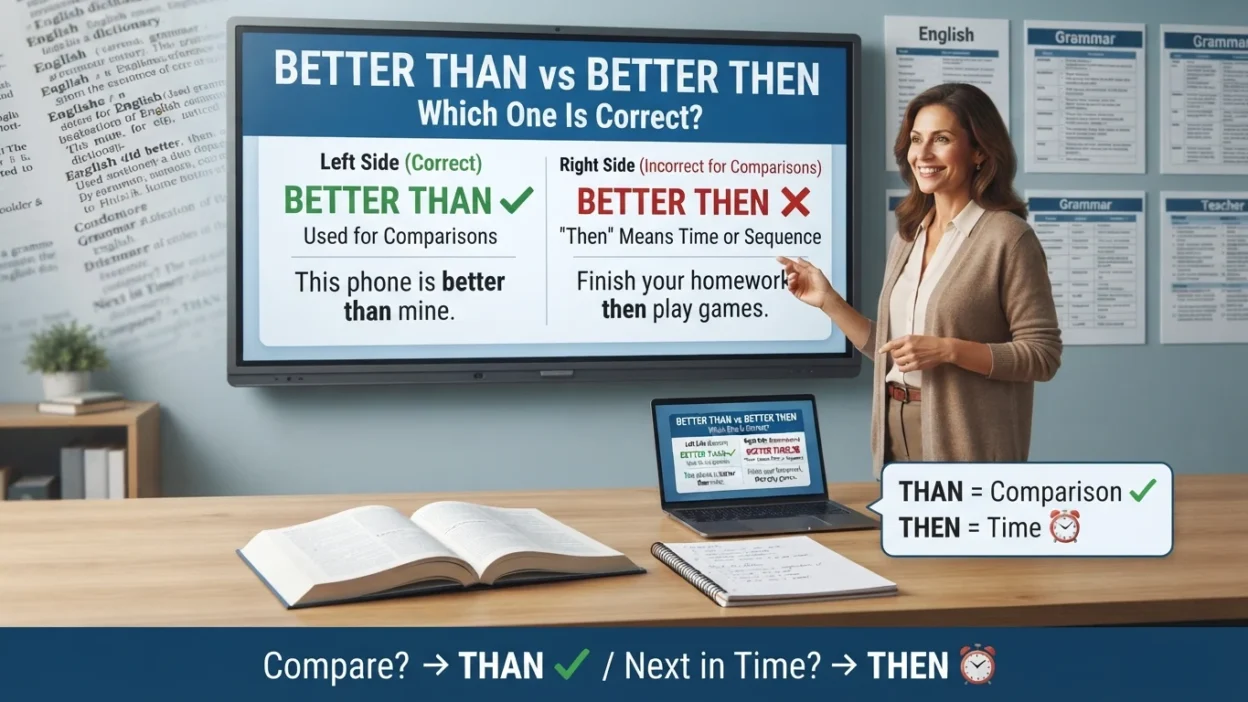
Better than is the correct phrase when comparing two or more people, things, or ideas.
Better then is usually incorrect in comparison sentences. It is only correct when then keeps its normal meaning of at that time or next.
Simple Rule
- ✅ Better than = Used for comparisons.
- ❌ Better then = Incorrect in most comparison sentences.
Example
She sings better than I do. ✅
She sings better then I do. ❌
What Does “Better Than” Mean?
Better than is a comparison phrase.
The word better is the comparative form of good, while than is the conjunction used to compare two things.
For example:
This laptop is better than my old one.
The sentence compares two laptops.
Other examples include:
Coffee tastes better than tea to me.
Reading is better than scrolling endlessly on your phone.
He is better than his opponent at chess.
Whenever you compare one thing with another, than is the correct word.
What Does “Then” Mean?
Unlike than, then is mainly related to time, sequence, or the next step.
For example:
Finish your homework, then watch television.
Here, then means after that.
Another example:
Back then, we didn’t have smartphones.
In this sentence, then refers to that time in the past.
Common meanings of then include:
- Next
- Afterward
- At that time
- In that case
Notice that none of these meanings involve making comparisons.
Better Than vs Better Then: Comparison Table
| Feature | Better Than | Better Then |
|---|---|---|
| Correct for comparisons | ✅ Yes | ❌ No |
| Uses “than” | Yes | No |
| Uses “then” | No | Yes, only for time or sequence |
| Common in formal writing | Yes | Only when referring to time |
| Example | She is better than me. | Finish eating, then leave. |
The easiest way to remember the difference is that than compares, while then tells time or order.
When Should You Use “Better Than”?
Use better than whenever you’re comparing:
- People
- Places
- Objects
- Ideas
- Skills
- Experiences
- Performance
- Quality
Examples:
This phone is better than the previous model.
Swimming is better than sitting all day.
Today’s weather is better than yesterday’s.
The second solution is better than the first.
Every example compares one thing with another.
When Can “Better Then” Be Correct?
Most of the time, better then is considered incorrect because writers actually mean better than.
However, better then can appear in a sentence if then keeps its normal meaning.
For example:
If you feel better then, we can continue the meeting.
Here, then means at that time.
Another example:
We’ll discuss the issue then if everyone feels better.
Notice that then refers to a future or past point in time, not a comparison.
Examples of “Better Than”
Here are several correct examples.
Example 1
This restaurant is better than the one across the street.
The sentence compares two restaurants.
Example 2
She speaks English better than her brother.
The comparison is between two people.
Example 3
Practice is better than perfectionism.
The sentence compares two ideas.
Example 4
The new software works better than the old version.
The comparison is between two versions of software.
Example 5
Walking is better than driving short distances.
The comparison focuses on two activities.
Examples of “Then”
Now let’s see then used correctly.
Example 1
Eat dinner, then wash the dishes.
The word indicates the next action.
Example 2
Back then, life was much simpler.
The word refers to a time in the past.
Example 3
If you’re ready then, we’ll begin.
The word refers to a specific time.
Example 4
First study, then take the test.
The word shows sequence.
Notice that none of these examples involve comparisons.
Common Mistakes
Mistake 1: Writing “Better Then” Instead of “Better Than”
Incorrect:
This car is better then that one.
Correct:
This car is better than that one.
Whenever you’re comparing two things, use than.
Mistake 2: Confusing Pronunciation
Many speakers pronounce than and then similarly in casual conversation.
Because they sound alike, writers often spell the word incorrectly.
Remember:
You may hear then, but comparisons almost always require than.
Mistake 3: Forgetting That “Than” Is a Comparison Word
Ask yourself:
Am I comparing two things?
If the answer is yes, use than.
Example:
Math is better than guessing.
Mistake 4: Using “Then” After Comparative Adjectives
Words like:
- Better
- Worse
- Bigger
- Smaller
- Faster
- Stronger
- Easier
are normally followed by than, not then.
Examples:
Bigger than
Faster than
Better than
Memory Trick
An easy way to remember the difference is:
Than = Comparison
Then = Time
Another helpful trick:
The word than contains the letter A, which can remind you of A comparison.
The word then contains the letter E, which can remind you of Events or Everything happens next.
Better Than in Everyday English
The phrase better than appears constantly in spoken and written English.
Examples include:
Better than expected
Better than ever
Better than nothing
Better than before
These expressions all use than because they compare one condition with another.
American English vs British English
There is no difference between American and British English regarding better than and better then.
Both varieties of English follow the same grammar rule:
- Better than is used for comparisons.
- Then refers to time or sequence.
Examples:
American English: This option is better than the other one.
British English: This option is better than the other one.
The grammar remains identical.
Related Comparative Expressions
The same rule applies to many other comparative words.
Examples include:
- More than
- Less than
- Faster than
- Bigger than
- Easier than
- Harder than
- Smaller than
- Older than
In each case, than introduces the comparison.
FAQs
1. Which is correct: better than or better then?
Better than is correct when making a comparison. Better then is usually incorrect unless then refers to time.
2. Why do people write “better then”?
Because than and then sound very similar in everyday speech. The mistake is caused by pronunciation rather than grammar.
3. Can “better then” ever be correct?
Yes, but only when then means at that time.
Example:
If you feel better then, call me.
4. Is “better than me” grammatically correct?
Yes. In everyday English, better than me is widely accepted.
In very formal grammar, some writers prefer:
Better than I am or better than I do, depending on the sentence.
5. Does American English use “better than”?
Yes. American English and British English both use better than for comparisons.
6. What does “then” mean?
Then usually means:
- Next
- Afterward
- At that time
- In that case
7. Is “better then expected” correct?
No.
The correct phrase is:
Better than expected.
8. How can I remember the difference?
Remember:
Than compares.
Then tells time.
This simple rule works in almost every situation.
Final Summary
The difference between better than vs better then is straightforward once you understand the roles of than and then. Better than is the correct phrase whenever you’re comparing two or more people, things, or ideas. Then, on the other hand, refers to time, sequence, or what happens next, so it doesn’t belong in comparison phrases.
Both American and British English follow the same rule, making better than the standard choice in nearly every comparison. If you accidentally write better then, you’re likely confusing two words that sound similar but have completely different meanings. Keeping this distinction in mind will make your writing clearer and more accurate.
Actionable Takeaway
Whenever you write a sentence with better, ask yourself one question: Am I comparing something? If the answer is yes, the correct word is than.
A simple memory trick is: Than = Comparison, Then = Time. Once you remember this rule, you’ll avoid one of the most common English spelling mistakes and use better than with confidence every time.