Have you ever heard someone say “`same difference`” after comparing two things that are clearly different? At first glance, the phrase seems contradictory. After all, how can something be both the same and different? Yet, same difference is a common English expression that native speakers use in everyday conversations.
The phrase is an idiom, meaning its actual meaning is different from the literal words. Depending on the context, same difference usually means that the small differences between two things are not important because the overall result is essentially the same. In this guide, you’ll learn the meaning of same difference, when to use it, examples, common mistakes, and how it compares to similar expressions.
Quick Answer: What Does “Same Difference” Mean?
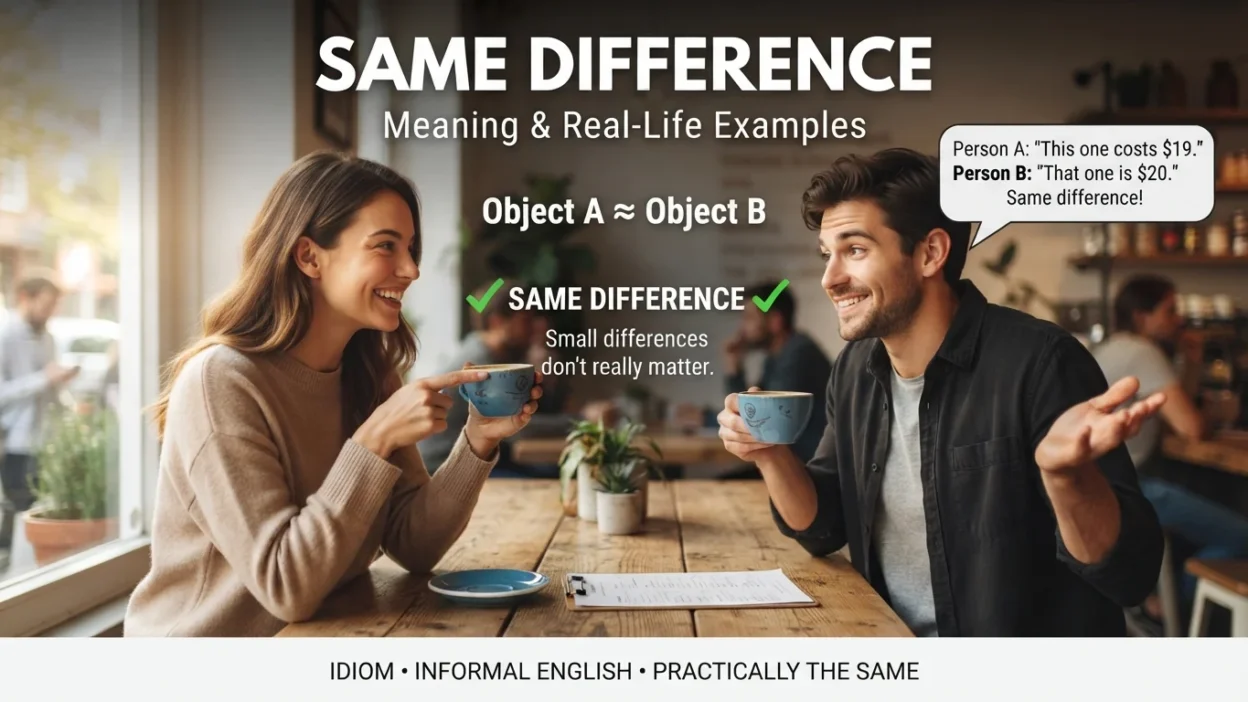
Same difference is an informal English idiom that means the difference between two things is so small that it doesn’t really matter.
People often use it when they believe two options lead to the same outcome or have no meaningful distinction.
Examples
A: “Should we leave at 7:00 or 7:05?”
B: “Same difference.”
Here, Person B means that five minutes won’t make much of a difference.
Another example:
A: “It’s dark blue, not navy.”
B: “Same difference.”
The speaker believes the distinction is unimportant.
Simple Rule
Use same difference when small differences exist, but they don’t significantly change the overall situation.
What Does “Same Difference” Mean?
The idiom same difference expresses the idea that two things may technically differ, but those differences are not important enough to affect the result.
Although the phrase sounds contradictory, it makes sense because the speaker is saying:
“The difference doesn’t really matter.”
It is often used:
- To dismiss minor differences
- To simplify a discussion
- To express that two choices are practically identical
- As a casual or humorous response
The phrase is common in informal spoken English and should generally be avoided in formal writing.
Why Does “Same Difference” Sound Contradictory?
The words same and difference normally have opposite meanings.
- Same means identical.
- Different means not identical.
However, idioms don’t always follow literal logic.
When someone says same difference, they are not claiming that two things are literally identical. Instead, they mean that the difference is too small to matter.
For example:
“It’s a five-minute walk instead of a four-minute walk.”
“Same difference.”
The speaker recognizes a difference but considers it insignificant.
Examples of “Same Difference”
Here are several natural examples.
Example 1: Time
A: “We’ll arrive at 10:00.”
B: “Actually, it’ll be 10:03.”
A: “Same difference.”
Three minutes is considered unimportant.
Example 2: Money
A: “The book costs $19.”
B: “It’s actually $20.”
A: “Same difference.”
The speaker feels the price difference is negligible.
Example 3: Color
A: “It’s turquoise.”
B: “No, it’s teal.”
A: “Same difference.”
The speaker believes the distinction is not significant.
Example 4: Distance
A: “It’s four miles away.”
B: “It’s closer to five.”
A: “Same difference.”
The difference is viewed as too small to matter.
Example 5: Sports
A: “The match starts at 6:55.”
B: “No, it’s 7:00.”
A: “Same difference.”
The speaker doesn’t think the timing difference changes anything important.
Same Difference vs No Difference
These two expressions are related but not identical.
No difference means there is absolutely no meaningful distinction.
Same difference means there is a technical difference, but it is unimportant.
Compare these examples:
These two phones have no difference in battery life.
This means the battery life is identical.
These two phones have slightly different screens, but same difference.
The speaker believes the screen difference isn’t worth worrying about.
Same Difference vs Six of One, Half a Dozen of the Other
Another similar idiom is:
Six of one, half a dozen of the other.
Both expressions suggest that two choices are essentially equal.
However:
Same difference focuses on small differences that don’t matter.
Six of one, half a dozen of the other emphasizes that two alternatives produce the same overall result.
Same Difference Comparison Table
| Expression | Meaning | Tone | Example |
|---|---|---|---|
| Same difference | The difference doesn’t really matter | Informal | “It’s five dollars more.” “Same difference.” |
| No difference | Absolutely identical result | Neutral | There is no difference between the two results. |
| Six of one, half a dozen of the other | Two options are effectively the same | Informal | Either restaurant is fine. Six of one, half a dozen of the other. |
| It’s all the same | The outcome doesn’t matter | Informal | Choose whichever you like. It’s all the same. |
When Should You Use “Same Difference”?
The expression works best when:
- The differences are very small.
- The outcome remains the same.
- You’re speaking informally.
- You’re chatting with friends or coworkers.
- You’re making a lighthearted comment.
Examples include:
- Small price differences
- Minor schedule changes
- Tiny measurement differences
- Slight color variations
- Nearly identical choices
It is especially common in everyday conversations.
When Should You Avoid It?
Although same difference is widely understood, it isn’t appropriate everywhere.
Avoid using it in:
- Academic essays
- Legal documents
- Scientific reports
- Formal business writing
- Professional presentations
Instead, use clearer alternatives such as:
- The difference is negligible.
- The distinction is minimal.
- The outcome is essentially the same.
- There is little practical difference.
These alternatives sound more precise and professional.
Common Mistakes
Mistake 1: Thinking It Means “Exactly the Same”
It doesn’t.
The phrase recognizes that a difference exists.
It simply suggests the difference is unimportant.
Mistake 2: Using It for Major Differences
Don’t use same difference when the distinction significantly changes the outcome.
Incorrect:
A bicycle and a car? Same difference.
These are clearly different in meaningful ways.
Correct:
Leaving at 7:00 or 7:02? Same difference.
Mistake 3: Using It in Formal Writing
Because it’s an idiom, same difference sounds conversational.
Formal writing should usually use:
- Essentially the same
- Nearly identical
- Practically equivalent
- Little meaningful difference
Mistake 4: Taking the Phrase Literally
Many English learners think the expression is grammatically incorrect.
It isn’t.
As an idiom, its meaning is figurative rather than literal.
Is “Same Difference” Sarcastic?
Sometimes.
Depending on the speaker’s tone, same difference may sound:
- Friendly
- Casual
- Humorous
- Slightly impatient
- Mildly sarcastic
For example:
A: “It’s 99.8%, not 100%.”
B: “Same difference.”
Here, Person B may be joking that the tiny difference isn’t worth discussing.
Tone plays an important role in how the phrase is understood.
American English vs British English
Same difference is understood in both American and British English.
It is especially common in informal conversations across both varieties.
The meaning is essentially identical in each.
For example:
American English: “It’s $49 instead of $50.”
“Same difference.”
British English: “It’s £49 instead of £50.”
“Same difference.”
Both speakers are expressing that the difference is insignificant.
There is no major grammatical or usage difference between American and British English for this idiom.
Similar Expressions
If you want to express a similar idea, you can also use:
- Practically the same
- More or less the same
- Close enough
- It makes no real difference
- It’s all the same
- Six of one, half a dozen of the other
- Nearly identical
- Essentially the same
Each has a slightly different tone, but all suggest that the differences are minor.
FAQs
1. What does “same difference” mean?
It means that although two things are technically different, the differences are too small to matter in a practical sense.
2. Is “same difference” an idiom?
Yes. It is a common informal English idiom with a figurative meaning.
3. Is “same difference” grammatically correct?
As an idiomatic expression, yes. Although it sounds contradictory literally, it is a well-established phrase in English.
4. Can I use “same difference” in formal writing?
Generally, no. It is better suited to casual conversation. In formal writing, use alternatives such as essentially the same or the difference is negligible.
5. Is “same difference” sarcastic?
It can be. Depending on the speaker’s tone, it may sound humorous, dismissive, or mildly sarcastic.
6. What is another way to say “same difference”?
Alternatives include practically the same, essentially the same, close enough, and it makes no real difference.
7. Is “same difference” used in both American and British English?
Yes. The phrase is common and understood in both American and British English.
8. Can “same difference” refer to large differences?
No. It should only be used when the differences are relatively small or unimportant.
Final Summary
The phrase same difference is an informal English idiom that means the differences between two things are too small to matter. While the words themselves seem contradictory, native speakers use the expression to emphasize that two options, situations, or details are practically the same in terms of the final outcome. It is commonly heard in casual conversations, often with a humorous or slightly sarcastic tone.
Understanding the context is essential. Same difference works well when discussing minor variations in time, price, color, distance, or similar situations where the distinction is insignificant. However, it should generally be avoided in formal writing, where more precise expressions such as essentially the same or the difference is negligible are preferred.
Actionable Takeaway
Whenever you’re unsure whether to use same difference, ask yourself one question: Does the small difference actually change the outcome? If the answer is no, then same difference is likely an appropriate informal expression.
Remember this easy rule: Same difference = there is a difference, but it doesn’t really matter. Using the idiom naturally will make your everyday English sound more fluent and conversational.