If you’ve ever read a contract, company policy, legal document, or formal email, you’ve probably come across the phrase “deem fit.” While it may sound old-fashioned or overly formal, it’s still widely used in professional and legal English. Many English learners wonder exactly what deem fit means and when it’s appropriate to use it.
The good news is that the phrase is easier to understand than it appears. Simply put, deem fit means to consider something appropriate, suitable, necessary, or acceptable based on one’s judgment. In this guide, you’ll learn the meaning of deem fit, how to use it naturally, common examples, mistakes to avoid, and the differences between formal and everyday English.
Quick Answer: What Does “Deem Fit” Mean?
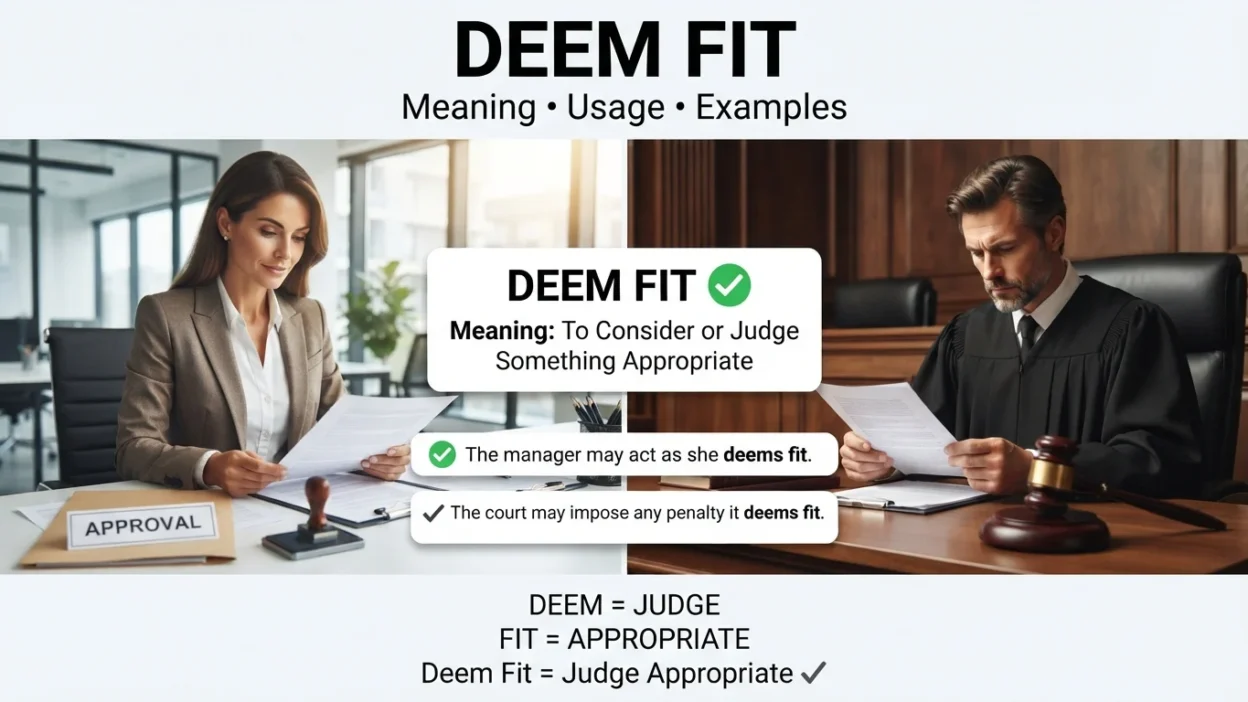
Deem fit means to judge, consider, or decide that something is appropriate, suitable, or necessary.
The phrase usually appears in formal English, especially in:
- Legal documents
- Business writing
- Official notices
- Employment contracts
- Government communications
- Academic writing
Examples
- The manager may take any action she deems fit.
- The court will impose any penalty it deems fit.
- Please proceed as you deem fit.
Simple Rule
Use deem fit when someone has the authority or responsibility to decide what is appropriate in a particular situation.
What Does “Deem Fit” Mean?
The verb deem means to think, judge, or consider.
The adjective fit means appropriate, suitable, or acceptable.
Together, deem fit means:
“To consider something suitable based on one’s own judgment.”
For example:
The committee will take whatever action it deems fit.
This means the committee will choose whichever action it believes is appropriate.
The phrase emphasizes personal judgment or official authority.
Understanding the Structure
The expression often appears in this pattern:
Subject + deem(s) + something + fit
Examples:
- We deem this proposal fit for approval.
- The director deemed the project fit for funding.
It also commonly appears in the expression:
As someone deems fit
Examples:
- Use the budget as you deem fit.
- Spend the funds as the organization deems fit.
- Employees may arrange their schedules as management deems fit.
This is one of the most common ways the phrase is used.
Examples of “Deem Fit”
Here are several natural examples.
Example 1: Workplace
The supervisor may assign additional tasks as she deems fit.
Example 2: Legal
The judge may impose any sentence he deems fit under the law.
Example 3: Business
Management reserves the right to make changes as it deems fit.
Example 4: School
Teachers may adjust classroom activities as they deem fit.
Example 5: Charity
The organization may distribute the donations as it deems fit.
Comparison Table
| Expression | Meaning | Level of Formality | Example |
|---|---|---|---|
| Deem fit | Consider appropriate | Very formal | The board will act as it deems fit. |
| Consider appropriate | Think suitable | Formal | We consider this appropriate. |
| Think best | Believe is the best option | Neutral | Do what you think is best. |
| See fit | Decide appropriate | Formal | The manager may see fit to approve it. |
| Find suitable | Believe something is suitable | Neutral | We found the plan suitable. |
While these expressions are similar, deem fit is among the most formal.
When Should You Use “Deem Fit”?
Use the phrase when discussing:
- Official decisions
- Legal authority
- Company policies
- Administrative actions
- Professional judgment
- Formal recommendations
Examples include:
- Contracts
- Government notices
- Court decisions
- Human resources policies
- University regulations
It is especially useful when someone has discretion to make a decision.
When Should You Avoid It?
Because deem fit sounds formal, it is not always the best choice in everyday conversation.
Instead of saying:
“I’ll do whatever I deem fit.”
Most people would simply say:
- I’ll do what I think is best.
- I’ll decide what to do.
- I’ll do what’s appropriate.
- I’ll handle it the way I think is right.
These alternatives sound more natural in casual English.
Deem Fit vs See Fit
Many learners confuse these two expressions.
Deem Fit
Focuses on judging something to be appropriate.
Example:
The committee deems the proposal fit for approval.
See Fit
Means to decide that something should be done.
Example:
The manager saw fit to promote the employee.
Although similar, see fit often emphasizes the decision itself, while deem fit emphasizes the judgment behind the decision.
Common Mistakes
Mistake 1: Using “Deem Fit” in Casual Conversation
Overly formal:
“I deem it fit to order pizza.”
Natural:
“I think ordering pizza is a good idea.”
Mistake 2: Thinking “Fit” Means Physically Healthy
In this phrase, fit does not mean healthy.
Instead, it means:
- Suitable
- Appropriate
- Proper
- Acceptable
Mistake 3: Forgetting That “Deem” Means “Consider”
Some learners think deem means “allow.”
Actually, it means:
- Judge
- Consider
- Regard
- Believe
The authority decides based on their judgment.
Mistake 4: Using the Wrong Tone
Because deem fit sounds formal, avoid using it in casual chats with friends unless you’re joking or intentionally sounding formal.
Similar Expressions
If you want alternatives, consider:
- Consider appropriate
- Think suitable
- Judge appropriate
- Regard as suitable
- Find acceptable
- See fit
- Think best
- Believe appropriate
- Exercise discretion
The best alternative depends on the level of formality.
American vs British English
The phrase deem fit is used in both American and British English.
Its meaning is the same in both varieties.
However, because modern English tends to favor simpler wording, everyday speakers in both countries often replace it with:
- Think is appropriate
- Consider suitable
- Think best
- Decide to
- Believe is right
Even so, deem fit remains common in:
- Legal writing
- Government documents
- Business contracts
- Official policies
Therefore, you’ll still encounter it regularly in professional settings.
Real-Life Situations
You might read deem fit in sentences like:
“The company reserves the right to terminate employment if it deems fit.”
“The court may award compensation as it deems fit.”
“The university may revise its policies whenever it deems fit.”
“The board may appoint additional members as it deems fit.”
In each example, an authority is exercising its judgment.
FAQs
1. What does “deem fit” mean?
It means to consider, judge, or decide that something is appropriate or suitable.
2. Is “deem fit” formal?
Yes. It is a formal expression commonly used in legal, business, and official writing.
3. Can I use “deem fit” in everyday conversation?
You can, but it usually sounds overly formal. Everyday alternatives like think is best or consider appropriate are more natural.
4. What does “as you deem fit” mean?
It means you may decide what is appropriate based on your own judgment.
5. Is “deem fit” used in legal English?
Yes. It frequently appears in contracts, court decisions, laws, and official policies.
6. Is “deem fit” the same as “see fit”?
They are similar. Deem fit emphasizes judging something appropriate, while see fit emphasizes deciding to do something.
7. What is another way to say “deem fit”?
Alternatives include consider appropriate, think best, judge suitable, and find acceptable.
8. Is “deem fit” correct in American and British English?
Yes. The phrase is correct and understood in both American and British English.
Final Summary
The phrase deem fit means to consider or judge something to be appropriate, suitable, or necessary based on one’s own authority or judgment. It is most commonly used in formal contexts such as legal documents, contracts, company policies, and official communications. While it may sound old-fashioned in everyday conversation, it remains an important expression in professional English.
When choosing whether to use deem fit, think about your audience. In formal writing, it conveys authority and careful judgment. In casual speech, however, simpler alternatives such as think is best, consider appropriate, or decide usually sound more natural. Understanding the difference will help you communicate clearly in both professional and everyday situations.