
Have you ever read impatient and inpatient and wondered whether they meant the same thing? Since these two words differ by only one letter, they’re easy to confuse. However, their meanings are completely unrelated. Using the wrong one can change the meaning of an entire sentence, especially in healthcare, business, or everyday conversations.
If you’ve searched for impatient vs inpatient, you’re likely looking for a simple explanation with clear examples. This guide covers everything you need to know, including definitions, grammar, pronunciation, common mistakes, comparison tables, and practical tips to help you use both words correctly and confidently.
Quick Answer
The difference between impatient and inpatient is simple:
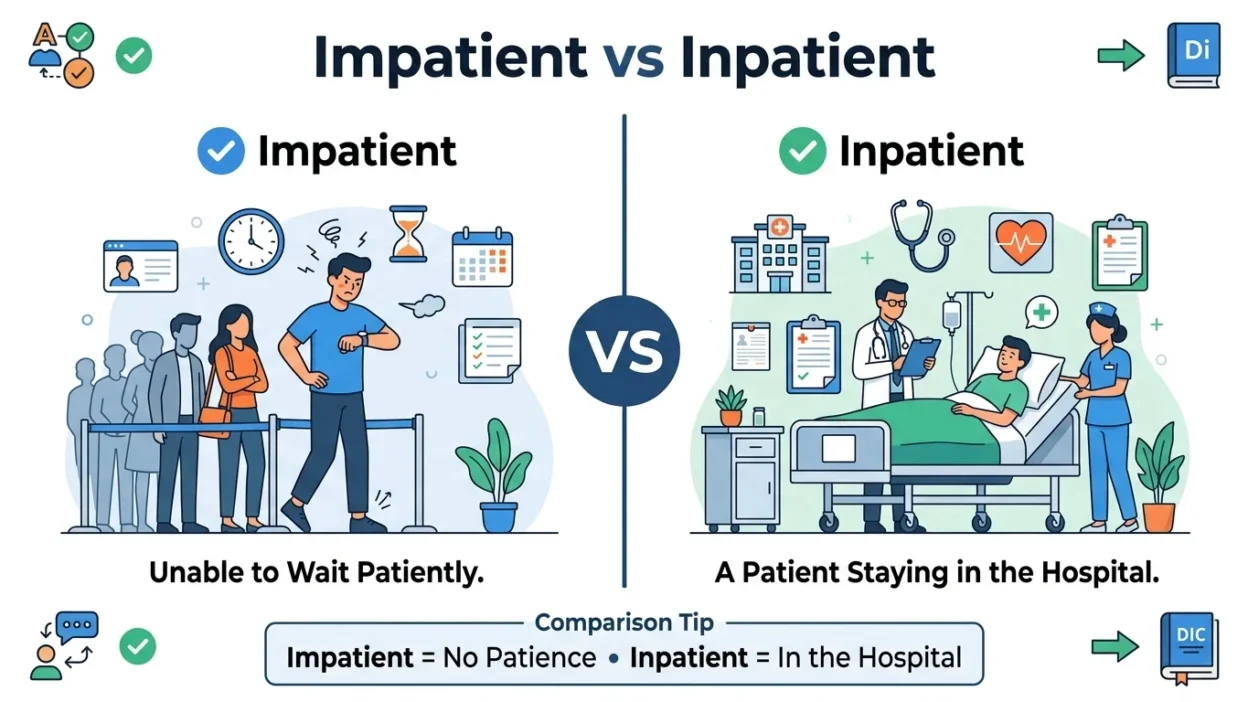
- Impatient is an adjective that describes someone who is unable or unwilling to wait calmly.
- Inpatient is a noun (and sometimes an adjective) referring to a person who stays in a hospital or medical facility for treatment.
Examples
- She became impatient while waiting in line. ✅
- The doctor checked on every inpatient this morning. ✅
Although they look alike, these words have completely different meanings and should never be used interchangeably.
What Does “Impatient” Mean?
Impatient is an adjective used to describe a person who becomes frustrated, restless, or annoyed because something is taking too long.
It often expresses a lack of patience or difficulty waiting.
Simple Definition
Impatient means:
Examples
- The children grew impatient before dinner.
- I’m becoming impatient with the slow internet.
- She looked impatient during the meeting.
- Customers became impatient after waiting an hour.
- He was impatient to hear the results.
Notice that impatient describes feelings or behavior.
What Does “Inpatient” Mean?
Inpatient is a medical term.
It refers to a person who is admitted to a hospital and stays overnight or longer for treatment, observation, or recovery.
Simple Definition
Inpatient means:
Examples
- The hospital admitted twenty new inpatients yesterday.
- Every inpatient receives regular medical care.
- She remained an inpatient after surgery.
- The doctor visited each inpatient during morning rounds.
- The hospital expanded its inpatient services.
Here, the word refers to hospitalized patients rather than emotions.
Impatient vs Inpatient: Key Difference
Although these words are similar in spelling, they belong to different categories and have entirely different meanings.
| Feature | Impatient | Inpatient |
|---|---|---|
| Part of speech | Adjective | Noun (sometimes adjective) |
| Main meaning | Unable to wait calmly | Hospital patient staying overnight |
| Context | Everyday emotions | Healthcare and medicine |
| Related word | Patience | Hospital admission |
| Opposite | Patient | Outpatient |
The easiest way to remember them is:
- Impatient = No patience
- Inpatient = Inside a hospital
When Should You Use “Impatient”?
Use impatient whenever you’re describing someone’s emotions, attitude, or behavior while waiting.
Common situations include:
- Waiting in line
- Delayed flights
- Slow internet
- Long meetings
- Waiting for news
- Traffic jams
- Customer service
Examples
- We became impatient during the delay.
- The audience grew impatient.
- She sounded impatient on the phone.
- He was impatient to begin the project.
- Drivers became impatient in heavy traffic.
When Should You Use “Inpatient”?
Use inpatient when referring to someone admitted to a hospital or healthcare facility.
Common situations include:
- Hospitals
- Medical reports
- Insurance documents
- Healthcare services
- Surgery
- Recovery
- Long-term treatment
Examples
- The inpatient recovered quickly.
- She received excellent inpatient care.
- The hospital hired more inpatient nurses.
- Insurance covers certain inpatient treatments.
- His condition required inpatient rehabilitation.
Impatient vs Inpatient in Context
Comparing the words side by side makes the difference much clearer.
Example 1
The child became impatient while waiting for the movie to start.
Meaning: The child was tired of waiting.
Example 2
The child remained an inpatient after surgery.
Meaning: The child stayed in the hospital for treatment.
The first sentence describes an emotion.
The second describes a medical status.
Common Expressions with “Impatient”
You’ll often hear these phrases:
- become impatient
- grow impatient
- impatient customer
- impatient driver
- impatient child
- impatient waiting
- visibly impatient
- impatient for results
These combinations appear frequently in everyday English.
Common Expressions with “Inpatient”
Likewise, inpatient is commonly used in healthcare.
Examples include:
- inpatient care
- inpatient treatment
- inpatient services
- inpatient admission
- inpatient rehabilitation
- inpatient unit
- inpatient facility
- inpatient department
These collocations are standard medical terminology.
Common Mistakes to Avoid
Because these words differ by only one letter, they’re often confused.
1. Using “Inpatient” for Emotions
Incorrect:
- She became inpatient while waiting.
Correct:
- She became impatient while waiting.
2. Using “Impatient” in Medical Contexts
Incorrect:
- The hospital admitted several impatient yesterday.
Correct:
- The hospital admitted several inpatients yesterday.
3. Forgetting the Double Meaning of “Patient”
Many learners confuse:
- patient (calm person)
- patient (person receiving medical care)
Remember:
- Impatient comes from the first meaning (not calm).
- Inpatient comes from the second meaning (hospital patient).
Understanding this distinction makes the words easier to remember.
Impatient vs Outpatient vs Inpatient
Medical vocabulary often includes another similar word.
| Word | Meaning |
|---|---|
| Impatient | Unable to wait calmly |
| Inpatient | Patient staying in a hospital |
| Outpatient | Patient treated without staying overnight |
Examples:
- He became impatient after waiting.
- She is an inpatient recovering from surgery.
- The clinic treated hundreds of outpatients this week.
American vs British English
The meanings of impatient and inpatient are the same in both American and British English.
There are:
- no spelling differences
- no grammar differences
- no pronunciation changes that affect meaning
Healthcare systems may differ between countries, but the words themselves are used the same way.
Related Words and Synonyms
Synonyms for Impatient
Depending on the context, you can use:
- restless
- eager
- anxious
- frustrated
- irritated
- uneasy
- agitated
- intolerant of delay
Synonyms for Inpatient
In healthcare, related terms include:
- hospitalized patient
- admitted patient
- resident patient
- hospital patient
- medical patient
Learning these related words expands your vocabulary and supports natural writing.
Tips to Remember the Difference
A simple memory trick can help.
Think about the prefixes.
Impatient begins with im-, reminding you of impatience or being unable to wait.
Inpatient begins with in-, reminding you that the patient stays in the hospital.
Remember:
- Impatient = No patience
- Inpatient = In the hospital
This quick association works in almost every situation.
FAQs
What is the difference between impatient and inpatient?
Impatient describes someone who cannot wait calmly, while inpatient refers to a person staying in a hospital for treatment.
Is inpatient one word or two?
Inpatient is one word in modern English and is the standard spelling.
Is impatient an adjective?
Yes. Impatient is an adjective describing a person’s feelings or behavior.
Can inpatient be an adjective?
Yes. It can describe healthcare services, such as inpatient care or inpatient treatment.
Do British and American English use these words differently?
No. Both varieties use impatient and inpatient in the same way.
What is the opposite of inpatient?
The opposite medical term is outpatient, referring to someone treated without staying overnight.
How can I remember the difference?
Think of inpatient as a patient who stays in the hospital, while impatient means someone who lacks patience.
Summary
Understanding impatient vs inpatient is easier once you recognize that they belong to completely different contexts. Impatient describes an emotion or behavior, specifically the inability to wait calmly or tolerate delays. Inpatient, on the other hand, is a medical term referring to a patient who stays in a hospital for treatment or observation. Although they differ by just one letter, confusing them can completely change the meaning of your sentence.
If you’re writing an email, reading a medical report, or improving your English vocabulary, choosing the correct word helps you communicate clearly and professionally. Since both American and British English use these words in the same way, these rules apply wherever English is spoken.