The phrases He is risen and He has risen are both closely associated with the resurrection of Jesus Christ, especially during Easter celebrations. Because they look so similar, many people wonder whether one is grammatically correct and the other is outdated—or whether both are acceptable. If you’ve ever been unsure which phrase to use, you’re not alone.
The answer depends on grammar, history, and context. While He has risen follows modern English grammar, He is risen is a traditional expression that has deep roots in older forms of English and Christian worship. In this guide, you’ll learn the difference between he is risen vs he has risen, their meanings, historical background, examples, common mistakes, and when each phrase is most appropriate.
Quick Answer
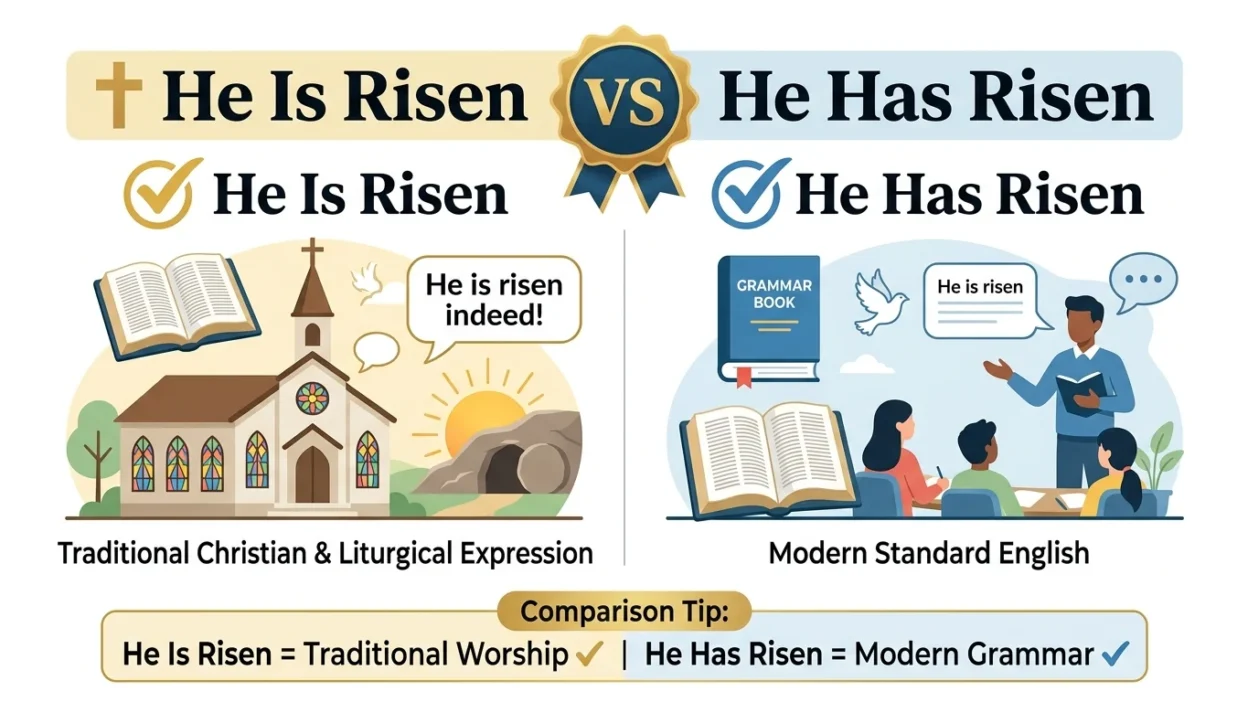
Both phrases are correct, but they serve different purposes.
- He has risen is the grammatically standard form in modern English.
- He is risen is a traditional, liturgical, and biblical expression preserved in many Christian churches, hymns, and older Bible translations.
Examples
- He has risen, just as He said. ✅ (Modern English)
- He is risen indeed! ✅ (Traditional Christian greeting)
If you’re writing in everyday English, He has risen is usually the preferred choice. If you’re quoting Scripture, participating in worship, or using traditional Easter greetings, He is risen is perfectly appropriate.
What Does “He Has Risen” Mean?
He has risen is the present perfect tense.
It combines:
- has (helping verb)
- risen (past participle of rise)
It means that Jesus rose from the dead, and the result continues to be true today.
Examples
- He has risen from the dead.
- Christ has risen.
- Jesus has risen, fulfilling the prophecy.
This construction follows modern English grammar and is commonly found in contemporary Bible translations.
What Does “He Is Risen” Mean?
He is risen is an older grammatical construction that uses the verb to be as an auxiliary with certain intransitive verbs.
Centuries ago, English often formed the perfect tense of verbs like rise, come, and go using is or was instead of has or had.
Today, this pattern survives mainly in:
- traditional Christian worship
- Easter greetings
- classic hymns
- historic Bible translations
- liturgical language
Examples
- He is risen indeed!
- Christ is risen!
- Alleluia! He is risen!
These expressions are cherished for their historical and spiritual significance.
He Is Risen vs He Has Risen: Key Difference
The meanings are essentially the same, but the style and grammar differ.
| Feature | He Is Risen | He Has Risen |
|---|---|---|
| Modern grammar | Traditional rather than standard | Standard |
| Historical usage | Yes | Yes |
| Church liturgy | Very common | Common |
| Everyday English | Rare | Common |
| Easter greeting | Very common | Also used |
| Bible translations | Older translations | Modern translations |
Neither phrase changes the underlying message of Christ’s resurrection.
Why Do Christians Still Say “He Is Risen”?
Many churches continue using He is risen because it has become a traditional declaration of faith.
The familiar Easter greeting is:
Leader:
“He is risen!”
Response:
“He is risen indeed!”
This exchange has been used by Christians for centuries and remains meaningful regardless of modern grammatical changes.
Its continued use reflects tradition rather than incorrect grammar.
Historical Background
In older English, verbs expressing movement often used be instead of have.
Examples from Early Modern English include:
- He is come.
- They are departed.
- Christ is risen.
Over time, English grammar shifted toward using have.
Today we normally say:
- He has come.
- They have departed.
- Christ has risen.
The older forms remain preserved in literature, worship, and historical texts.
Examples of “He Has Risen”
Modern examples include:
- Christians believe He has risen from the dead.
- The Gospel teaches that Christ has risen.
- Easter celebrates that Jesus has risen.
- We rejoice because He has risen.
- He has risen just as He promised.
These sound natural in contemporary English.
Examples of “He Is Risen”
Traditional examples include:
- He is risen indeed!
- Christ is risen! Alleluia!
- The Lord is risen.
- Today we proclaim that He is risen.
- The congregation joyfully declared, “He is risen!”
These examples are commonly heard in churches around the world.
Common Mistakes to Avoid
Because both phrases are correct in different settings, confusion is understandable.
1. Thinking “He Is Risen” Is Wrong
It is not wrong.
It is simply an older, traditional form preserved in Christian worship.
2. Assuming They Mean Different Things
Both phrases communicate the same central belief:
Jesus rose from the dead.
The difference lies in grammar and style—not meaning.
3. Using “He Is Risen” in General Modern Writing
Outside religious contexts, He has risen usually sounds more natural to modern readers.
4. Correcting Traditional Easter Greetings
Some people mistakenly “correct” the phrase:
“He is risen indeed.”
In church settings, this traditional greeting is entirely appropriate and should not be treated as a grammatical mistake.
American vs British English
There is virtually no difference between American and British English regarding these phrases.
Both varieties:
- use He has risen in modern writing,
- preserve He is risen in religious and liturgical contexts.
The distinction is based on historical English rather than regional English.
Related Expressions
These phrases often appear alongside the main keyword.
Examples include:
- Christ is risen
- Christ has risen
- He is risen indeed
- He has risen indeed
- Easter greeting
- Resurrection of Christ
- Resurrection Sunday
- Paschal greeting
- Alleluia
- The Lord has risen
These related expressions naturally support understanding of the topic.
Tips to Remember the Difference
Here’s an easy way to remember.
Ask yourself where you’re using the phrase.
If you’re writing:
- an essay
- an article
- modern English
choose:
He has risen
If you’re:
- celebrating Easter
- quoting historic liturgy
- using a traditional greeting
choose:
He is risen
Both are correct within their intended contexts.
FAQs
Which is correct: He is risen or He has risen?
Both are correct. He has risen follows modern grammar, while He is risen is the traditional liturgical expression.
Why do churches say “He is risen”?
Because it preserves an older English grammatical form that has become part of Christian worship and Easter tradition.
Is “He is risen” grammatically incorrect?
No. It reflects historical English grammar rather than contemporary usage.
Which phrase appears in modern Bible translations?
Most modern translations use He has risen, although some traditional translations preserve older wording in certain contexts.
Can I say “He is risen indeed”?
Yes. It is the traditional Christian Easter response used around the world.
Do British and American English differ?
No. Both use the same traditional and modern forms.
Which phrase should I use in everyday writing?
For modern English outside religious tradition, He has risen is usually the better choice.
Summary
Understanding he is risen vs he has risen is easier once you recognize the difference between modern grammar and historical tradition. He has risen is the standard present perfect construction used in contemporary English and most modern Bible translations. He is risen, however, is a respected traditional expression that has been preserved in Christian worship, hymns, and Easter greetings for centuries.
Rather than viewing one phrase as right and the other as wrong, it’s better to see them as serving different purposes. He has risen is ideal for everyday modern writing, while He is risen continues to carry profound historical, literary, and spiritual significance within the Christian faith.