If you’ve ever stopped while writing and wondered whether to use by which or in which, you’re not alone.
These two English phrases often appear in formal writing, academic papers, business communication, and even everyday conversations.
Because they both begin with the word which, many learners assume they can be used interchangeably. However, they serve different grammatical purposes.
Understanding the difference between by which vs in which will help you write more clearly and confidently.
In this guide, you’ll learn what each phrase means, when to use it, common mistakes to avoid, practical examples, and whether American and British English treat these expressions differently.
Quick Answer
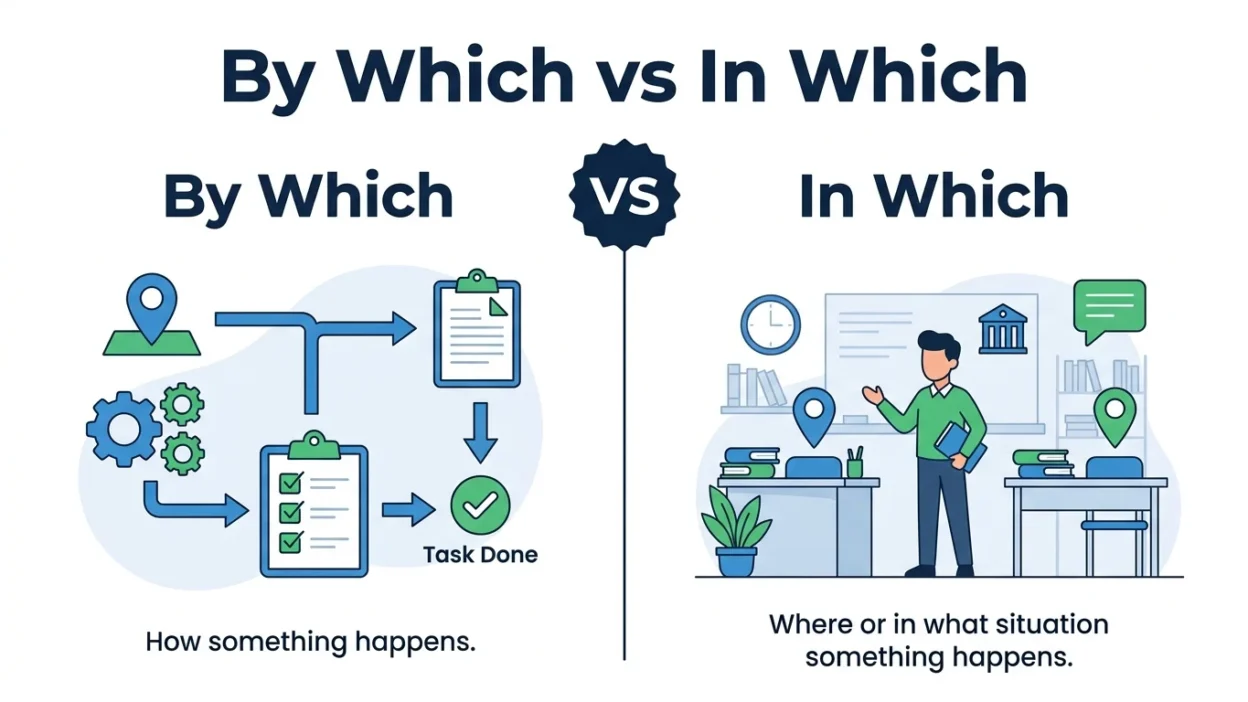
By which and in which are both grammatically correct, but they have different meanings.
- By which refers to the method, means, or way something happens.
- In which refers to the place, situation, condition, or context where something happens.
Example:
- This is the method by which the machine operates. ✅
- This is the room in which the meeting was held. ✅
The easiest way to remember the difference is:
- By which = how something happens
- In which = where or in what situation something happens
What Does “By Which” Mean?
By which is used to describe the means, method, process, or instrument through which something is done.
It answers questions like:
- How?
- By what method?
- By what means?
This phrase commonly appears in formal English, academic writing, legal documents, scientific reports, and professional communication.
Examples
- The policy by which employees are evaluated has changed.
- This is the process by which water is purified.
- The technology by which data is transmitted is highly secure.
- We explained the method by which the results were calculated.
- The agreement outlines the procedure by which payments will be made.
In each sentence, by which introduces the method or means.
What Does “In Which” Mean?
In which refers to a place, circumstance, condition, event, or situation.
It answers questions like:
- Where?
- In what situation?
- Under what circumstances?
It is commonly used in both formal and everyday English.
Examples
- This is the office in which I work.
- We visited the town in which she was born.
- It was a situation in which everyone felt uncomfortable.
- This is the chapter in which the mystery is solved.
- The meeting in which we discussed the budget lasted two hours.
Here, in which introduces the location or context.
By Which vs In Which: Key Difference
Although both phrases are relative expressions, they perform different grammatical functions.
| Feature | By Which | In Which |
|---|---|---|
| Main meaning | Method or means | Place or situation |
| Answers | How? By what means? | Where? In what context? |
| Common use | Processes, procedures, methods | Locations, events, conditions |
| Formal writing | Very common | Very common |
| Everyday English | Less frequent | More frequent |
The easiest distinction is:
- By which explains how something happens.
- In which explains where or under what circumstances something happens.
When Should You Use “By Which”?
Use by which whenever you’re describing the method, process, tool, or mechanism responsible for an action.
Common situations include:
- Scientific explanations
- Technical writing
- Business procedures
- Legal documents
- Academic papers
- Instruction manuals
Examples
- The formula by which interest is calculated is simple.
- This is the process by which diamonds are formed.
- The system by which orders are tracked has improved.
- The standards by which performance is measured are clear.
- We explained the technique by which the artwork was restored.
Notice that every sentence describes how something happens.
When Should You Use “In Which”?
Choose in which when referring to a place, event, condition, circumstance, or period.
It’s useful when writing about:
- Locations
- Buildings
- Meetings
- Stories
- Situations
- Historical events
- Periods of time
Examples
- The hotel in which we stayed was beautiful.
- This is the classroom in which the exam will take place.
- It was a conversation in which everyone participated.
- The decade in which computers became common changed society.
- We reached an agreement in which both sides benefited.
Each example identifies a location or context.
Understanding the Difference Through Context
Sometimes both phrases appear in similar topics, but their meanings remain different.
Example 1
The process by which plants produce oxygen.
Here, you’re describing the method.
Example 2
The greenhouse in which the plants grow.
Here, you’re describing the place.
One explains how.
The other explains where.
Everyday Examples
Understanding real-life situations makes the distinction easier.
At School
- The method by which students are graded has changed.
- The classroom in which students learn is newly renovated.
At Work
- The software by which reports are generated saves time.
- The office in which we work is downtown.
At Home
- The recipe by which Grandma makes bread is famous.
- The kitchen in which she cooks is very spacious.
Can You Replace Them with Simpler Words?
Yes. In everyday conversation, native speakers often use shorter alternatives.
Instead of:
- The house in which I live.
People often say:
- The house that I live in.
Instead of:
- The process by which water is filtered.
People may say:
- The process used to filter water.
These alternatives sound more natural in casual speech, while by which and in which are more common in formal writing.
Common Mistakes to Avoid
Many English learners confuse these phrases because they look similar.
1. Using “By Which” for Places
Incorrect:
- The room by which we studied.
Correct:
- The room in which we studied.
Rooms are places, so use in which.
2. Using “In Which” for Methods
Incorrect:
- The method in which data is collected.
Correct:
- The method by which data is collected.
Methods require by which.
3. Forgetting the Meaning of the Preposition
Remember:
- By = method or means.
- In = location or context.
Focusing on the preposition usually leads you to the correct choice.
American vs British English
One advantage of learning these expressions is that there is no significant difference between American and British English.
Both varieties use by which and in which in the same grammatical way.
However, conversational English in both regions often replaces them with simpler constructions.
Formal writing:
- The procedure by which applications are reviewed.
Casual speech:
- The procedure we use to review applications.
Formal writing:
- The building in which they work.
Casual speech:
- The building they work in.
The meaning stays the same.
Related Grammar Patterns
These expressions belong to a larger group of relative phrases.
Examples include:
- by whom
- in which
- through which
- during which
- from which
- with which
- on which
- under which
- for which
- to which
Learning these patterns helps improve both grammar and writing style.
Tips to Remember the Difference
A simple memory trick can make choosing much easier.
Think of the prepositions.
By = Method
Ask yourself:
“By what method?”
If the sentence answers that question, use by which.
In = Place
Ask yourself:
“In what place or situation?”
If it answers that question, use in which.
This quick test works in most situations.
FAQs
Is “by which” grammatically correct?
Yes. It is grammatically correct and commonly used to introduce the method or means by which something happens.
Is “in which” grammatically correct?
Yes. It is a standard English expression used to refer to places, situations, or contexts.
Can “by which” and “in which” be used interchangeably?
No. By which refers to methods or means, while in which refers to locations or situations.
Which phrase is more common?
In which appears more frequently because people often describe places and situations. By which is especially common in formal and technical writing.
Are these expressions formal?
Yes. Both are more common in formal writing than in casual conversation.
Is there any difference between American and British English?
No. Both American and British English use these phrases with the same meanings and grammar rules.
Can I replace them with “that”?
Sometimes. In which is often replaced by “that…in” or simply omitted in informal English. By which usually requires a different sentence structure rather than a direct replacement.
Summary
Understanding by which vs in which becomes much easier once you focus on the role of the preposition.
By which explains the method, process, or means through which something happens, while in which identifies the place, circumstance, or context where something occurs.
Although both expressions are common in formal English, they describe different relationships and should not be used interchangeably.
If you’re writing an academic paper, business report, blog post, or simply improving your English, mastering these phrases will make your writing clearer and more precise.
Since both American and British English follow the same rules, you can confidently apply them in any variety of English.
Actionable Takeaway
Whenever you’re choosing between by which and in which, pause and ask yourself one simple question: Am I describing how something happens or where it happens? If you’re explaining a method or process, use by which. If you’re referring to a place, situation, or context, choose in which. This small habit will help you write with greater accuracy and confidence.