
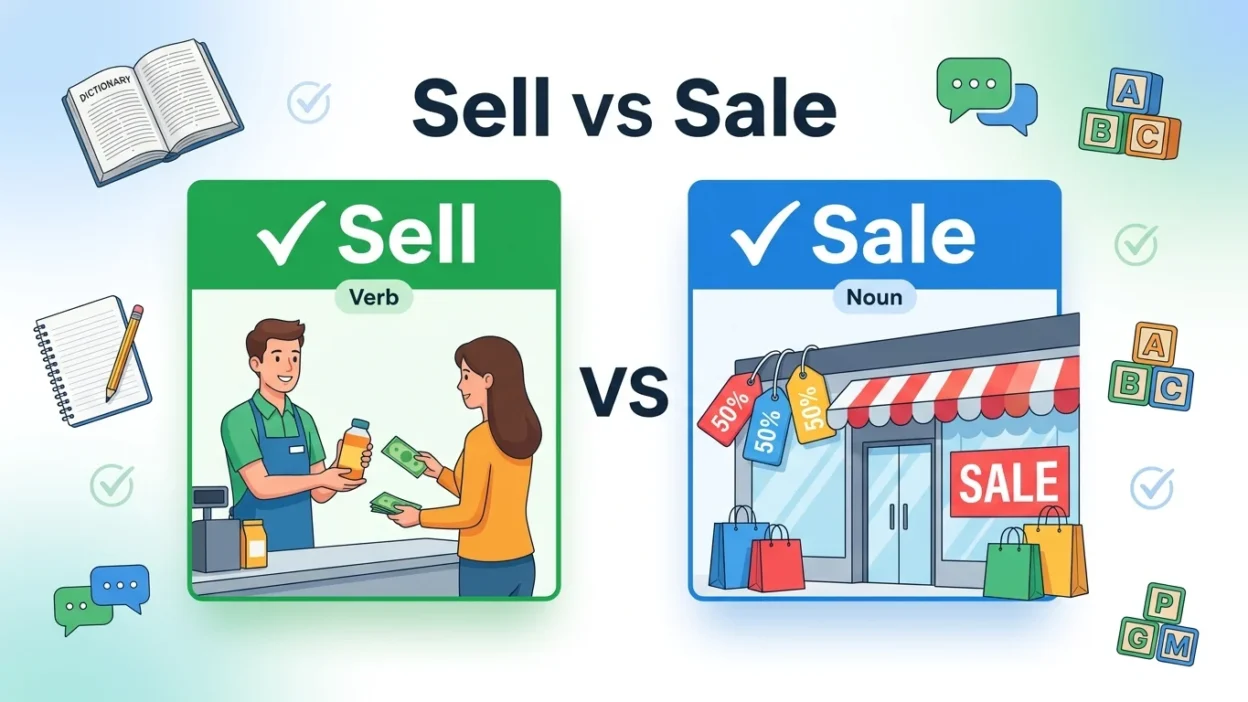
Have you ever paused while writing and wondered whether to use sell or sale? You’re not alone.
These two words are closely related, and because they both involve buying and selling, many English learners mistakenly use them interchangeably. However, they have different meanings and grammatical roles.
Understanding the difference between sell vs sale will help you write and speak more confidently, if you’re shopping online, writing business emails, creating advertisements, or improving your English vocabulary.
In this guide, you’ll learn what each word means, when to use it, common mistakes to avoid, and simple memory tricks that make the distinction easy to remember.
Quick Answer
The difference between sell and sale is straightforward:
- Sell is a verb that means to give something to someone in exchange for money.
- Sale is a noun that refers to the act of selling something or a special event where goods are sold at reduced prices.
Examples
- ✅ I want to sell my old bicycle.
- ✅ The store is having a big sale this weekend.
- ❌ I want to sale my bicycle.
- ❌ The shop will sell starts tomorrow.
If you’re describing an action, use sell. If you’re referring to an event or transaction, use sale.
What Does “Sell” Mean?
Sell is a verb that means to exchange goods or services for money.
It describes the action performed by a person, company, or business.
Examples of Sell
- I want to sell my laptop.
- They sell fresh vegetables every morning.
- She sold her car last month.
- This company sells software worldwide.
- We plan to sell our house next year.
Notice that sell expresses an action.
What Does “Sale” Mean?
Sale is a noun.
It refers to:
- The act of selling something.
- A business transaction.
- A promotional event where products are offered at discounted prices.
Examples of Sale
- The sale begins on Friday.
- We made our first sale today.
- The clothing store is having a clearance sale.
- Ticket sales increased this month.
- The house is for sale.
Unlike sell, sale names an event or thing rather than an action.
Sell vs Sale: Comparison Table
| Feature | Sell | Sale |
|---|---|---|
| Part of Speech | Verb | Noun |
| Meaning | Exchange something for money | Selling event or transaction |
| Describes | Action | Thing or event |
| Example | They sell books. | The books are on sale. |
| Can be a verb? | Yes | No |
| Can be a noun? | No | Yes |
This comparison makes it easier to remember when each word should be used.
When Should You Use “Sell”?
Use sell whenever you’re describing the action of offering or exchanging something for money.
Common Situations
- Selling products
- Selling services
- Selling a house
- Selling a car
- Online marketplaces
- Business conversations
Correct Examples
- I want to sell my phone.
- She sells handmade jewelry.
- They sold their business.
- The company sells furniture online.
- He hopes to sell more products this year.
In every example, sell is an action.
When Should You Use “Sale”?
Use sale when referring to:
- A completed transaction.
- A discount event.
- Merchandise available for purchase.
- Business records.
Correct Examples
- The store announced a holiday sale.
- We completed the sale yesterday.
- Everything is on sale today.
- House sales have increased this year.
- The final sale price was lower than expected.
Here, sale functions as a noun.
Common Expressions with Sell
You’ll often hear these expressions:
- Sell online
- Sell quickly
- Sell products
- Sell your car
- Sell your home
- Sell successfully
- Sell directly
- Sell to customers
Example Sentences
- They sell electronics worldwide.
- I want to sell my old books.
Common Expressions with Sale
These phrases are extremely common in everyday English.
- On sale
- For sale
- Garage sale
- Clearance sale
- Flash sale
- Seasonal sale
- Final sale
- Sales event
Example Sentences
- Everything is on sale.
- The bicycle is for sale.
- The supermarket has a weekend sale.
Common Mistakes to Avoid
Many learners confuse these two words because they’re closely related.
1. Using Sale as a Verb
❌ I want to sale my car.
✅ I want to sell my car.
2. Using Sell as a Noun
❌ The shop has a big sell.
✅ The shop has a big sale.
3. Confusing “For Sale” and “Sell”
Correct:
- This house is for sale.
Correct:
- They want to sell the house.
These two expressions are related but have different grammar.
4. Forgetting the Part of Speech
Remember:
- Sell = verb
- Sale = noun
This simple rule solves most mistakes.
Easy Memory Trick
Here’s an easy way to remember.
Sell = Action
Think:
You sell something.
Since it’s something you do, it’s a verb.
Sale = Event or Thing
Think:
A sale happens.
Since it’s an event or result, it’s a noun.
Another trick:
If you can replace the word with discount event, you probably need sale.
If you can replace it with exchange for money, you need sell.
Related Words
Understanding related forms can strengthen your vocabulary.
| Word | Part of Speech | Meaning |
|---|---|---|
| Sell | Verb | Exchange for money |
| Sale | Noun | Selling event or transaction |
| Seller | Noun | Person who sells |
| Salesperson | Noun | Person employed to sell |
| Selling | Verb/Adjective | The act of offering goods |
| Sales | Noun | Business transactions |
Learning the entire word family makes it easier to remember each form.
Sell vs Sale in Business English
In business communication, the difference is especially important.
Examples:
- Our company sells software.
- Software sales increased by 20%.
- The marketing team wants to sell more products.
- The holiday sale starts tomorrow.
Using the correct word improves professionalism and clarity.
American vs British English
There is no spelling or grammatical difference between American and British English regarding sell and sale.
Both varieties use:
- Sell
- Sale
- Sales
- Selling
The only differences may be in vocabulary surrounding shopping.
For example:
American English:
- Clearance sale
British English:
- Closing-down sale
The meanings of sell and sale remain exactly the same.
Example Sentences
Sell Examples
- We sell coffee every morning.
- She sold her bicycle.
- They sell clothing online.
- I hope to sell my artwork.
- He sells insurance.
Sale Examples
- The furniture is on sale.
- The sale starts tomorrow.
- Our biggest sale happened in December.
- This phone is for sale.
- The store held a clearance sale.
Why Do People Confuse Sell and Sale?
The confusion comes from three main reasons.
- They share the same root word.
- They are pronounced similarly.
- They both relate to buying and selling.
However, remembering that sell is a verb and sale is a noun will help you avoid nearly every mistake.
FAQs
What is the difference between sell and sale?
Sell is a verb meaning to exchange something for money, while sale is a noun referring to the act of selling or a promotional event.
Is it “for sale” or “for sell”?
The correct expression is for sale.
Can sale be used as a verb?
No. Sale is always a noun.
Can sell be used as a noun?
No. Sell functions as a verb in standard English.
Why do people confuse sell and sale?
Because they have similar spellings, related meanings, and nearly identical pronunciations.
Is there a British and American English difference?
No. Both American and British English use sell and sale in the same way.
What is another word for sell?
Depending on the context, alternatives include market, trade, offer, retail, and vend.
What is another word for sale?
Similar words include promotion, discount event, clearance, offer, and transaction, depending on the context.
Summary
Understanding sell vs sale is easier once you recognize their grammatical roles.
Sell is a verb used to describe the action of exchanging goods or services for money, while sale is a noun referring to the event, transaction, or promotional discount.
Although the two words are closely connected, they are not interchangeable and should be used according to their function in a sentence.
If you’re writing a business email, posting an online advertisement, or improving your English grammar, choosing the correct word will make your communication clearer and more professional.
By remembering that sell expresses an action and sale names a thing or event, you’ll avoid one of the most common vocabulary mistakes in English.
Actionable Takeaway
Before choosing between sell and sale, ask yourself one simple question: Am I describing an action or naming an event? If it’s an action, use sell. If it’s an event, transaction, or discount promotion, use sale. Practicing this quick check will help you use both words accurately and confidently every time.