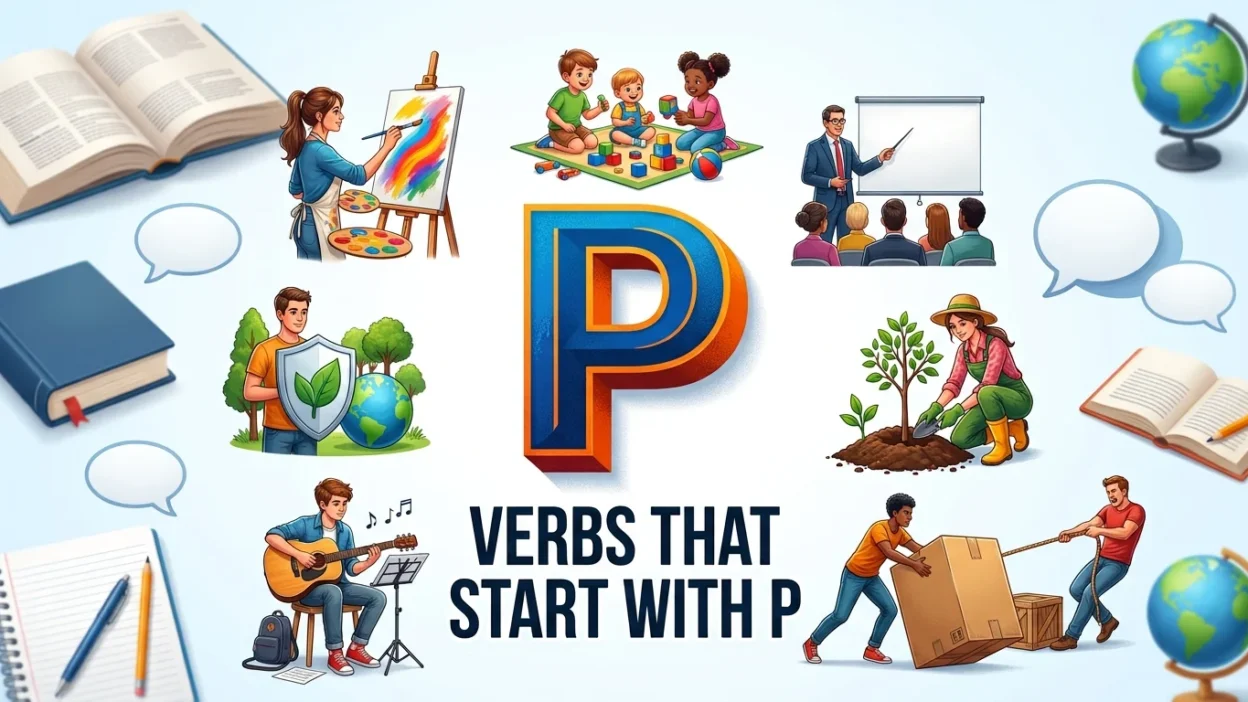
Looking for verbs that start with P? Whether you’re improving your English vocabulary, writing creatively, preparing for school, or finding action words for games like Scrabble or Wordle, learning verbs that begin with the letter P can significantly expand your language skills.
Verbs are the heart of every sentence because they describe actions, events, or states of being. In this guide, you’ll discover a comprehensive list of verbs that start with P, their meanings, example sentences, common mistakes to avoid, and practical tips for using them correctly in everyday English.
Quick Answer
Verbs that start with P are action or state words beginning with the letter P. Common examples include:
- Paint
- Play
- Prepare
- Protect
- Perform
- Practice
- Push
- Pull
- Pass
- Promise
These verbs are widely used in conversations, academic writing, storytelling, business communication, and professional settings.
What Are Verbs That Start With P?
A verb is a word that expresses an action, occurrence, or state of being. When a verb starts with the letter P, it simply means its first letter is P.
These verbs help describe what people, animals, or objects do.
For example:
- She painted a beautiful landscape.
- They prepared dinner together.
- We protected the environment.
- He performed well in the interview.
- The children played outside.
Each highlighted word describes an action.
Common Verbs That Start With P
Here’s a list of commonly used verbs beginning with P.
| Verb | Meaning | Example Sentence |
|---|---|---|
| Paint | Apply color | She painted the wall. |
| Play | Take part in an activity | They played football. |
| Push | Apply force | Push the door gently. |
| Pull | Move toward yourself | Pull the rope carefully. |
| Pass | Move beyond or succeed | He passed the exam. |
| Prepare | Get ready | We prepared breakfast. |
| Protect | Keep safe | Trees protect wildlife. |
| Promise | Give your word | I promise to help. |
| Perform | Carry out | She performed beautifully. |
| Practice | Repeat to improve | They practice daily. |
| Pack | Put into a container | Pack your suitcase. |
| Plant | Put in the ground | We planted flowers. |
| Produce text | Print the document. | |
| Prevent | Stop from happening | Exercise prevents illness. |
| Produce | Create or manufacture | Farmers produce wheat. |
| Provide | Supply | The school provides meals. |
| Prefer | Like better | I prefer tea. |
| Persuade | Convince | She persuaded me. |
| Permit | Allow | Cameras are permitted here. |
| Praise | Express approval | Teachers praise effort. |
Positive Verbs That Start With P
Positive verbs can make your communication more encouraging and inspiring.
Some excellent positive P verbs include:
- Praise
- Protect
- Promote
- Prosper
- Progress
- Participate
- Provide
- Perform
- Preserve
- Perfect
Example Sentences
- Good leaders promote teamwork.
- Parents protect their children.
- We should preserve nature.
- Volunteers participate enthusiastically.
- Hard work helps people prosper.
These verbs work well in motivational writing and professional communication.
Action Verbs That Start With P
Action verbs describe physical or mental activities.
Examples include:
- Push
- Pull
- Paint
- Play
- Pass
- Pick
- Plant
- Pack
- Punch
- Paddle
- Point
- Patrol
- Perform
- Prepare
- Publish
Example Sentences
- She picked fresh apples.
- The workers painted the house.
- They packed their bags.
- He published a new article.
- We prepared for the meeting.
Phrasal Verbs That Start With P
Phrasal verbs combine a verb with a preposition or adverb.
Common examples include:
| Phrasal Verb | Meaning |
|---|---|
| Pick up | Collect or learn |
| Pay back | Return money |
| Pass away | Die |
| Point out | Highlight |
| Pull over | Stop a vehicle |
| Put away | Store something |
| Put off | Postpone |
| Put on | Wear |
| Pull through | Recover |
| Pay off | Succeed or settle a debt |
Examples
- I’ll pick up the kids after school.
- She pointed out the mistake.
- We had to put off the meeting.
- He finally paid off the loan.
- The doctor believes she’ll pull through.
Learning phrasal verbs improves fluency because native speakers use them frequently.
Verbs That Start With P for Students
Students often need simple action words for writing assignments.
Here are useful choices:
- Practice
- Present
- Participate
- Predict
- Plan
- Prepare
- Produce
- Publish
- Prove
- Perform
These verbs appear regularly in classrooms and exams.
Verbs That Start With P for Creative Writing
Creative writers use vivid verbs to make stories more engaging.
Examples include:
- Pierce
- Pursue
- Ponder
- Peek
- Pause
- Patrol
- Pounce
- Propel
- Perceive
- Pursue
Instead of writing:
“The cat went toward the mouse.”
You could write:
“The cat pounced on the mouse.”
Strong verbs create stronger imagery.
Common Mistakes to Avoid
Learning new verbs is exciting, but there are some mistakes to watch for.
1. Confusing Similar Verbs
Some verbs have different meanings.
For example:
- Practice means to improve through repetition.
- Perform means to carry out or present.
2. Using the Wrong Verb Form
Remember to change the verb according to tense.
Correct:
- She plays every day.
- She played yesterday.
- She has played before.
3. Choosing Weak Verbs
Instead of:
“He did a speech.”
Use:
“He presented a speech.”
Specific verbs make writing more powerful.
4. Forgetting Context
Some verbs work better in certain situations.
For example:
- Promote fits business.
- Plant fits gardening.
- Publish fits writing.
Always consider context.
Tips for Learning New Verbs
Growing your vocabulary becomes easier with regular practice.
Try these methods:
- Learn five new verbs every day.
- Write your own example sentences.
- Read books and notice action words.
- Use new verbs in conversations.
- Keep a vocabulary notebook.
- Practice with flashcards.
- Review regularly.
Consistent practice helps new words become part of your everyday language.
American vs British English
Most verbs that start with P have the same meanings in American and British English.
However, spelling differences may appear in related nouns or adjectives rather than the verbs themselves.
For example:
| American English | British English |
|---|---|
| Practice (verb) | Practice (verb) |
| Practice (noun) | Practice (noun) or Practise (verb in British English) |
One important difference is:
- American English
- Practice = noun and verb
- British English
- Practice = noun
- Practise = verb
Examples:
American:
- I practice piano daily.
British:
- I practise piano daily.
Most other P verbs remain identical across both varieties of English.
Related Words and Synonyms
Learning synonyms improves vocabulary even further.
| Verb | Synonyms |
|---|---|
| Protect | Defend, Guard, Shield |
| Prepare | Organize, Arrange |
| Praise | Compliment, Commend |
| Produce | Create, Generate |
| Perform | Execute, Carry Out |
| Persuade | Convince, Influence |
| Provide | Supply, Offer |
| Prevent | Stop, Avoid |
| Plan | Organize, Design |
| Push | Press, Shove |
Using synonyms makes writing more varied and engaging.
FAQs
What are verbs that start with P?
They are action or state words beginning with the letter P, such as play, paint, prepare, protect, and perform.
What is the most common verb starting with P?
Some of the most common are play, pass, pay, put, practice, and prepare.
Are there positive verbs that start with P?
Yes. Examples include praise, promote, prosper, participate, provide, and protect.
What are action verbs that start with P?
Examples include push, pull, paint, pick, plant, perform, and pack.
Are phrasal verbs with P important?
Absolutely. Phrasal verbs like pick up, put off, and pay back are widely used in everyday English.
Is there a difference between American and British English?
Most P verbs are the same. The main exception is practice/practise, where British English uses practise as the verb.
How can I remember new verbs?
Practice using them in sentences, read regularly, review vocabulary often, and use flashcards or writing exercises.
Summary
Learning verbs that start with P is an excellent way to strengthen your English vocabulary and make your speaking and writing more expressive.
From everyday verbs like play, prepare, and pass to more advanced words like persuade, preserve, and participate, these action words help you communicate clearly in academic, professional, and personal settings.
Adding positive verbs, action verbs, and phrasal verbs to your vocabulary also improves fluency and confidence.
Remember that knowing a verb is only the first step. The real improvement comes from using it correctly in context and practicing it regularly.
Pay attention to verb forms, choose precise action words instead of vague ones, and be aware of small differences such as practice and practise in American and British English.
With consistent effort, these verbs will become a natural part of your everyday English.
Actionable Takeaway
Start building your vocabulary today by choosing 10 verbs that start with P from this list and writing one original sentence with each. Then, try using those verbs in conversations, emails, or journal entries throughout the week. This simple habit will improve your grammar, expand your vocabulary, and make your English sound more natural.

Liam James is a language enthusiast and content writer at Verseslay, specializing in word comparisons, grammar debates, and vocabulary insights. He helps readers understand language nuances through clear, engaging, and practical explanations.