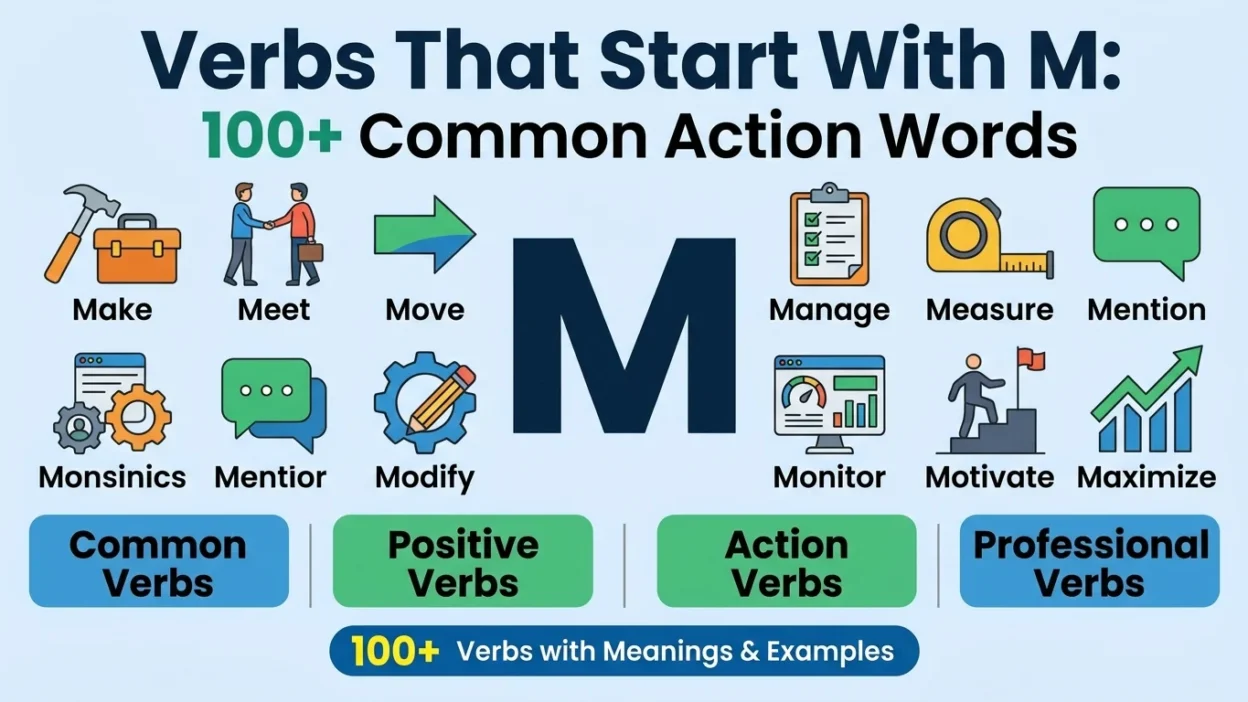
Learning verbs that start with M is a simple yet effective way to improve your English vocabulary.
If you’re a student, teacher, writer, or English learner, understanding action words that begin with the letter M can help you communicate more clearly and confidently.
Since verbs are the foundation of every sentence, adding new ones to your vocabulary makes both speaking and writing more expressive.
From everyday verbs like make, move, and meet to advanced words such as motivate, modify, and maximize, the letter M offers a wide variety of useful verbs for daily conversations, academic writing, business communication, and creative storytelling.
In this guide, you’ll discover over 100 verbs that start with M, learn their meanings, see practical examples, and understand how to use them correctly.
Quick Answer
Verbs that start with M are action or state-of-being words that begin with the letter M.
Some of the most common examples include:
- Make
- Manage
- March
- Mark
- Match
- Matter
- Measure
- Meet
- Melt
- Mend
- Mention
- Mix
- Move
- Multiply
- Motivate
These verbs describe actions, thoughts, changes, communication, and movement, making them essential in everyday English.
What Is a Verb?
A verb is a word that expresses an action, occurrence, or state of being. Every complete sentence contains a verb because it explains what the subject does or experiences.
Examples
- She made a delicious cake.
- We met our friends after school.
- The snow melted in the sunshine.
- Good teachers motivate their students.
Each highlighted word is a verb because it shows an action or process.
Common Verbs That Start With M
Below are some of the most frequently used verbs beginning with M.
| Verb | Meaning |
|---|---|
| Make | To create or produce |
| Manage | To control or organize |
| March | To walk in a regular manner |
| Mark | To label or indicate |
| Match | To pair or correspond |
| Matter | To be important |
| Measure | To determine size or amount |
| Meet | To come together |
| Melt | To change from solid to liquid |
| Mend | To repair |
| Mention | To refer to something |
| Mix | To combine |
| Model | To serve as an example or create a model |
| Modify | To change slightly |
| Monitor | To observe carefully |
| Motivate | To encourage |
| Move | To change position |
| Multiply | To increase by multiplication |
| Mumble | To speak unclearly |
| Manufacture | To produce goods |
These verbs are commonly used in schools, workplaces, and everyday conversations.
Everyday M Verbs
- Make
- Manage
- March
- Mark
- Match
- Matter
- Measure
- Meet
- Melt
- Mend
- Mention
- Mix
- Move
- Mop
- Mow
- Multiply
- Mumble
- Murder
- Miss
School and Work Verbs
- Manage
- Measure
- Memorize
- Mentor
- Modify
- Monitor
- Motivate
- Manufacture
- Market
- Merge
Professional and Business Verbs
- Maximize
- Mediate
- Modernize
- Mobilize
- Maintain
- Merge
- Manage
- Motivate
- Market
- Monitor
Advanced M Verbs
- Magnify
- Manipulate
- Materialize
- Meditate
- Mitigate
- Mobilize
- Modularize
- Motivate
- Modernize
- Multitask
Learning these verbs can improve your vocabulary and help you express ideas more precisely.
Examples of Verbs That Start With M in Sentences
Using verbs in real sentences helps reinforce their meanings.
Make
- She made a handmade birthday card.
Meet
- We’ll meet at the library after class.
Move
- Please move your chair closer to the table.
Manage
- He manages a successful restaurant.
Measure
- Always measure the ingredients carefully.
Mention
- She forgot to mention the meeting.
Modify
- The engineer modified the design to improve safety.
Monitor
- Doctors monitor the patient’s condition closely.
Motivate
- Great leaders motivate their teams through encouragement.
Maximize
- The company wants to maximize productivity.
These examples show how versatile M verbs are in everyday communication.
Verbs That Start With M by Category
Grouping vocabulary by theme makes learning faster and more effective.
Communication Verbs
These verbs are used when sharing information or interacting with others.
- Mention
- Message
- Motivate
- Mediate
- Mumble
- Mock
- Motivate
Example:
- Please mention my name when you arrive.
Movement Verbs
These verbs describe physical actions.
- Move
- March
- Migrate
- Mount
- Mop
- Mow
- March
- Maneuver
Example:
- The hikers marched through the forest.
Thinking and Learning Verbs
These verbs involve memory, learning, or decision-making.
- Memorize
- Measure
- Monitor
- Meditate
- Modify
- Manage
Example:
- Students should memorize important vocabulary every week.
Creation and Improvement Verbs
These verbs describe building, changing, or improving something.
- Make
- Mend
- Modify
- Modernize
- Manufacture
- Maximize
- Merge
- Model
Example:
- The company plans to modernize its production process.
- Maximize
- Mobilize
- Modernize
- Motivate
- Modify
- Magnify
- Maintain
- Manufacture
- Manage
- Merge
These verbs are especially useful in business writing, resumes, academic papers, and professional communication.
Here are some powerful M verbs:
Example
Weak sentence:
- The manager helped improve the team’s performance.
Stronger sentence:
- The manager motivated the team to achieve record-breaking results.
Replacing general verbs with stronger alternatives makes your writing more engaging, precise, and impactful.
Positive Verbs That Start With M
Positive verbs help your writing sound more encouraging, inspiring, and professional. They are especially useful in motivational content, business communication, teaching, and everyday conversations.
Here are some uplifting verbs that start with M:
- Motivate
- Mend
- Mentor
- Maximize
- Modernize
- Magnify
- Manage
- Mediate
- Mobilize
- Mature
Example Sentences
- Great teachers motivate students to achieve their goals.
- Good communication can mend broken relationships.
- Experienced leaders mentor new employees.
- Businesses should maximize customer satisfaction.
- Communities often mobilize during emergencies.
These verbs promote growth, improvement, teamwork, and positive change.
Common Mistakes When Using Verbs That Start With M
Even familiar verbs can be misused. Understanding common errors helps improve your grammar and writing.
Mistake 1: Confusing Similar Verbs
Some M verbs have related meanings but different uses.
For example:
Meet means to come together with someone.
- We will meet at the office tomorrow.
Match means to correspond or pair with something.
- These shoes match your outfit.
Using the wrong verb can change the meaning of your sentence.
Mistake 2: Incorrect Verb Tense
Some verbs have irregular past forms.
Incorrect:
- Yesterday I meet my teacher.
Correct:
- Yesterday I met my teacher.
Another example:
Incorrect:
- She has maked a cake.
Correct:
- She has made a cake.
Learning irregular verbs like make → made → made and meet → met → met is essential for accurate English.
Mistake 3: Using Weak Verbs Repeatedly
Instead of writing:
- The company made changes.
Use more specific verbs like:
- The company modified its policies.
- The company modernized its equipment.
- The company merged with another organization.
Specific verbs create stronger, clearer writing.
Comparison Table: Common M Verbs
Some verbs beginning with M are commonly confused. This comparison table explains the differences.
| Verb | Meaning | Example |
|---|---|---|
| Make | To create or produce | She made a delicious meal. |
| Manage | To organize or control | He manages a busy office. |
| Meet | To come together | We’ll meet after lunch. |
| Match | To correspond or pair | The curtains match the sofa. |
| Mend | To repair | My grandmother mended my shirt. |
| Modify | To change slightly | The designer modified the plan. |
| Monitor | To observe carefully | Nurses monitor patients regularly. |
| Motivate | To encourage someone | Parents motivate their children to learn. |
Knowing these distinctions helps you choose the most accurate verb for each situation.
Why Learning M Verbs Improves Your Writing
A strong vocabulary allows you to communicate with greater precision and confidence.
Using a variety of M verbs can help you:
- Improve sentence variety
- Avoid repetitive wording
- Write more persuasive content
- Strengthen business communication
- Enhance storytelling
For example:
Instead of:
- The company made improvements.
Try:
- The company modernized its technology.
- The company maximized efficiency.
- The company mobilized additional resources.
Replacing general verbs with more descriptive alternatives creates stronger writing.
Verbs That Start With M for Students
Students often learn vocabulary alphabetically because it’s easier to organize and remember.
Here are some beginner-friendly M verbs:
- Make
- March
- Mark
- Match
- Matter
- Measure
- Meet
- Melt
- Mention
- Move
Teachers can encourage students to practice these verbs by writing simple sentences.
Examples:
- Birds make nests in trees.
- We meet our classmates every morning.
- Please measure the length of the table.
- Ice melts when it gets warm.
Regular practice builds vocabulary and improves confidence.
Verbs That Start With M for Resume Writing
Strong action verbs make resumes more professional and achievement-focused.
Here are some excellent resume verbs:
- Managed
- Motivated
- Modernized
- Maximized
- Monitored
- Modified
- Mentored
- Merged
- Mobilized
- Maintained
Resume Examples
- Managed a team of 20 employees.
- Motivated staff to exceed monthly sales goals.
- Modernized office procedures, improving efficiency.
- Monitored project progress and deadlines.
- Mentored new team members during onboarding.
These verbs highlight leadership, initiative, and measurable accomplishments.
American vs British English
Most verbs that start with M have identical spelling and meaning in both American and British English.
Examples include:
- Make
- Meet
- Manage
- Measure
- Mention
- Move
- Monitor
- Motivate
However, some related words—not necessarily the verbs themselves—may have spelling differences.
Example
American English:
- Maximize
- Mobilize
- Modernize
British English:
- Maximise
- Mobilise
- Modernise
This follows the common American -ize versus British -ise spelling pattern. Both forms are correct within their respective varieties of English, and their meanings remain exactly the same.
FAQs
What are verbs that start with M?
Verbs that start with M are action or state-of-being words beginning with the letter M, such as make, meet, move, manage, and motivate. They describe actions, processes, thoughts, or conditions.
What are the most common verbs that start with M?
Some of the most frequently used M verbs include:
- Make
- Manage
- March
- Mark
- Match
- Matter
- Measure
- Meet
- Mention
- Move
These verbs appear regularly in everyday conversations, schoolwork, emails, and professional writing.
Why should I learn verbs alphabetically?
Learning verbs alphabetically makes vocabulary building more organized and manageable. It also helps you:
- Expand your English vocabulary
- Improve memory retention
- Strengthen reading and writing skills
- Prepare for spelling tests and language exams
- Communicate more confidently
What are some positive verbs that start with M?
Positive M verbs include:
- Motivate
- Mentor
- Mend
- Maximize
- Magnify
- Modernize
- Mobilize
- Manage
- Mature
- Mediate
These verbs are ideal for motivational writing, leadership communication, and personal development.
What are some strong action verbs that start with M?
Powerful action verbs include:
- Maximize
- Mobilize
- Modernize
- Motivate
- Manufacture
- Merge
- Modify
- Manage
- Maintain
- Magnify
Using these verbs makes your writing more dynamic and persuasive.
Are verbs that start with M useful in professional writing?
Absolutely. Verbs such as managed, maintained, monitored, mentored, modified, and maximized are commonly used in resumes, business reports, presentations, and workplace communication because they clearly describe responsibilities and achievements.
How can I remember more M verbs?
Here are some practical strategies:
- Learn five to ten new verbs each week.
- Group verbs by categories like communication, movement, and business.
- Write original sentences using each new verb.
- Read books and articles regularly.
- Review vocabulary with flashcards or language-learning apps.
Daily practice helps turn new words into lasting vocabulary.
Are there irregular verbs that start with M?
Yes. Several common M verbs are irregular.
| Base Form | Past Tense | Past Participle |
|---|---|---|
| Make | Made | Made |
| Meet | Met | Met |
| Mean | Meant | Meant |
Because these verbs don’t follow the standard -ed pattern, it’s important to memorize their past and past participle forms.
Summary
Learning verbs that start with M is a practical way to expand your English vocabulary and improve your communication skills.
From everyday verbs like make, meet, move, and measure to advanced words such as modernize, mobilize, maximize, and motivate, these action words help you express ideas with greater clarity and confidence in both personal and professional settings.
Using a wide variety of verbs also makes your writing more engaging and precise.
if you’re writing essays, emails, resumes, business reports, or creative stories, choosing the right verb allows you to communicate more effectively and avoid repetitive language.
With regular practice, these M verbs will become a natural part of your everyday English.
Actionable Takeaway
Start by mastering these 10 essential verbs that start with M:
- Make
- Manage
- March
- Match
- Measure
- Meet
- Mention
- Modify
- Motivate
- Move
Then, challenge yourself to use each verb in an original sentence every day. As your confidence grows, incorporate advanced verbs like maximize, mobilize, modernize, and mentor into your writing to make your vocabulary richer and more impactful.
Consistent practice is the key to becoming a stronger English speaker and writer.