Have you ever typed a word quickly and wondered whether it should be message or messege? You’re not alone.
This is one of the most common spelling mistakes in English, especially in emails, text messages, social media posts, and professional communication.
The confusion happens because English spelling doesn’t always match pronunciation perfectly.
Many people accidentally write messege because it sounds similar to how the word is spoken. However, only one spelling is correct.
In this guide, we’ll break down message vs messege, explain the correct spelling, provide examples, highlight common mistakes, and share easy tricks to remember it forever.
Quick Answer
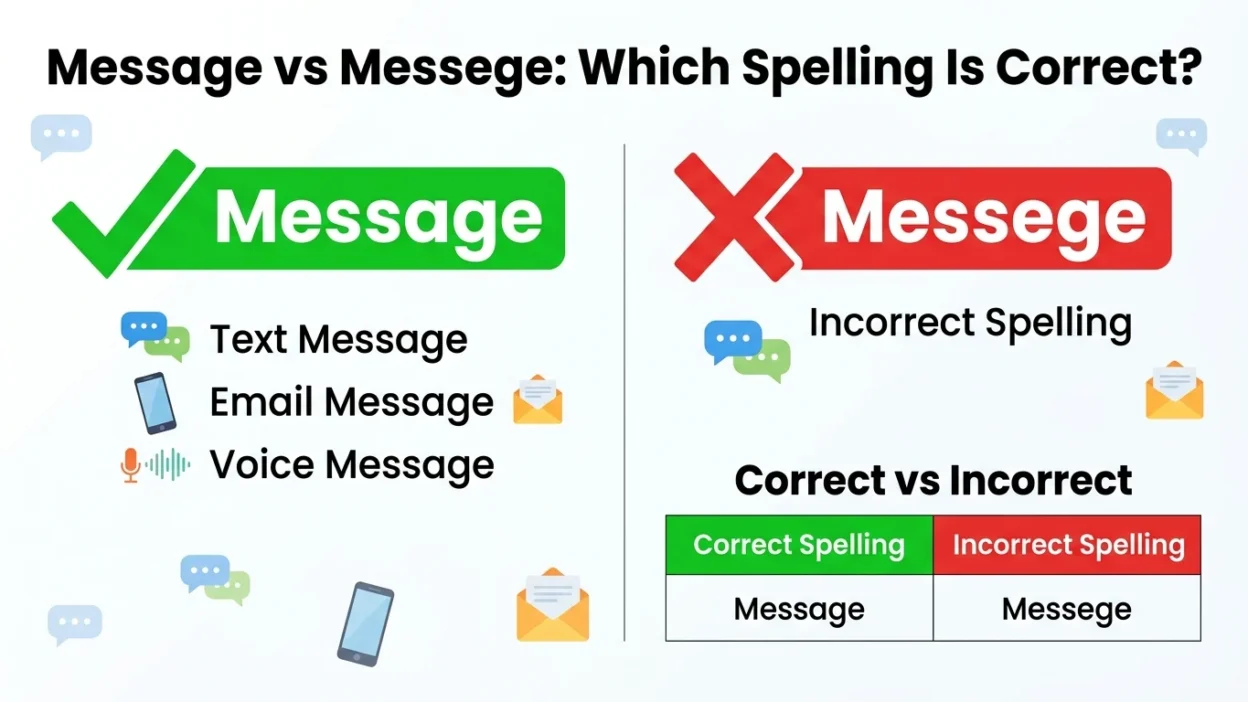
The correct spelling is message.
- ✅ Message = Correct spelling
- ❌ Messege = Incorrect spelling
Example:
- I received your message this morning. ✅
- I received your messege this morning. ❌
If you’re writing in English, always use message.
What Does “Message” Mean?
A message is a piece of communication sent from one person to another.
It can be delivered in many forms, including:
- Text messages
- Emails
- Voice messages
- Social media messages
- Written notes
- Verbal communication
The word can also refer to an idea, lesson, or meaning that someone wants to convey.
Examples of Message
- She sent me a message on WhatsApp.
- I received your email message.
- The teacher’s message was inspiring.
- Please leave a message after the beep.
- The movie carries a powerful message about friendship.
In all these examples, message refers to communication or information being shared.
Is “Messege” a Real Word?
No.
Messege is not a recognized English word. It is simply a spelling mistake of message.
You will not find messege in reputable dictionaries because it is considered incorrect in standard English.
Why Do People Write “Messege”?
Several factors contribute to this common misspelling:
- Pronunciation confusion
- Fast typing
- Autocorrect errors
- Lack of familiarity with English spelling patterns
- Mixing up similar vowel sounds
Because the word sounds somewhat like “messege” when spoken quickly, many learners assume that spelling is correct.
Message vs Messege: Key Differences
| Feature | Message | Messege |
|---|---|---|
| Correct English Word | Yes | No |
| Dictionary Entry | Yes | No |
| Accepted in Formal Writing | Yes | No |
| Accepted in Academic Writing | Yes | No |
| Accepted in Professional Emails | Yes | No |
| Standard English Spelling | Yes | No |
The comparison is simple: message is always correct, while messege is always incorrect.
The Meaning of Message in Different Contexts
The word message can have several related meanings depending on context.
Digital Communication
Today, the most common use involves electronic communication.
Examples:
- Send me a text message.
- I missed your message yesterday.
- She replied to my message immediately.
Business Communication
In professional settings, message often refers to formal communication.
Examples:
- The manager sent an important message to employees.
- The company shared a message regarding policy updates.
Media and Literature
Message can also refer to a deeper meaning or lesson.
Examples:
- The novel’s message focuses on hope.
- The documentary delivers an important social message.
Religious or Inspirational Contexts
Examples:
- The speaker shared a positive message.
- The sermon carried a message of compassion.
Common Examples of “Message” in Sentences
Here are some everyday examples.
Personal Communication
- I received your message.
- Thank you for your message.
- Did you read my message?
- She sent a message before leaving.
Work and Business
- Please forward the message to the team.
- The CEO released an official message.
- Your message has been received.
Social Media
- Send me a direct message.
- I saw your private message.
- The influencer posted a message for followers.
These examples show how frequently the word appears in modern communication.
Common Mistakes People Make
Understanding common errors can help you avoid them.
Mistake 1: Writing “Messege”
Incorrect:
- I got your messege.
Correct:
- I got your message.
This is by far the most frequent mistake.
Mistake 2: Mixing Up Similar Words
Some learners confuse:
- Message
- Massage
These words have completely different meanings.
Message = Communication
Massage = Physical treatment involving muscles and body tissues
Examples:
- She sent me a message. ✅
- She sent me a massage. ❌
Mistake 3: Relying Completely on Pronunciation
English spelling often differs from pronunciation.
For example:
- Message
- Language
- Village
All follow similar spelling patterns.
Why the Correct Spelling Matters
Some people think spelling mistakes are unimportant. However, spelling can affect how others perceive your communication.
Professional Impression
Correct spelling creates a more professional image.
Example:
- Thank you for your message. ✅
looks more polished than:
- Thank you for your messege. ❌
Academic Writing
Teachers and examiners often consider spelling accuracy when evaluating written work.
Online Credibility
Correct spelling increases trust and readability in:
- Blog posts
- Websites
- Social media content
- Marketing materials
Searchability
Using the correct spelling improves search engine optimization (SEO) because people typically search for the correct word.
Easy Memory Trick to Remember “Message”
A simple trick can help you remember the correct spelling forever.
Think of the Word “Age”
The word message ends with age.
Examples:
- Message
- Language
- Village
- Package
Notice the common pattern:
-age
Not:
-ege
This makes it easier to remember that message is the correct spelling.
Visual Memory Trick
Break the word into parts:
Mess + age = Message
Think:
- A message can be messy.
- Message = Mess + age
Although not related etymologically, this trick helps many people remember the correct spelling.
Message in Modern Communication
The word message has become even more important in the digital age.
Today people send messages through:
- SMS
- Facebook Messenger
- Telegram
- Slack
- Microsoft Teams
Because digital communication is part of daily life, the word message appears more frequently than ever before.
Understanding its correct spelling is essential for effective communication.
Related Words and Synonyms
Here are some common synonyms and related terms.
Synonyms
- Communication
- Note
- Text
- Announcement
- Notification
- Statement
- Correspondence
Related Phrases
- Text message
- Voice message
- Direct message
- Private message
- Important message
- Error message
- Welcome message
Using these related terms naturally strengthens vocabulary and writing skills.
American vs British English
There is no difference between American English and British English regarding the spelling of message.
Both varieties use:
- Message ✅
Neither variety accepts:
- Messege ❌
This means the spelling remains the same regardless of region.
Examples:
American English:
- I received your message.
British English:
- I received your message.
The spelling is identical worldwide.
Frequently Asked Questions
Is message or messege correct?
Message is correct. Messege is a spelling mistake.
Is messege a real word?
No. It is not recognized in standard English dictionaries.
Why do people spell message as messege?
Many people rely on pronunciation and mistakenly assume the word ends in “-ege” instead of “-age.”
How do I remember the correct spelling?
Remember that message ends with -age, just like language and village.
Is message used as both a noun and a verb?
Yes.
Noun:
- I received a message.
Verb:
- Please message me later.
Do Americans and British people spell message differently?
No. Both use the spelling message.
What is a text message?
A text message is a short written communication sent electronically between devices.
Is message a commonly misspelled word?
Yes. It is one of the most frequently misspelled words in digital communication.
Summary
When comparing message vs messege, the answer is simple: message is the only correct spelling. It refers to a communication, note, text, email, or piece of information sent from one person to another.
Meanwhile, messege is merely a common spelling mistake that should be avoided in formal, academic, and everyday writing.
Although the words may sound similar when spoken, correct spelling matters for professionalism, clarity, and credibility.
Whether you’re writing an email, sending a text, posting on social media, or creating website content, using message correctly helps ensure your communication appears polished and trustworthy.
Actionable Takeaway
Whenever you’re unsure, remember this quick rule:
Message ends with “-age,” just like language and village.
If you see messege, replace it with message immediately. Following this simple habit will improve your writing accuracy and help you communicate with confidence.