
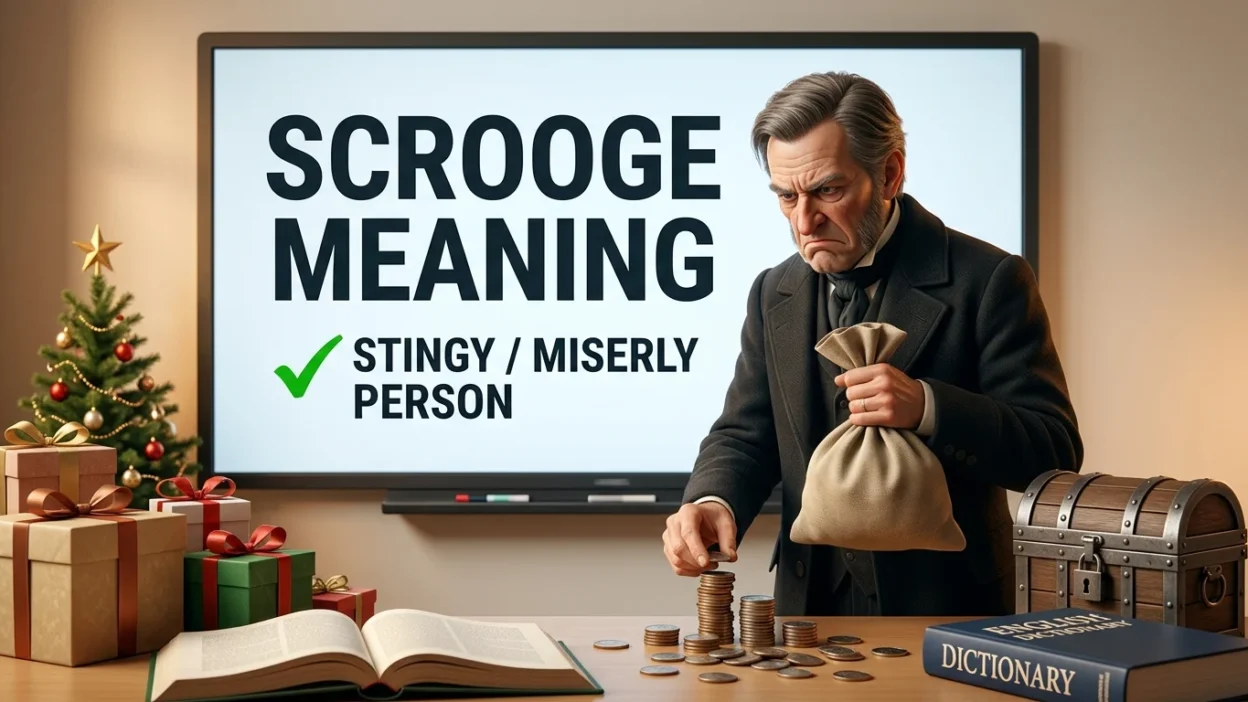
Have you ever met someone who hates spending money, avoids giving gifts, and seems unwilling to share anything with others? You may have heard such a person described as a Scrooge. This word is commonly used for someone who is extremely miserly, stingy, or unwilling to spend money, especially when generosity would be expected.
The Scrooge meaning comes from one of literature’s most famous characters, Ebenezer Scrooge in Charles Dickens’s A Christmas Carol. Over time, Scrooge’s name became a common noun in English. Today, you do not have to be talking about the character himself to use the word Scrooge.
Quick Answer
Scrooge means a person who is very stingy, miserly, or unwilling to spend or share money.
It is usually used in a negative or humorous way.
For example:
- My boss is such a Scrooge; he never wants to spend money on office events.
- Don’t be a Scrooge. Come and enjoy the Christmas party with us.
The word is especially common around Christmas, when people talk about generosity, gifts, celebrations, and the Christmas spirit.
Scrooge Meaning
A Scrooge is someone who is excessively unwilling to spend money or give things to others. The word can describe a person who has plenty of money but refuses to spend it or share it.
The term comes from Ebenezer Scrooge, the central character in Charles Dickens’s 1843 novella A Christmas Carol.
At the beginning of the story, Scrooge is portrayed as cold, selfish, miserly, and uninterested in helping others. He dislikes Christmas and has little sympathy for people who are struggling.
Because the character became so well known, his name eventually developed into a general English word.
Today, calling someone a Scrooge usually means that the person is behaving in a miserly or ungenerous way.
What Does Scrooge Mean in Simple English?
In simple English:
A Scrooge is a person who does not like spending money or being generous.
Imagine a friend who always refuses to contribute to a group meal, never wants to buy a gift, and complains whenever money needs to be spent.
You might jokingly say:
Don’t be such a Scrooge!
The expression can be serious, but it is often used humorously or playfully.
Who Is Ebenezer Scrooge?
Ebenezer Scrooge is the famous fictional character from Charles Dickens’s A Christmas Carol.
At the beginning of the story, Scrooge is a wealthy businessman who cares deeply about money but very little about helping other people. He is portrayed as miserly and emotionally cold.
The story follows his transformation after he is visited by supernatural figures connected with his past, present, and future.
By the end of the story, Scrooge becomes much more generous and caring.
This transformation is one reason the name Scrooge became so strongly associated with stinginess and, later, with the possibility of becoming more generous.
Scrooge Examples in Sentences
Here are some natural examples showing how Scrooge is used.
Example 1: Refusing to Spend
My uncle is a real Scrooge; he never wants to spend money on anything.
The speaker describes the uncle as extremely unwilling to spend.
Example 2: Christmas Gifts
Don’t be a Scrooge. You should buy the children some Christmas presents.
Here, the word is used playfully to criticize a lack of generosity.
Example 3: Group Dinner
He acted like a Scrooge and refused to contribute to the group dinner.
The person is being described as stingy.
Example 4: Workplace
The manager is such a Scrooge that he will not even provide coffee for the office.
This is an informal and somewhat humorous use.
Example 5: Holiday Decorations
Our neighbor is no Scrooge when it comes to Christmas decorations.
This means the neighbor is actually generous or enthusiastic about spending on decorations.
Scrooge as a Noun
Scrooge is primarily used as a noun when it refers to a person.
Examples:
- He is a Scrooge.
- She can be a bit of a Scrooge.
- Nobody wants to be called a Scrooge.
- My brother is acting like a Scrooge.
The word can also appear after expressions such as a real Scrooge and such a Scrooge.
For example:
He is such a Scrooge when it comes to spending money.
Scrooge as a Verb
You may also encounter Scrooge used informally as a verb, particularly in expressions such as Scrooge someone out of something, although this use is much less common than the noun.
For most everyday English learners, the important usage to remember is the noun:
a Scrooge = a stingy or miserly person.
Scrooge vs Stingy vs Miserly
These words are related but have slightly different associations.
| Word | Meaning | Typical tone |
|---|---|---|
| Scrooge | An extremely ungenerous or miserly person | Often humorous or critical |
| Stingy | Unwilling to spend or share money | Negative |
| Miserly | Extremely unwilling to spend money | Strongly negative |
| Cheap | Unwilling to spend money, sometimes unfairly | Often negative |
| Frugal | Careful and economical with money | Usually neutral or positive |
| Generous | Willing to give or spend for others | Positive |
| The most important distinction is between stingy and frugal. | ||
| A frugal person may carefully manage money because they want to avoid waste. A Scrooge, by contrast, is generally portrayed as excessively unwilling to spend or give. |
Scrooge vs Frugal
These words should not be treated as exact synonyms.
Someone who is frugal may avoid unnecessary spending while still being generous when it matters.
For example:
Sarah is frugal, but she always helps her friends when they need support.
Calling Sarah a Scrooge would suggest something stronger: that she is excessively ungenerous.
This distinction is useful because being careful with money is not automatically the same as being stingy.
Is Scrooge Always a Negative Word?
Usually, Scrooge has a negative meaning, but it is often used humorously rather than harshly.
For example:
You are such a Scrooge! You did not even want to decorate the office for Christmas.
Depending on the relationship and tone, this could be playful teasing rather than a serious insult.
However, calling someone a Scrooge can still be offensive if it is used to criticize their character seriously.
Context and tone matter.
Scrooge and Christmas
The word is particularly associated with Christmas because of Dickens’s A Christmas Carol.
During the holiday season, you may hear expressions such as:
- Don’t be a Scrooge.
- He is acting like Scrooge.
- She is no Scrooge when it comes to Christmas gifts.
- Stop being such a Scrooge.
These expressions generally criticize someone for being unwilling to participate in holiday generosity or celebration.
However, the word is not limited to Christmas. It can describe stingy behavior at any time of year.
Common Mistakes with Scrooge
Mistake 1: Thinking Scrooge only means someone who hates Christmas
Although Scrooge is strongly associated with Christmas, the modern noun mainly refers to someone who is miserly or ungenerous.
Mistake 2: Assuming every careful spender is a Scrooge
Being economical does not automatically make someone a Scrooge.
A person can be frugal while still being generous.
Mistake 3: Writing scrooge in every context
When referring to the Dickens character, Scrooge is normally capitalized because it is his proper name.
When the name is used as a common noun, dictionaries and style guides may vary in capitalization depending on the publication and usage. In ordinary modern writing, the character’s name is conventionally written Scrooge, and the lowercase form scrooge can appear when the word has fully developed into a common noun.
For consistency, writers often retain the capital S when directly echoing the character.
Mistake 4: Assuming Scrooge means poor
A Scrooge is not necessarily poor.
In fact, the original character is wealthy. The word describes attitude toward spending and generosity, not someone’s financial situation.
American vs British English
Scrooge is widely understood and used in both American English and British English.
There is no major difference in meaning between the two varieties.
The word is especially familiar in both countries because A Christmas Carol is a major part of English-language Christmas culture.
American English:
Don’t be such a Scrooge.
British English:
Don’t be such a Scrooge.
The expression works naturally in both varieties.
Synonyms for Scrooge
Depending on the context, you can use several related words:
- miser
- cheapskate
- skinflint
- penny-pincher
- tightwad
- stingy person
- miserly person
- ungenerous person
Some of these words are more informal or insulting than others.
Miser is particularly close in meaning to Scrooge, while frugal is not a true synonym because it can have a positive meaning.
FAQs
What is the Scrooge meaning?
Scrooge means a person who is very stingy, miserly, or unwilling to spend money or be generous.
Why is someone called a Scrooge?
Someone is called a Scrooge because they are behaving in a miserly or ungenerous way. The expression comes from Ebenezer Scrooge in Charles Dickens’s A Christmas Carol.
Is Scrooge a bad word?
Scrooge is not a swear word, but it can be insulting because it criticizes someone for being stingy or ungenerous. It is also commonly used jokingly.
Does Scrooge mean cheap?
It can be similar to cheap when cheap means unwilling to spend money, but Scrooge specifically emphasizes extreme stinginess or lack of generosity.
Is Scrooge the same as frugal?
No. Frugal usually means careful and sensible with money, while Scrooge suggests excessive unwillingness to spend or share.
Is Scrooge only related to Christmas?
No. Although the word is strongly associated with Christmas, it can describe a stingy person at any time of year.
Who was the original Scrooge?
The original Scrooge was Ebenezer Scrooge, a fictional character created by Charles Dickens in A Christmas Carol.
What are synonyms for Scrooge?
Common related words include miser, cheapskate, skinflint, tightwad, penny-pincher, stingy, and miserly.
Summary
The Scrooge meaning is a person who is extremely stingy, miserly, or unwilling to be generous. The word comes from Ebenezer Scrooge, the famous character in Charles Dickens’s A Christmas Carol. Because Scrooge begins the story as a wealthy but miserly and cold-hearted man, his name eventually became associated with people who are excessively unwilling to spend or share.
Today, Scrooge is commonly used in both American and British English. It is especially popular around Christmas, but its meaning extends beyond the holiday season. Remember that being frugal is not necessarily being a Scrooge: frugality can involve sensible money management, while Scrooge usually suggests an excessive lack of generosity.
Actionable Takeaway
Remember Scrooge = a stingy or miserly person. Use it when someone seems excessively unwilling to spend, share, or show generosity, often in a humorous way.

Liam James is a language enthusiast and content writer at Verseslay, specializing in word comparisons, grammar debates, and vocabulary insights. He helps readers understand language nuances through clear, engaging, and practical explanations.