Have you ever wondered whether to write that’s or thats? It’s one of the most common punctuation mistakes in English, especially in text messages, emails, social media posts, and even professional writing. Because apostrophes can be easy to overlook, many people accidentally write thats when they actually mean that’s.
The good news is that the rule is simple. Once you understand the role of the apostrophe, you’ll never have to second-guess yourself again. In this guide, you’ll learn the difference between that’s vs thats, when to use each form, common mistakes to avoid, real-life examples, and tips to help you remember the correct spelling every time.
Quick Answer
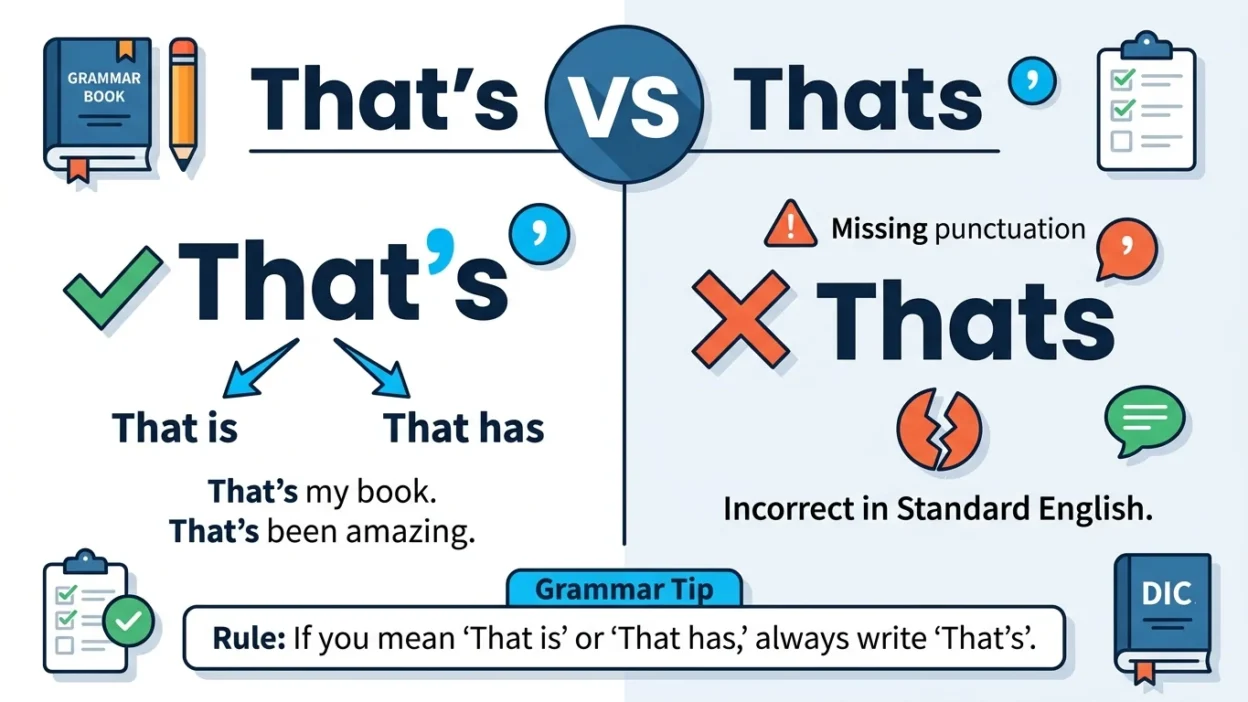
That’s is the correct spelling in standard English because it is a contraction of:
- that is
- that has
Thats (without an apostrophe) is not a correct English word and should generally be avoided.
Examples
- That’s a beautiful house. ✅
- That’s been my dream for years. ✅
- Thats a beautiful house. ❌
Whenever you mean that is or that has, always write that’s.
What Does “That’s” Mean?
That’s is a contraction, meaning it combines two words into one using an apostrophe.
It can stand for:
- that is
- that has
The apostrophe replaces the missing letter i in is or part of has.
Examples Meaning “That Is”
- That’s my favorite restaurant.
- That’s an interesting question.
- That’s exactly what I needed.
- That’s the correct answer.
- That’s a wonderful idea.
Expanded:
- That is my favorite restaurant.
- That is an interesting question.
Examples Meaning “That Has”
- That’s been a great experience.
- That’s already happened.
- That’s become much easier.
- That’s never occurred before.
Expanded:
- That has been a great experience.
- That has already happened.
Is “Thats” Correct?
No.
Thats without an apostrophe is not considered correct in standard English.
It frequently appears because of:
- Typing quickly
- Text message shortcuts
- Autocorrect mistakes
- Forgetting punctuation
In formal writing, school assignments, business emails, blogs, and professional communication, always use that’s.
That’s vs Thats: Key Difference
Here’s a quick comparison.
| Feature | That’s | Thats |
|---|---|---|
| Correct spelling | ✅ Yes | ❌ No |
| Contains apostrophe | Yes | No |
| Meaning | That is / That has | None in standard English |
| Academic writing | Correct | Incorrect |
| Professional writing | Correct | Incorrect |
Remember:
That’s is always the correct choice when you mean that is or that has.
Why Is the Apostrophe Important?
The apostrophe shows that letters have been omitted.
For example:
- that is → that’s
- it is → it’s
- do not → don’t
- cannot → can’t
Without the apostrophe, the contraction becomes incorrect.
English uses apostrophes to make writing shorter while preserving grammatical accuracy.
Examples of “That’s” in Everyday English
You’ll hear and see that’s everywhere.
In Conversation
- That’s amazing!
- That’s fantastic.
- That’s exactly what I meant.
- That’s enough for today.
- That’s my brother.
In Business
- That’s an excellent proposal.
- That’s our final decision.
- That’s included in the report.
In School
- That’s the correct answer.
- That’s how grammar works.
- That’s an important concept.
In Writing
- That’s why preparation matters.
- That’s one of the best examples.
- That’s what makes the story memorable.
Common Mistakes to Avoid
Many English learners—and even native speakers—make similar errors.
1. Forgetting the Apostrophe
Incorrect:
- Thats my phone.
Correct:
- That’s my phone.
2. Confusing “That’s” with “Its”
Many learners also confuse:
- it’s
- its
Remember:
- That’s = that is / that has
- It’s = it is / it has
- Its = possessive form
Example:
- The company changed its policy.
- It’s a great company.
3. Using “Thats” in Professional Writing
Avoid:
- Thats a good idea.
Instead write:
- That’s a good idea.
4. Assuming Informal Texting Rules Apply Everywhere
While friends may understand “thats” in text messages, it should not appear in:
- essays
- emails
- reports
- resumes
- articles
- presentations
Professional writing always requires the apostrophe.
That’s in Formal and Informal Writing
One advantage of that’s is its versatility.
It’s appropriate in:
- everyday conversation
- blogs
- emails
- business writing
- academic writing
- journalism
- social media
In very formal legal or academic documents, some writers choose the full form that is for added clarity.
Example:
Formal:
- That is the primary objective.
Less formal:
- That’s the primary objective.
Both are grammatically correct.
American vs British English
One common question is whether British and American English treat that’s differently.
The answer is simple.
There is no difference.
Both varieties use:
- that’s
Both consider:
- thats
incorrect in standard writing.
The spelling and grammar remain identical in:
- American English
- British English
- Australian English
- Canadian English
Similar Contractions
Learning similar contractions helps reinforce the rule.
Examples include:
| Full Form | Contraction |
|---|---|
| That is | That’s |
| That has | That’s |
| It is | It’s |
| Who is | Who’s |
| There is | There’s |
| Here is | Here’s |
| What is | What’s |
| Where is | Where’s |
Notice that each contraction uses an apostrophe.
Tips to Remember the Difference
Here’s an easy trick.
Expand the sentence.
If that is fits naturally, write that’s.
Example:
- That’s my car.
Expanded:
- That is my car.
If the expanded version works, the contraction is correct.
Also remember:
No apostrophe means no correct word.
Whenever you type thats, ask yourself:
“Can I replace it with that is?”
If yes, add the apostrophe.
Related Words and LSI Keywords
To better understand this topic, it’s helpful to know related grammar terms such as:
- apostrophe rules
- English contractions
- punctuation
- grammar mistakes
- common English errors
- correct spelling
- writing tips
- English grammar guide
- contraction examples
- punctuation rules
These terms naturally support your understanding of the main keyword.
FAQs
Which is correct: “that’s” or “thats”?
That’s is correct. Thats is not a standard English word.
Why does “that’s” have an apostrophe?
The apostrophe shows that letters have been omitted from that is or that has.
Can “that’s” mean “that has”?
Yes.
Example:
- That’s been a wonderful year.
This means:
- That has been a wonderful year.
Is “thats” ever correct?
No. In standard English, thats without an apostrophe is considered incorrect.
Do British and American English spell it differently?
No. Both use that’s.
Is it okay to write “thats” in text messages?
People sometimes do, but it is still considered incorrect. Using that’s is always better.
Should I write “that is” instead of “that’s”?
Both are correct. That is sounds slightly more formal, while that’s sounds more natural in everyday communication.
Summary
Understanding that’s vs thats is one of the easiest ways to improve your English punctuation. That’s is the correct contraction of that is or that has, while thats without an apostrophe is not accepted in standard English. Whether you’re writing an email, essay, blog post, or social media caption, remembering this simple rule will make your writing look more polished and professional.
The apostrophe may seem like a small detail, but it plays an important role in English grammar. Since both American and British English follow the same rule, you can confidently use that’s in almost every situation where you mean that is or that has.