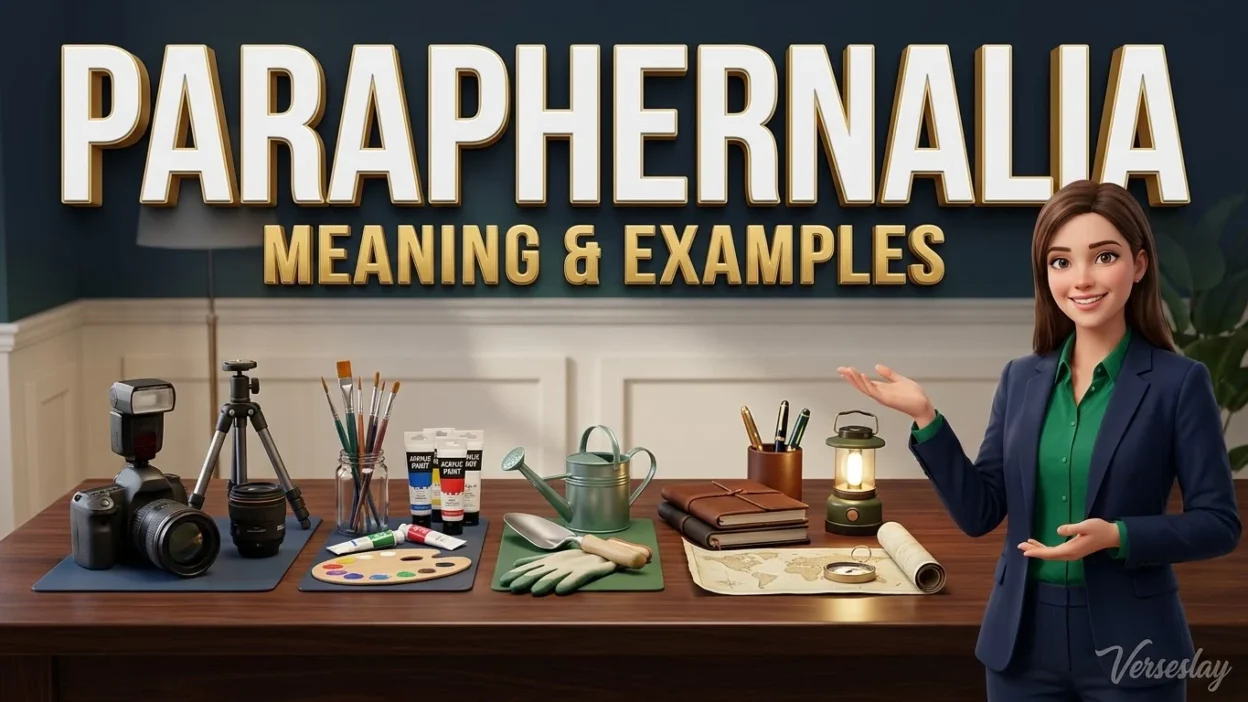
Have you ever heard someone use the word paraphernalia and wondered what it actually means? You might encounter it in a news report, a book, a police investigation, or an everyday conversation about the equipment someone needs for a particular activity. Although the word may look complicated, its meaning becomes much easier to understand when you see it in context.
The word paraphernalia generally refers to the equipment, tools, accessories, or other items associated with a particular activity, hobby, profession, or purpose. For example, a student’s school paraphernalia might include notebooks, pens, a backpack, and other study supplies. In this guide, you will learn the paraphernalia meaning, its pronunciation, common synonyms, practical examples, and the mistakes to avoid when using this useful English word.
Quick Answer: Paraphernalia Meaning
Paraphernalia means a collection of items, equipment, tools, or accessories associated with a particular activity, purpose, or person.
Examples:
- The photographer packed all her photography paraphernalia before leaving for the trip.
- The kitchen was filled with baking paraphernalia.
- The detective examined the items and paraphernalia found at the scene.
The word is often used when several related items are considered together rather than individually.
Simple definition: Paraphernalia means the things or equipment you need for, use in, or associate with a particular activity.
What Does Paraphernalia Mean?
The noun paraphernalia refers to a collection of objects connected with a specific activity, occupation, interest, or situation. These objects might include tools, accessories, supplies, instruments, or other useful items.
The word can be used in both everyday and formal English. Its exact meaning depends on the context in which it appears.
For example, a musician’s paraphernalia might include musical instruments, cables, a microphone, and other performance equipment. A painter’s paraphernalia might include brushes, paints, palettes, and canvases.
Here are a few more examples:
- She organized her art paraphernalia before beginning the painting.
- The camping paraphernalia was packed into several large bags.
- His desk was covered with office paraphernalia.
- The magician carried a suitcase full of performance paraphernalia.
In each sentence, the word describes a group of related items rather than one particular object.
Different Meanings of Paraphernalia in Context
Although paraphernalia generally means equipment or associated items, its meaning can vary slightly depending on the situation.
1. Paraphernalia Meaning in Everyday English
In everyday conversation, paraphernalia often refers to all the items someone uses for a hobby, task, or routine.
Examples:
- She brought all her gardening paraphernalia to the backyard.
- My brother keeps his badminton paraphernalia in a separate bag.
- The children spread their school paraphernalia across the dining table.
- He packed his fishing paraphernalia before sunrise.
In these examples, the word describes the collection of objects associated with an activity.
2. Paraphernalia Meaning in a Professional Setting
In workplaces and professional settings, paraphernalia can describe the tools, accessories, and equipment associated with a job.
Examples:
- The photographer checked her camera paraphernalia before the wedding.
- The laboratory assistant cleaned the scientific paraphernalia after the experiment.
- The mechanic stored his repair paraphernalia in labeled boxes.
- The musician loaded his performance paraphernalia into the van.
Depending on the context, words such as equipment, tools, or supplies may sound more direct and natural than paraphernalia.
3. Paraphernalia Meaning in Legal and News Contexts
In legal reporting and news coverage, paraphernalia can refer to objects associated with a particular activity, including activities that may be illegal.
For example, the phrase drug paraphernalia refers to equipment or objects associated with preparing, using, or otherwise handling drugs. Its legal definition and treatment vary by jurisdiction.
Examples:
- The report mentioned drug paraphernalia found during the investigation.
- Police described several objects as suspected drug paraphernalia.
- The news story discussed laws concerning drug-related paraphernalia.
It is important to understand the context: the word paraphernalia itself does not automatically imply anything illegal. It can refer to harmless items such as gardening tools, sports equipment, or art supplies.
4. Paraphernalia Meaning in a Hobby or Interest
People also use paraphernalia to describe collections of items associated with hobbies, sports, and personal interests.
Examples:
- The cyclist displayed his cycling paraphernalia in the garage.
- Her sewing paraphernalia included needles, thread, scissors, and fabric.
- The classroom contained science paraphernalia for student experiments.
- He bought new camping paraphernalia for his hiking trip.
This use is especially helpful when you want to describe several related items without naming each one separately.
Paraphernalia Pronunciation
The word paraphernalia may appear difficult to pronounce at first, but breaking it into smaller parts makes it easier.
Pronunciation: pair-uh-fer-NAY-lee-uh
The main stress falls on the syllable NAY.
A simple way to practise is to say the word slowly:
Pair – uh – fer – NAY – lee – uh.
Then gradually increase your speed until you can say the complete word naturally.
Example sentence to practise:
“She packed her camping paraphernalia before the journey.”
The word is commonly pronounced similarly in American and British English, although individual accents can produce slight differences.
Is Paraphernalia Singular or Plural?
One of the most important grammar points about paraphernalia is that it is generally used as an uncountable noun in modern English.
Although it ends in -ia, it does not normally function like a regular plural noun. You generally do not add -s to form paraphernalias.
Correct examples:
- The camping paraphernalia is in the garage.
- She packed all her photography paraphernalia.
- His paraphernalia was scattered across the room.
When you need to count the objects, use a phrase such as items of paraphernalia, pieces of equipment, or accessories.
Examples:
- She packed five items of camping paraphernalia.
- The shop sells several pieces of photography equipment.
- He bought three accessories for his camera.
Because paraphernalia usually refers to a collection of objects, the appropriate verb depends on how the sentence is constructed. When treating the collection as one whole, a singular verb is standard.
Paraphernalia Synonyms and Related Words
Several English words have meanings similar to paraphernalia, but they are not always interchangeable. The best choice depends on what you are describing.
| Word | Meaning | Example |
|---|---|---|
| Equipment | Items needed for a task or activity | The team packed its sports equipment. |
| Tools | Objects used to perform a task | The carpenter cleaned his tools. |
| Accessories | Additional items that complement something | She bought camera accessories. |
| Supplies | Materials needed for a particular purpose | The teacher ordered school supplies. |
| Gear | Equipment used for a specific activity; informal | He packed his hiking gear. |
| Apparatus | Equipment designed for a particular purpose, often technical | The laboratory apparatus was carefully cleaned. |
| Belongings | Personal possessions | She collected her belongings. |
| Kit | A set of items used together | The first-aid kit was fully stocked. |
Which synonym is best?
- Use equipment for machines, devices, and practical tools.
- Use supplies for materials that may be used up.
- Use gear in informal conversations about sports, travel, or outdoor activities.
- Use accessories for additional items that accompany another object.
- Use paraphernalia when referring broadly to a collection of objects associated with a particular activity.
Paraphernalia in Example Sentences
The best way to learn a new word is to see how it works in different situations. Here are ten examples of paraphernalia in everyday and professional English.
- School: The students gathered their school paraphernalia before leaving the classroom.
- Photography: She arranged her photography paraphernalia on the table.
- Sports: The athlete stored his training paraphernalia in a locker.
- Cooking: The kitchen was full of baking paraphernalia.
- Travel: He packed his travel paraphernalia into a small suitcase.
- Gardening: My mother keeps her gardening paraphernalia in the shed.
- Music: The band loaded its musical paraphernalia into the van.
- Art: The artist organized her painting paraphernalia by color and size.
- Camping: We checked our camping paraphernalia before setting off.
- News: The article discussed the discovery of drug paraphernalia during the investigation.
Notice how the word remains the same while the items it describes change according to the activity.
Common Mistakes When Using Paraphernalia
Mistake 1: Treating Paraphernalia as a Regular Plural
Incorrect: She bought several paraphernalias for her photography hobby.
Correct: She bought several photography accessories.
You can also say, “She bought several items of photography paraphernalia.”
Why? Paraphernalia is generally an uncountable noun, so it does not normally take a regular plural ending.
Mistake 2: Assuming Paraphernalia Always Means Illegal Items
Incorrect assumption: The word paraphernalia always refers to drug-related objects.
Correct understanding: It can describe equipment for almost any activity, including gardening, sports, art, and photography.
Why? The phrase drug paraphernalia is common in legal and news contexts, but the general word has a much broader meaning.
Mistake 3: Using Paraphernalia When a Simpler Word Is Better
Wordy: I collected all the paraphernalia required to write a short note.
More natural: I collected all the stationery I needed to write a short note.
Why? Although paraphernalia is correct, a more specific word can make your writing clearer and more concise.
Mistake 4: Confusing Paraphernalia With Personal Belongings
These words overlap in some situations, but their meanings are different.
- Paraphernalia usually emphasizes objects associated with an activity or purpose.
- Belongings refers to things that a person owns.
For example, “camping paraphernalia” refers to camping-related equipment, while “my belongings” could include clothes, a wallet, books, and personal documents.
American English vs British English: Is There a Difference?
The word paraphernalia is used in both American and British English, with broadly the same spelling and general meaning.
In both varieties, it can describe equipment, tools, accessories, and objects associated with an activity.
Examples:
- American English: He packed his camping paraphernalia into the car.
- British English: He packed his camping paraphernalia into the car.
There is no significant spelling difference between the two varieties. However, the word may sound more formal or elaborate than simpler alternatives such as gear, equipment, or stuff in casual conversation.
The phrase drug paraphernalia is also used in both varieties, although the legal definitions and regulations associated with it depend on the relevant jurisdiction.
FAQs
1. What does paraphernalia mean in simple words?
Paraphernalia means the collection of tools, equipment, accessories, or other items associated with an activity or purpose.
Example: A painter’s paraphernalia includes brushes, paints, and canvases.
2. Is paraphernalia a positive or negative word?
The word is neutral by itself. It can describe harmless objects, such as gardening equipment, or items associated with controversial or illegal activities. The surrounding context determines its tone.
3. Is paraphernalia singular or plural?
Paraphernalia is generally treated as an uncountable noun. It usually takes a singular verb when the collection is treated as a whole, and its standard form does not normally change to paraphernalias.
4. What is another word for paraphernalia?
Depending on the context, synonyms include equipment, tools, gear, supplies, accessories, and apparatus. Each word has a slightly different emphasis.
5. How do you pronounce paraphernalia?
It is commonly pronounced pair-uh-fer-NAY-lee-uh, with the main stress on NAY. Pronunciation can vary slightly by accent.
6. What does drug paraphernalia mean?
Drug paraphernalia refers to objects or equipment associated with preparing, using, or handling drugs. The precise legal meaning varies depending on the country or jurisdiction.
7. Can I use paraphernalia in a sentence?
Yes. For example: “The photographer organized her paraphernalia before the outdoor shoot.” Here, the word refers to the equipment and accessories used for photography.
8. Is paraphernalia formal or informal?
It can be used in both formal and informal contexts. However, it sounds relatively elaborate, so everyday alternatives such as stuff, gear, or equipment may sound more natural in casual conversation.
Summary
The word paraphernalia means a collection of equipment, tools, accessories, or other items associated with a particular activity or purpose. It can describe school supplies, photography equipment, camping gear, gardening tools, and many other collections of related objects. Although the word is sometimes associated with legal or news reports, it is not inherently negative and does not automatically imply illegal activity.
To use paraphernalia correctly, pay attention to the context and remember that it is generally an uncountable noun. Choose more specific alternatives such as equipment, supplies, or accessories whenever they make your sentence clearer. Actionable takeaway: The next time you want to describe a collection of items connected with a hobby, profession, or activity, consider whether paraphernalia fits the context—and use a simpler synonym if it makes your meaning easier to understand.