
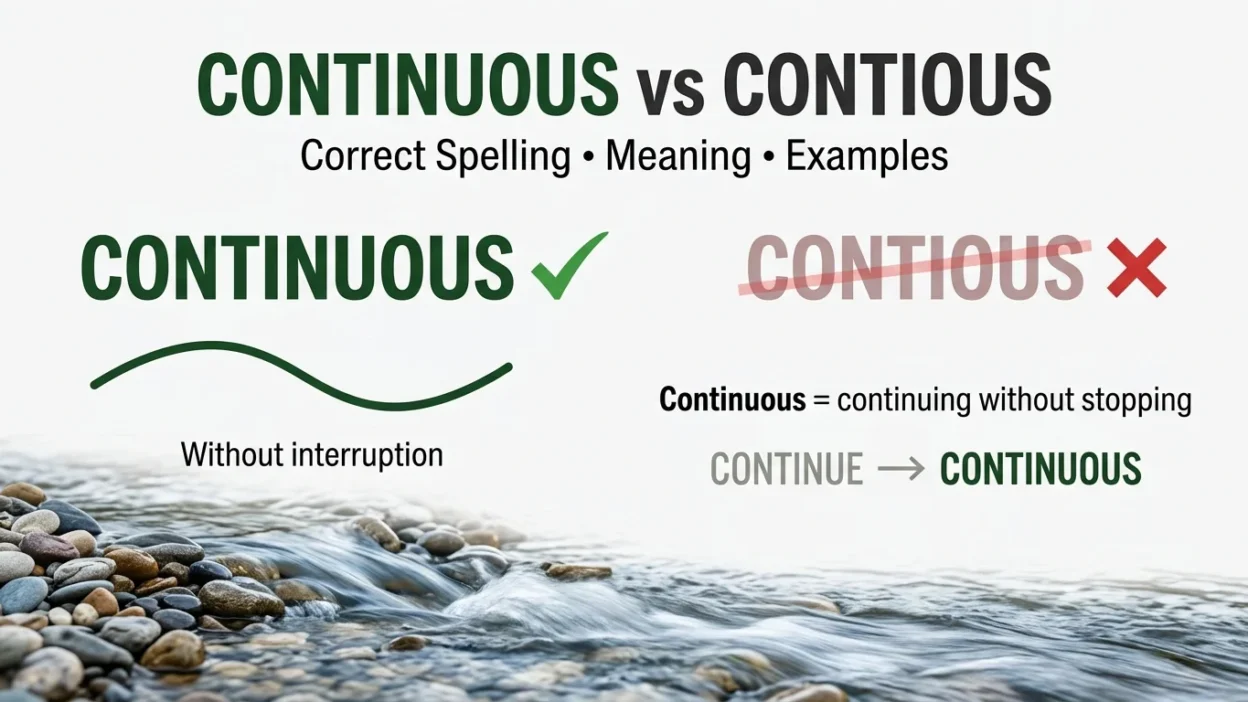
If you have ever wondered whether the correct spelling is continuous vs contious, you are not alone. These words look similar, and the missing letters in contious can easily be overlooked when typing quickly. However, there is an important difference: one is a correct English word, while the other is a common spelling mistake.
The correct word is continuous. It means something that continues without stopping, interruption, or a break. Contious is not the standard spelling in English. In this guide, we will explain the correct spelling, meaning, pronunciation, examples, common mistakes, related words, and American versus British English usage.
Quick Answer: Continuous vs Contious
The answer is simple:
- Continuous is the correct spelling.
- Contious is a misspelling and should generally be avoided.
Continuous means continuing without interruption or occurring repeatedly without a significant break.
Examples:
- The machine has been running continuously for six hours.
- We experienced continuous rain throughout the afternoon.
- Continuous practice can improve your English skills.
Incorrect:
- The machine has been running contiously.
Correct:
- The machine has been running continuously.
A useful way to remember the spelling is:
Continuous = contin + uous
The word contains continuous, including the important u after the n.
What Does Continuous Mean?
Continuous is an adjective used to describe something that continues without stopping or interruption.
For example:
The continuous noise made it difficult to sleep.
This means the noise continued without stopping.
Another example:
There was continuous rainfall throughout the night.
This suggests that the rain continued for a long period without a meaningful interruption.
The word can describe actions, sounds, movement, events, processes, conditions, and many other things.
Is Contious a Word?
No. Contious is generally considered a spelling error.
It is often created when people accidentally leave out the nu sequence in continuous.
Correct:
continuous
Incorrect:
contious
If you are writing an email, essay, article, application, academic assignment, or professional document, always use continuous.
Continuous Meaning in Simple English
In simple terms, continuous means:
without stopping or without interruption
For example:
The continuous rain lasted for three hours.
The rain continued during that period.
You can think of continuous as something that forms an uninterrupted flow.
Some related words include:
- Uninterrupted
- Ongoing
- Constant
- Nonstop
- Unbroken
- Perpetual
- Sustained
These words are related but are not always perfect replacements for continuous.
Examples of Continuous
Here are some natural examples:
The baby was crying continuously for several minutes.
The road requires continuous maintenance.
Continuous improvement is important for long-term success.
The factory operates continuously throughout the year.
The continuous sound of traffic was distracting.
She made continuous efforts to improve her writing.
The computer system provides continuous monitoring.
These examples demonstrate how broadly the word can be used.
Continuous in Everyday English
You will frequently see continuous in ordinary conversations and writing.
For example:
We had continuous problems with the internet connection.
The continuous rain ruined our outdoor plans.
He worked continuously for several hours.
The continuous noise from the construction site was annoying.
In each case, the word emphasizes continuation without a meaningful interruption.
Continuous vs Constant
Continuous and constant are closely related, but they are not always identical.
Continuous usually emphasizes something that continues without interruption.
Constant can mean something that does not change or something that happens frequently or persistently.
Compare:
There was continuous rain for five hours.
This emphasizes that the rain did not stop during that period.
There was constant traffic noise outside.
This emphasizes persistent or repeatedly present noise.
In some contexts, the two words can be interchangeable, but their emphasis can differ.
Continuous vs Continual
Another important distinction is between continuous and continual.
Continuous generally means without interruption.
Continual usually means happening repeatedly, often with short breaks between occurrences.
Compare:
The continuous rain lasted all afternoon.
The rain did not stop.
There were continual interruptions during the meeting.
The interruptions happened again and again, but there were breaks between them.
This distinction is especially useful for English learners.
Continuous vs Ongoing
Continuous and ongoing can sometimes have similar meanings.
However, ongoing usually means something is currently continuing or still in progress. It does not necessarily mean there are no interruptions.
For example:
The investigation is ongoing.
This means the investigation has not finished.
It does not necessarily mean investigators have been working every second without stopping.
By contrast:
The machine operated continuously for twelve hours.
This specifically emphasizes uninterrupted operation.
Continuous vs Nonstop
Nonstop is another close synonym.
For example:
The music played continuously for three hours.
The music played nonstop for three hours.
Both can communicate the idea that the music did not stop.
However, nonstop is generally more conversational and informal, while continuous can work naturally in formal, academic, scientific, and professional writing.
Common Spelling Mistakes
Mistake 1: Writing Contious
Incorrect:
The company focuses on contious improvement.
Correct:
The company focuses on continuous improvement.
The incorrect form leaves out letters from the middle of the word.
Mistake 2: Confusing Continuous With Continual
Incorrect usage can happen when someone wants to describe repeated events but chooses continuous.
For example:
There were continuous interruptions during the meeting.
This could imply that the interruptions occurred without stopping.
If the interruptions happened repeatedly with breaks, continual interruptions may communicate the idea more precisely.
Mistake 3: Forgetting the Middle Letters
The spelling can be difficult because the pronunciation does not always make every letter obvious.
Break the word into parts:
con-tin-u-ous
Then remember the complete spelling:
continuous
Mistake 4: Using Contious in Formal Writing
Because contious is a misspelling, it can make otherwise good writing appear careless.
Always check the spelling before publishing:
continuous
Continuous in Academic and Professional English
The word continuous is particularly common in academic, technical, scientific, and professional writing.
Examples include:
- Continuous improvement
- Continuous monitoring
- Continuous learning
- Continuous development
- Continuous operation
- Continuous assessment
- Continuous growth
- Continuous communication
- Continuous production
For example:
The organization uses continuous assessment to monitor student progress.
Continuous monitoring helps identify problems early.
The company encourages continuous professional development.
These expressions are widely understood and natural.
American vs British English
There is no major spelling difference between American and British English for continuous.
Both use:
continuous
The incorrect spelling contious is not a standard American or British English spelling.
There can be differences between American and British English in other words, such as color and colour or organize and organise, but continuous remains the same in both varieties.
Therefore, whether you are writing for an American or British audience, use continuous.
Continuous Pronunciation
The pronunciation of continuous can also cause confusion.
It is generally pronounced approximately as:
kuhn-TIN-yoo-us
The exact pronunciation can vary slightly depending on accent.
The spelling contains several syllables, so saying the word slowly can help you remember how it is written.
Try dividing it into:
con – tin – u – ous
Then combine the parts:
continuous
How to Remember Continuous Spelling
A simple memory trick is to remember that continuous contains the word sequence associated with continue.
Think:
continue → continuous
Both begin with:
continu-
Then add the ending:
-ous
This gives:
continuous
Another useful association is:
Continuous = continue + ous
Although this is a memory technique rather than a strict spelling rule, it can help you avoid the common mistake of writing contious.
Continuous vs Contious Comparison Table
| Feature | Continuous | Contious |
|---|---|---|
| Correct English word | Yes | No |
| Meaning | Continuing without interruption | No standard meaning |
| Usage | Common | Spelling mistake |
| Formal writing | Correct | Incorrect |
| American English | Correct | Incorrect |
| British English | Correct | Incorrect |
| Example | Continuous rain | Contious rain |
The choice is therefore straightforward: use continuous.
FAQs
1. Is continuous or contious correct?
Continuous is correct. Contious is a spelling mistake.
2. What does continuous mean?
Continuous means continuing without stopping or interruption.
3. Is contious a real English word?
No. Contious is not a standard English word. It is generally a misspelling of continuous.
4. How do you spell continuous correctly?
The correct spelling is:
continuous
A helpful way to remember it is to connect it with continue.
5. What is the difference between continuous and continual?
Continuous generally means without interruption, while continual usually means happening repeatedly, often with breaks between occurrences.
6. Is continuous the same in American and British English?
Yes. The spelling continuous is the same in both American and British English.
7. What is a synonym for continuous?
Depending on the context, synonyms include uninterrupted, nonstop, ongoing, constant, unbroken, and sustained.
8. How can I avoid spelling continuous incorrectly?
Remember the sequence continu- from the word continue. Then add -ous to form continuous.
Final Summary
The difference between continuous vs contious is primarily a matter of correct spelling. Continuous is the standard English word, while contious is a common misspelling. Continuous describes something that continues without interruption, such as continuous rain, continuous noise, continuous monitoring, or continuous improvement.
Although contious may appear in online searches or informal writing, it should not be used in polished English. Whether you are writing in American English or British English, the correct spelling remains continuous.
Actionable Takeaway
Remember this simple rule:
Continuous = correct
Contious = incorrect
If you are unsure about the spelling, connect the word with continue:
continue → continuous
Use continuous when you mean something that continues without interruption.
For example:
The machine operated continuously throughout the night.
The company believes in continuous improvement.
We experienced continuous rain for several hours.
Once you remember the continu- spelling pattern, it becomes much easier to avoid this common English spelling mistake.