Have you ever heard someone say that prices have gone through the roof and wondered what they really mean? This colorful English expression is common in everyday conversations, news reports, and informal writing. It usually describes something that has increased dramatically or reached an unusually high level.
The phrase can be confusing if you interpret it literally. In most situations, through the roof is an idiom rather than a description of something physically passing through a roof. In this guide, you will learn the through the roof meaning, where the expression comes from, how to use it naturally, common examples, similar expressions, and mistakes to avoid.
Quick Answer: Through the Roof Meaning
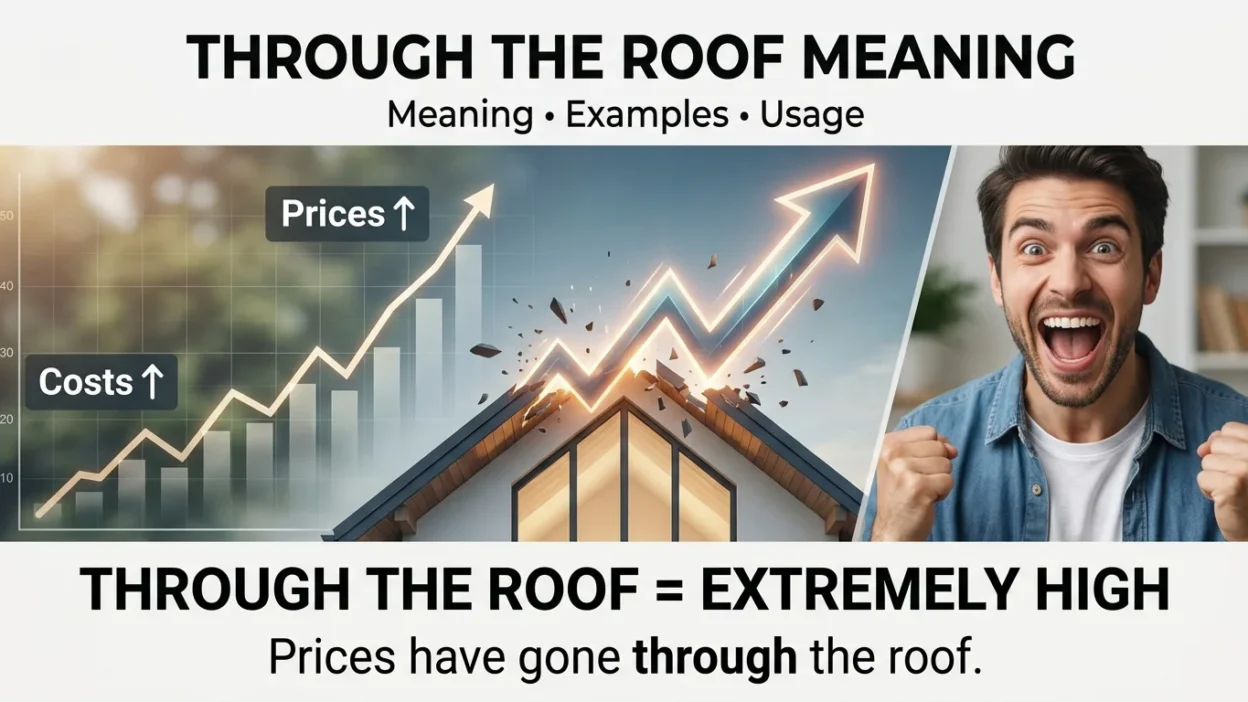
Through the roof is an idiomatic expression meaning extremely high, very expensive, or dramatically increased.
It is often used for things such as:
- Prices
- Costs
- Sales
- Demand
- Interest
- Anger
- Excitement
- Expectations
- Popularity
For example:
Gas prices have gone through the roof.
This means gas prices have increased dramatically.
Another example is:
Her excitement went through the roof when she heard the news.
This means she became extremely excited.
The phrase can therefore describe both very high numbers or levels and very strong emotions or reactions.
What Does Through the Roof Mean?
The expression through the roof literally suggests something going upward and passing through the roof of a building.
However, in normal conversation, it is usually figurative.
When something goes through the roof, it rises to an extremely high level.
For example:
The cost of living has gone through the roof.
This does not mean the cost of living physically went through a building. It means the cost has become extremely high.
The expression can also describe an emotional reaction:
His anger went through the roof.
This means he became extremely angry.
Through the Roof as an Idiom
An idiom is an expression whose meaning cannot always be understood simply by looking at the individual words.
The words through and roof have ordinary meanings, but together they create a figurative expression.
Compare:
The ball went through the roof.
This could literally mean a ball passed through a roof.
But:
The price of the house went through the roof.
Here, the phrase is clearly idiomatic. It means the price increased dramatically.
Understanding this distinction helps you recognize when the phrase is being used literally and when it is being used figuratively.
Examples of Through the Roof
Here are some natural examples:
Food prices have gone through the roof.
The demand for electric cars has gone through the roof.
Her confidence went through the roof after winning the competition.
Our electricity bill went through the roof last month.
Interest in the new product has gone through the roof.
His anger went through the roof when he discovered what happened.
Housing costs in the city have gone through the roof.
In each example, the expression emphasizes an unusually high level or dramatic increase.
Through the Roof for Prices and Costs
One of the most common uses of through the roof relates to money.
People often use it when prices become unexpectedly or extremely high.
For example:
The price of vegetables has gone through the roof.
Rent in this area has gone through the roof.
Hotel prices went through the roof during the holiday season.
The cost of building materials has gone through the roof.
These sentences all communicate the idea that something has become very expensive.
Related phrases include:
- Extremely expensive
- Very costly
- Sky-high prices
- Soaring costs
- Dramatically increased
- Extremely high
Through the Roof for Emotions
The expression can also describe strong emotions.
For example:
His anger went through the roof.
This means he became extremely angry.
You might also hear:
Her excitement went through the roof.
Their enthusiasm went through the roof.
My stress levels are through the roof.
In these examples, the expression describes an emotional state or level that has become extremely intense.
The meaning depends on the noun being described.
Through the Roof for Demand and Popularity
The idiom is also frequently used when discussing demand, sales, popularity, or interest.
For example:
Demand for the new phone has gone through the roof.
This means demand has increased dramatically.
The singer’s popularity went through the roof after the release of the song.
This means the singer became extremely popular.
Online sales went through the roof during the promotion.
This means sales increased significantly.
This usage is particularly common in business, marketing, and informal reporting.
Through the Roof vs Sky-High
Through the roof and sky-high can have very similar meanings.
| Expression | Meaning | Example |
|---|---|---|
| Through the roof | Extremely high or dramatically increased | Prices have gone through the roof. |
| Sky-high | Extremely high | Rent is sky-high. |
| Soaring | Increasing rapidly | Energy costs are soaring. |
| Extremely high | Very high | Housing prices are extremely high. |
| Off the charts | Beyond normal measurement or expectation | Interest was off the charts. |
Through the roof is especially natural in conversational English.
Sky-high can be used as an adjective:
Sky-high prices are hurting consumers.
By contrast:
Prices have gone through the roof.
Both communicate the idea of something becoming extremely high.
Through the Roof vs Over the Roof
These expressions are not the same.
Through the roof is commonly an idiom meaning extremely high or dramatically increased.
Over the roof usually has a more literal meaning and describes something located above or passing over a roof.
For example:
The bird flew over the roof.
This describes physical movement.
But:
The cost of repairs went through the roof.
This is figurative.
Choosing the right expression depends on whether you are describing physical movement or a dramatic increase.
Through the Roof vs Over the Top
Over the top is another common English expression, but it has a different meaning.
Over the top usually means excessive, exaggerated, or more extreme than necessary.
For example:
The decorations were a little over the top.
This means they were excessively elaborate.
The prices went through the roof.
This means the prices became extremely high.
Although both expressions can suggest something extreme, they are not interchangeable.
Common Mistakes With Through the Roof
Mistake 1: Taking It Literally
A common mistake is assuming that through the roof always means physically passing through a roof.
In everyday idiomatic English, it often means extremely high.
Incorrect interpretation:
Prices went through the roof.
This does not mean prices physically passed through a roof.
It means prices increased dramatically.
Mistake 2: Using It for Every Type of Increase
Although through the roof can describe many increases, it is generally used for dramatic or unusually high changes.
For a small increase, it would sound exaggerated.
For example:
The price increased by one percent and went through the roof.
This would normally sound inappropriate unless the speaker is deliberately exaggerating.
Mistake 3: Confusing It With Through the Rooftop
Through the roof is the established idiomatic expression.
Avoid changing it unnecessarily to phrases such as through the rooftop when you mean the idiom.
Mistake 4: Forgetting the Informal Tone
Through the roof is common and natural in conversation and informal writing.
In highly formal or academic writing, alternatives such as increased dramatically, rose substantially, or reached exceptionally high levels may be more appropriate.
American vs British English
Through the roof is used in both American and British English.
There is no significant difference in its basic meaning.
American speakers commonly use it for:
- Prices
- Costs
- Sales
- Anger
- Excitement
- Demand
British speakers use it in much the same way.
For example:
House prices have gone through the roof.
This sentence sounds natural in both varieties of English.
The expression is informal enough that you are more likely to hear it in conversation, newspapers, interviews, and general-interest writing than in highly formal academic texts.
Is Through the Roof Positive or Negative?
The expression can be positive, negative, or neutral, depending on context.
Negative:
Food prices have gone through the roof.
This suggests prices have become unreasonably expensive.
Positive:
Her confidence went through the roof after the victory.
This suggests her confidence increased dramatically.
Neutral or potentially positive:
Demand for the product went through the roof.
For a business, extremely high demand may be good news.
Therefore, the expression itself does not determine whether the situation is good or bad.
Through the Roof in Different Sentences
Here are some additional examples:
My phone bill went through the roof this month.
The team’s confidence went through the roof after the victory.
Demand for tickets has gone through the roof.
His anger went through the roof when he heard the accusation.
The popularity of the show went through the roof after the second season.
Construction costs have gone through the roof.
Her excitement was through the roof before the concert.
These examples show how flexible the expression can be.
FAQs
1. What does through the roof mean?
Through the roof usually means extremely high or dramatically increased. It is commonly used for prices, costs, demand, popularity, excitement, and anger.
2. Is through the roof an idiom?
Yes. In most everyday uses, through the roof is an idiomatic expression rather than a literal description.
3. What does prices went through the roof mean?
It means prices increased dramatically and became extremely high or expensive.
4. Can through the roof describe emotions?
Yes. For example, His anger went through the roof means he became extremely angry.
5. Is through the roof positive or negative?
It can be either. Costs going through the roof is usually negative, while confidence going through the roof can be positive.
6. Is through the roof American or British English?
It is used in both American and British English with essentially the same meaning.
7. What are synonyms for through the roof?
Depending on context, alternatives include sky-high, extremely high, soaring, skyrocketing, dramatically increased, and off the charts.
8. Is through the roof formal English?
It is standard English but generally has a conversational or informal tone. More formal writing may use expressions such as increased dramatically or reached exceptionally high levels.
Final Summary
The through the roof meaning is usually connected with something becoming extremely high or increasing dramatically. It is a common English idiom used to describe prices, costs, demand, popularity, sales, emotions, and other measurable or noticeable levels.
For example, when someone says house prices have gone through the roof, they mean that house prices have risen dramatically. When someone says her excitement went through the roof, they mean she became extremely excited. The expression can therefore be used for both positive and negative situations depending on the context.
Actionable Takeaway
Remember this simple rule:
Through the roof = extremely high or dramatically increased
Use it naturally when you want to emphasize that something has reached an unusually high level.
For example:
The cost of living has gone through the roof.
Demand for the product went through the roof.
His excitement went through the roof.
If you are writing formal academic or professional material, consider alternatives such as increased significantly, rose dramatically, or reached exceptionally high levels. For everyday English, however, through the roof is a natural, expressive, and widely understood idiom.