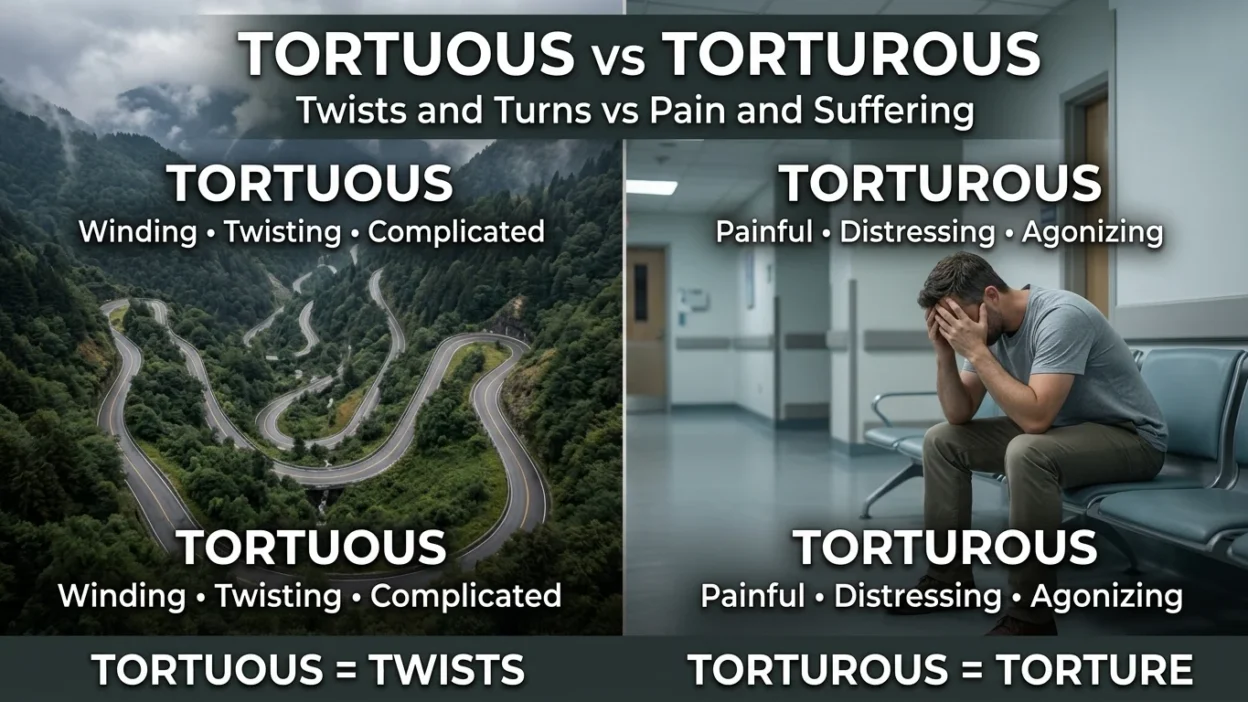
The words tortuous vs torturous are easy to confuse because they look and sound very similar. Both words can describe something difficult, unpleasant, or challenging, but they focus on completely different kinds of difficulty.
Tortuous usually describes something that is winding, complicated, indirect, or difficult to follow. Torturous, on the other hand, describes something that causes severe physical or emotional pain. Understanding this distinction will help you choose the right word when describing a difficult road, a complicated process, or an extremely painful experience.
Quick Answer: Tortuous vs Torturous
The easiest way to remember the difference is:
- Tortuous = winding, twisting, complicated, or indirect
- Torturous = extremely painful, distressing, or tormenting
Examples:
We drove along a tortuous mountain road.
Here, tortuous means winding and full of twists and turns.
The long wait was torturous.
Here, torturous means extremely unpleasant or painful.
A simple memory trick is:
Tortuous = twists
Torturous = torture
If something has many turns or complicated steps, think tortuous. If something feels like torture, think torturous.
What Does Tortuous Mean?
Tortuous is an adjective used to describe something that has many twists, turns, bends, or complicated parts.
It can describe a physical path, such as a road or river.
For example:
The hikers followed a tortuous mountain trail.
The tortuous road climbed through the hills.
A tortuous river passed through the valley.
In these examples, the word suggests something that is not straight or direct.
However, tortuous can also describe something figuratively complicated or difficult to follow.
For example:
The lawyer gave a tortuous explanation of the case.
The negotiations followed a tortuous path.
The company took a tortuous route to reach its final decision.
Here, tortuous does not mean physically winding. Instead, it means complicated, indirect, or difficult to understand.
What Does Torturous Mean?
Torturous describes something that causes intense physical or emotional suffering.
It comes from the idea of torture, so the connection is useful to remember.
For example:
The pain was torturous.
Waiting for the results was torturous.
The injured athlete endured a torturous recovery.
The journey became torturous because of the extreme heat.
In these examples, torturous describes an experience that feels extremely painful, distressing, or difficult to endure.
The pain can be physical, emotional, or psychological.
Tortuous vs Torturous Comparison Table
| Feature | Tortuous | Torturous |
|---|---|---|
| Main meaning | Winding, complicated, indirect | Extremely painful or distressing |
| Related idea | Twists and turns | Torture and suffering |
| Physical use | Roads, paths, rivers | Painful experiences |
| Figurative use | Complicated processes or explanations | Emotionally or physically painful situations |
| Example | A tortuous mountain road | A torturous experience |
| Memory clue | Twists | Torture |
The most important distinction is this:
Tortuous describes complexity or winding movement.
Torturous describes suffering or extreme discomfort.
Tortuous for Winding Roads and Paths
One of the most common uses of tortuous is to describe roads, trails, paths, or routes that contain many bends.
For example:
The tortuous road led to a remote village.
We followed a tortuous path through the forest.
The bus struggled along the tortuous mountain road.
These roads are not necessarily painful. They are simply winding and difficult to navigate.
This meaning is closely related to words such as:
- Winding
- Twisting
- Meandering
- Curving
- Indirect
For example:
A tortuous road
can often be described as:
A winding road
Tortuous for Complicated Ideas
Tortuous can also describe something that is complicated or indirect.
For example:
The investigation took a tortuous course.
This means the investigation followed a complicated or indirect path.
Another example:
His tortuous explanation made the simple issue difficult to understand.
Here, the explanation is not physically winding. It is complicated and difficult to follow.
Other examples include:
The project went through a tortuous approval process.
The negotiations took a tortuous route before an agreement was reached.
Her tortuous argument confused the audience.
This figurative meaning is particularly useful in formal writing.
Torturous for Painful Experiences
Torturous is used when something causes serious discomfort, suffering, or distress.
For example:
The headache became torturous.
The final minutes of the match were torturous for the fans.
The recovery process was torturous.
The uncertainty was torturous.
Notice that the experience does not have to involve literal torture.
Someone might describe waiting, physical pain, emotional stress, or an exhausting experience as torturous.
Common Mistakes With Tortuous and Torturous
Mistake 1: Using Torturous for a Winding Road
Incorrect:
We drove along a torturous mountain road.
This sentence could suggest that the road caused extreme suffering, rather than simply having many bends.
If you mean the road was winding, the clearer choice is:
We drove along a tortuous mountain road.
Mistake 2: Using Tortuous for Severe Pain
Incorrect:
The injury caused tortuous pain.
If you mean the pain was extremely severe or distressing, use:
The injury caused torturous pain.
Mistake 3: Assuming Tortuous Means Torture
This is one of the most common misunderstandings.
Although tortuous and torturous look related, tortuous does not normally mean painful.
Think of tortuous as being connected with twists.
Think of torturous as being connected with torture.
Mistake 4: Using Torturous Simply to Mean Difficult
Not everything difficult is necessarily torturous.
For example:
The exam was difficult.
You could say:
The exam was torturous.
if you mean it was extremely unpleasant or agonizing.
But for ordinary difficulty, words such as challenging, difficult, or complicated may be more precise.
Tortuous vs Torturous Pronunciation
The words are pronounced differently, although their spelling makes them easy to mix up.
Tortuous is generally pronounced approximately:
TOR-choo-us
Torturous is generally pronounced approximately:
TOR-chur-us
The exact pronunciation can vary slightly by accent, but the additional syllable in torturous helps distinguish it from tortuous.
When speaking, context usually makes the intended meaning clear.
Synonyms for Tortuous
Depending on the context, synonyms for tortuous include:
- Winding
- Twisting
- Curving
- Meandering
- Indirect
- Complicated
- Complex
- Intricate
- Convoluted
For example:
A tortuous road
could become:
A winding road
while:
A tortuous explanation
could become:
A complicated explanation
or:
A convoluted explanation
Synonyms for Torturous
Synonyms for torturous include:
- Painful
- Agonizing
- Excruciating
- Distressing
- Tormenting
- Unbearable
- Miserable
- Excruciatingly difficult
For example:
The recovery was torturous.
could be expressed as:
The recovery was agonizing.
or:
The recovery was extremely painful.
The best synonym depends on whether the suffering is physical, emotional, or both.
Tortuous and Torturous in Formal Writing
Both words can be useful in formal writing, but they serve different purposes.
Tortuous is especially useful when describing:
- Complex arguments
- Complicated procedures
- Long negotiations
- Indirect processes
- Winding routes
- Difficult paths
For example:
The legislation followed a tortuous path through parliament.
Torturous is useful when describing:
- Severe pain
- Emotional suffering
- Extreme discomfort
- An agonizing experience
- A difficult period of endurance
For example:
The waiting period was torturous for the family.
Using the correct word makes your writing more precise.
American vs British English
There is no major difference between American and British English in the meanings or spellings of tortuous and torturous.
Both varieties use:
tortuous
and:
torturous
with essentially the same meanings.
The distinction is therefore not an American-versus-British spelling issue. It is a difference in meaning and usage.
Whether you are writing for an American or British audience, the same basic rule applies:
Tortuous = winding or complicated
Torturous = painful or distressing
How to Remember Tortuous vs Torturous
A simple memory trick can make this distinction easy.
Think of Tortuous as Twists
The word tortuous describes something with twists and turns.
Think:
Tortuous → twists
Examples:
tortuous road
tortuous path
tortuous argument
Think of Torturous as Torture
The word torturous contains the idea of torture.
Think:
Torturous → torture → pain
Examples:
torturous pain
torturous experience
torturous waiting period
This memory technique works because it connects each spelling to its central meaning.
FAQs
1. What is the difference between tortuous and torturous?
Tortuous means winding, twisting, complicated, or indirect. Torturous means extremely painful, distressing, or difficult to endure.
2. Is a tortuous road painful?
Not necessarily. A tortuous road is usually a road with many bends and twists. It may be difficult to drive on, but the word itself describes its winding nature.
3. Does torturous mean painful?
Yes. Torturous describes something that causes intense physical or emotional suffering.
4. Can tortuous describe an argument?
Yes. Tortuous can describe an argument, explanation, or process that is complicated, indirect, or difficult to follow.
5. Is tortuous related to torture?
The words are historically related, but in modern English their meanings have developed differently. Tortuous commonly refers to winding or complicated things, while torturous refers to suffering or extreme pain.
6. Is torturous stronger than difficult?
Usually, yes. Torturous suggests an experience that is extremely unpleasant, painful, or distressing, rather than merely challenging.
7. Are tortuous and torturous different in American and British English?
No major difference exists. Both American and British English use the words with the same basic meanings and spellings.
8. What is an easy way to remember the difference?
Remember:
Tortuous = twists
Torturous = torture
If something is winding or complicated, choose tortuous. If something causes intense suffering, choose torturous.
Final Summary
The difference between tortuous vs torturous comes down to what kind of difficulty you are describing. Tortuous usually means winding, twisting, complicated, or indirect. It can describe a mountain road, a complicated process, a confusing argument, or a difficult route toward a goal.
Torturous describes something that causes severe physical or emotional pain. It can describe an agonizing injury, a deeply distressing experience, or a long period of uncomfortable waiting. Although the words look similar, they should not normally be used interchangeably.
Actionable Takeaway
Use this simple rule whenever you are unsure:
Tortuous = twists, turns, or complications
Torturous = torture, pain, or suffering
For example:
We traveled along a tortuous mountain road.
The recovery was torturous.
If you remember the connection between tortuous and twists and torturous and torture, you will be able to choose the correct word confidently in both everyday and formal English writing.

Liam James is a language enthusiast and content writer at Verseslay, specializing in word comparisons, grammar debates, and vocabulary insights. He helps readers understand language nuances through clear, engaging, and practical explanations.