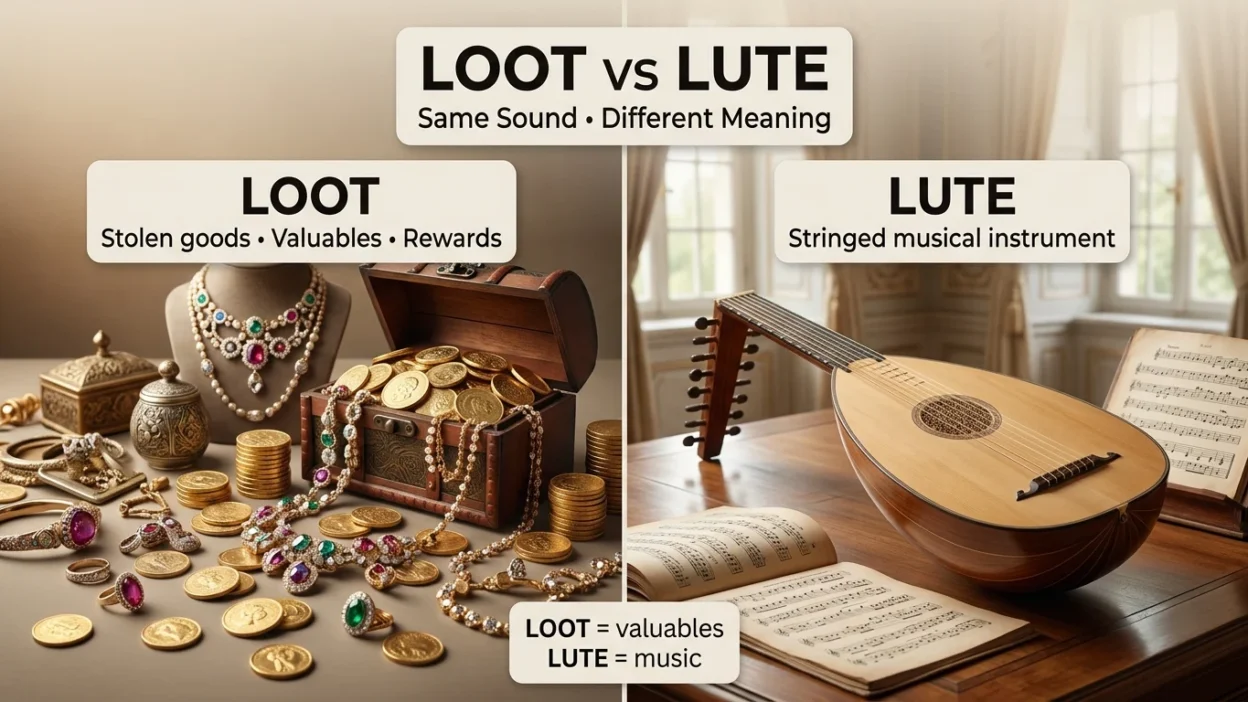
The words loot vs lute may look almost identical, but they refer to completely different things. One is connected with stolen goods or taking valuable items, while the other is a musical instrument with a long and fascinating history.
Because they differ by only one letter, loot and lute can easily be confused when writing or learning English. In this guide, we will explain their meanings, pronunciation, examples, common mistakes, and the small but important differences between them. We will also look at whether American and British English use these words differently.
Quick Answer: Loot vs Lute
The simplest distinction is:
- Loot = valuable goods taken by force, theft, or during a period of disorder; it can also mean to steal such goods.
- Lute = a stringed musical instrument with a rounded body and neck.
Examples:
The thieves escaped with the loot.
Here, loot means stolen or illegally obtained valuable items.
The musician played a beautiful melody on the lute.
Here, lute refers to a musical instrument.
A simple memory trick is:
Loot = stolen goods
Lute = musical instrument
What Does Loot Mean?
Loot can be used as both a noun and a verb.
As a noun, loot means valuable things that have been stolen or taken, especially during a war, riot, invasion, or other period of disorder.
For example:
The soldiers returned with valuable loot.
The police recovered the stolen loot.
The thieves divided the loot among themselves.
Loot may include money, jewelry, artwork, electronics, food, or other valuable possessions.
The word is often associated with theft, conflict, or lawless situations.
Loot as a Verb
Loot can also mean to steal valuable goods, particularly from a building, store, or area during disorder.
For example:
Several shops were looted during the unrest.
The invaders looted the village.
The museum was looted during the conflict.
In these examples, looted is the past tense of loot.
The verb can also be used more generally to describe taking valuable things without permission.
Loot in Modern Informal English
In modern informal language, especially online and in gaming, loot can have a less serious meaning.
In video games, loot often refers to items that players collect after defeating enemies, opening chests, completing missions, or exploring locations.
For example:
The player found rare loot in the treasure chest.
We collected some useful loot after defeating the enemy.
This dungeon has better loot than the previous one.
In gaming, loot does not necessarily mean stolen goods. It often simply means collectible rewards or valuable items.
What Does Lute Mean?
A lute is a stringed musical instrument with a rounded or pear-shaped body and a neck.
The lute has a long history and was particularly important in European music during the Renaissance and earlier periods.
It is traditionally played by plucking its strings with the fingers or a plectrum, depending on the instrument and musical tradition.
For example:
The musician played a melody on the lute.
The museum displays a beautifully preserved Renaissance lute.
He studied historical music and learned to play the lute.
The lute is closely related to other historical and modern stringed instruments.
The History of the Lute
The lute has a rich musical history.
In Europe, it became especially important during the medieval and Renaissance periods. Lutes were used for both solo performances and accompaniment.
The instrument has also influenced the development of other stringed instruments.
Historical lutes can vary considerably in size, shape, number of strings, and tuning.
The word lute therefore often appears in discussions about:
- Renaissance music
- Medieval music
- Classical music
- Historical instruments
- String instruments
- Early music
- Music history
Loot vs Lute Comparison Table
| Feature | Loot | Lute |
|---|---|---|
| Meaning | Stolen or taken valuables; to steal | A stringed musical instrument |
| Part of speech | Noun and verb | Noun |
| Common context | Theft, war, conflict, gaming | Music and history |
| Pronunciation | Usually rhymes with boot | Usually rhymes with cute |
| Example | The police recovered the loot. | She played the lute. |
| Related words | Stolen goods, plunder, steal | Instrument, strings, music |
The key difference is extremely simple:
Loot is about valuable things.
Lute is about music.
Loot vs Plunder
Loot is closely related to plunder, but the two words are not always interchangeable.
Plunder often suggests taking valuable property by force, especially during war or conflict.
Loot can have a similar meaning but is also common in everyday descriptions of stolen goods and in modern gaming language.
For example:
The invaders plundered the city.
The thieves escaped with the loot.
In gaming, loot is much more common:
The player collected rare loot.
Lute vs Other String Instruments
The lute belongs to the family of stringed instruments.
It has similarities to instruments such as:
- Guitar
- Oud
- Mandolin
- Theorbo
- Archlute
- Other plucked string instruments
However, these instruments are not identical.
The oud, for example, is a traditional Middle Eastern and North African instrument that has a distinctive rounded body and no frets in its traditional form.
The European lute developed along its own historical path and became particularly important in European art music.
Common Mistakes With Loot and Lute
Mistake 1: Using Lute for Stolen Goods
Incorrect:
The thieves divided the lute after the robbery.
Correct:
The thieves divided the loot after the robbery.
If you mean stolen valuables, use loot.
Mistake 2: Using Loot for a Musical Instrument
Incorrect:
The musician played the loot.
Correct:
The musician played the lute.
If you are talking about the historical stringed instrument, the correct spelling is lute.
Mistake 3: Confusing Their Pronunciation
The words are pronounced differently.
Loot generally sounds like:
LOOT
It rhymes with boot and root.
Lute generally sounds like:
LOOT
Interestingly, these two words are normally pronounced the same way in standard English.
That means the difference is primarily visible in spelling and understood from context.
Are Loot and Lute Homophones?
Yes. In standard English pronunciation, loot and lute are generally homophones.
This means they have the same pronunciation but different spellings and meanings.
Other examples of homophones include:
- See / sea
- Pair / pear
- Right / write
- Flower / flour
Similarly:
loot / lute
sound the same but mean different things.
This is why context is especially important when listening to these words.
American vs British English
There is essentially no major American vs British spelling difference between loot and lute.
Both American and British English use:
loot
and:
lute
with the same basic meanings.
The pronunciation is also generally the same.
What may vary is the context in which the words are commonly encountered.
For example, loot is now extremely common in international gaming language, while lute is more likely to appear in discussions about music history, classical music, or historical instruments.
Synonyms for Loot
Depending on the context, synonyms for loot include:
- Plunder
- Stolen goods
- Booty
- Spoils
- Treasure
- Valuables
As a verb, related words include:
- Steal
- Rob
- Plunder
- Ransack
- Take
- Pilfer
These words have different shades of meaning, so they should not always be treated as exact replacements.
Words Related to Lute
Words associated with lute include:
- String instrument
- Musical instrument
- Renaissance music
- Medieval music
- Classical music
- Strings
- Plucked instrument
- Oud
- Theorbo
- Archlute
These terms can help you recognize lute when reading about music or musical history.
How to Remember Loot vs Lute
A simple memory trick can help:
Loot has two O’s → think of a pile of valuable goods.
Lute has a U → think of a unique musical instrument.
You can also remember:
Loot = valuables
Lute = music
Try putting each word into a sentence:
The thieves took the loot.
The musician played the lute.
If the sentence is about stealing or valuable items, choose loot.
If it is about music, choose lute.
FAQs
1. What is the difference between loot and lute?
Loot means stolen or unlawfully taken valuable goods, and it can also mean to steal such goods. Lute is a stringed musical instrument.
2. Are loot and lute pronounced the same?
Yes. In standard English, loot and lute are generally pronounced the same way. They are homophones.
3. Is loot a noun or a verb?
It can be both. As a noun, loot means stolen or taken valuables. As a verb, loot means to steal valuable goods.
4. What is a lute?
A lute is a historical stringed musical instrument with a rounded body and neck. It was especially important in medieval and Renaissance European music.
5. Is loot used in video games?
Yes. In gaming, loot commonly refers to items, rewards, equipment, or valuables collected during gameplay.
6. Is lute used in American and British English?
Yes. Lute is used in both American and British English with essentially the same meaning and spelling.
7. What are synonyms for loot?
Depending on the context, related words include plunder, booty, spoils, stolen goods, valuables, and treasure.
8. Are loot and lute homophones?
Yes. They are generally pronounced alike but have different spellings and meanings.
Final Summary
The difference between loot vs lute is straightforward once you connect each word with its meaning. Loot refers to valuable goods that have been stolen or taken, and it can also function as a verb meaning to steal such goods. In modern gaming language, loot can also mean valuable items or rewards collected during gameplay.
Lute, by contrast, is a stringed musical instrument with a long history, especially in medieval and Renaissance music. The two words are generally pronounced exactly alike, making them homophones, but their meanings are completely different.
Actionable Takeaway
Remember this simple rule:
Loot = stolen goods, valuables, or gaming rewards
Lute = musical instrument
For example:
The thieves escaped with the loot.
The musician played the lute.
Because the two words sound the same, pay close attention to the context when writing. If you are talking about money, valuables, theft, or gaming rewards, use loot. If you are talking about music or a historical string instrument, use lute.