Have you ever typed openned and wondered if it was correct, or if the proper spelling was actually opened? You’re certainly not alone.
English spelling rules can be tricky, especially when it comes to forming past tense verbs. Many writers, students, and English learners pause when deciding which version to use.
The good news is that the answer is straightforward. Understanding the difference between opened vs openned can help improve your writing, prevent spelling mistakes, and make your communication look more professional.
In this guide, we’ll explain the correct spelling, provide examples, discuss common errors, and share simple memory tricks to help you remember it with confidence.
Quick Answer
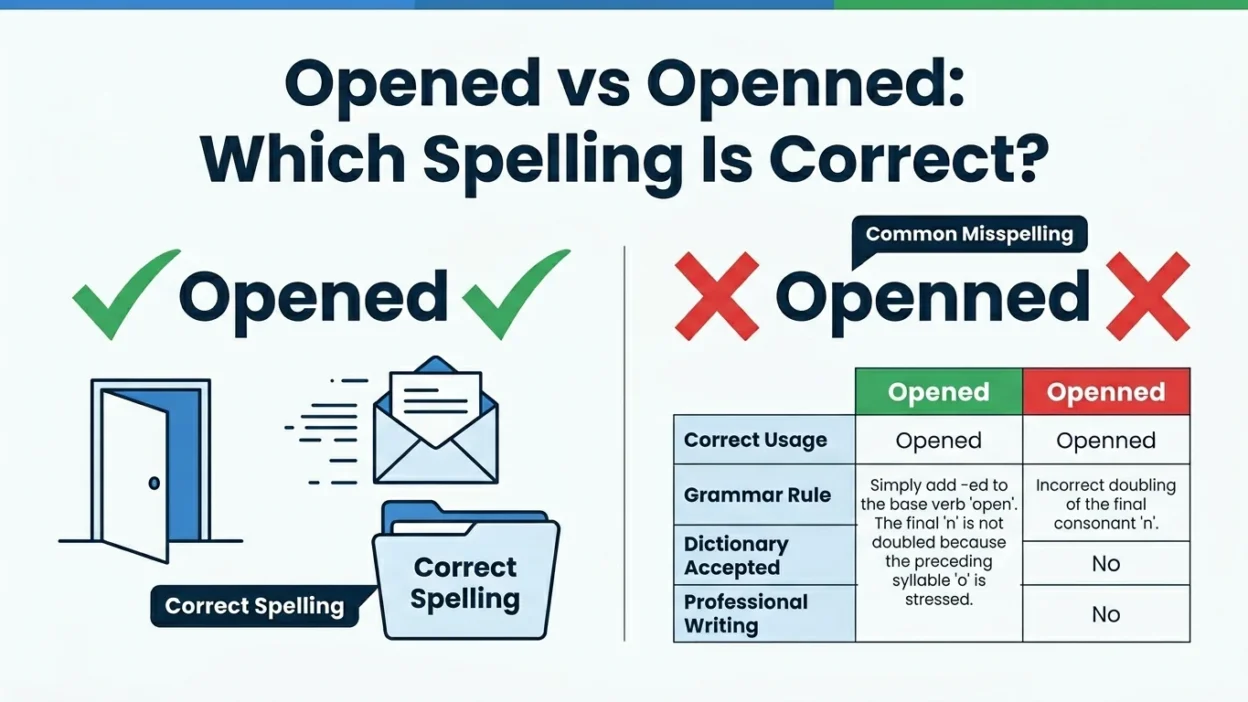
The correct spelling is opened.
- ✅ Opened = Correct spelling
- ❌ Openned = Incorrect spelling
Examples:
- She opened the door. ✅
- She openned the door. ❌
In both American and British English, opened is the only accepted spelling.
What Does “Opened” Mean?
Opened is the past tense and past participle form of the verb open.
The verb open means:
- To move something so it is no longer closed
- To make accessible
- To begin or start something
- To make available
Examples of Opened
- He opened the window.
- The store opened at 9 a.m.
- She opened her email.
- They opened a new business.
In every case, the action involves making something accessible, available, or no longer closed.
Is “Openned” a Real Word?
No.
Openned is not a recognized English word.
It is a spelling mistake that occurs when people incorrectly double the letter n before adding -ed.
Modern dictionaries, grammar guides, and style manuals do not accept openned as a correct spelling.
Example
Incorrect:
- I openned the package.
Correct:
- I opened the package.
Whenever you’re writing in English, choose opened.
Opened vs Openned: Key Differences
| Feature | Opened | Openned |
|---|---|---|
| Correct English Spelling | Yes | No |
| Dictionary Recognition | Yes | No |
| Academic Writing | Accepted | Incorrect |
| Professional Writing | Accepted | Incorrect |
| American English | Standard | Incorrect |
| British English | Standard | Incorrect |
| Search Engine Recognition | Yes | No |
The comparison is simple: opened is correct, while openned is a misspelling.
Why Do People Write “Openned”?
This mistake usually occurs because writers try to apply other English spelling patterns incorrectly.
Similar Words That Double the Final Consonant
Examples:
- Plan → Planned
- Stop → Stopped
- Admit → Admitted
Because these words double the final consonant before adding -ed, some people assume open should become openned.
However, English spelling rules do not work that way for every verb.
Why “Opened” Is Correct
The verb open follows a different pattern.
Rule
When a verb ends with:
- A vowel + consonant pattern
- But the stress is not on the final syllable
The final consonant is usually not doubled.
Examples:
| Base Verb | Past Tense |
|---|---|
| Open | Opened |
| Visit | Visited |
| Listen | Listened |
| Happen | Happened |
| Enter | Entered |
Notice that none of these verbs double the final consonant.
Therefore:
- Open → Opened ✅
- Open → Openned ❌
The Meaning of Opened in Different Contexts
The word opened appears in many situations.
Physical Objects
Examples:
- She opened the door.
- He opened the gate.
- They opened the box.
Technology
Examples:
- I opened the file.
- She opened the app.
- He opened the website.
Business
Examples:
- The company opened a new office.
- They opened a restaurant downtown.
Communication
Examples:
- She opened the email.
- He opened the message.
- They opened the discussion.
The word is incredibly versatile in modern English.
Examples of Opened in Sentences
Understanding real-world usage makes the spelling easier to remember.
Everyday Actions
- She opened the window to let fresh air in.
- He opened the package carefully.
- I opened the book and started reading.
Workplace Examples
- The manager opened the meeting.
- She opened the presentation file.
- The company opened a new branch.
Online Activities
- I opened the attachment.
- He opened the website.
- They opened the document for review.
Educational Examples
- The teacher opened the lesson with a question.
- Students opened their textbooks.
In every example, opened remains the correct spelling.
Common Mistakes to Avoid
Many writers repeat the same spelling errors.
Mistake 1: Writing Openned
Incorrect:
- I openned the email.
Correct:
- I opened the email.
This is the most common mistake.
Mistake 2: Doubling Consonants Automatically
Some people believe every verb ending in a consonant should double the letter before -ed.
This is not true.
Examples:
Correct:
- Opened
- Happened
- Listened
- Entered
Incorrect:
- Openned
- Happenned
- Listenned
- Enterred
Mistake 3: Relying Only on Pronunciation
English spelling often differs from how words sound.
Because spoken English can make “opened” sound like it contains a doubled “n,” some writers mistakenly spell it as openned.
Always rely on standard spelling rules rather than pronunciation alone.
Easy Memory Trick
A simple trick can help you remember the correct spelling forever.
Think of Similar Verbs
Compare:
- Open → Opened
- Listen → Listened
- Happen → Happened
- Enter → Entered
None of these words double the final consonant.
Visual Trick
Break the word into:
Open + ed = Opened
There is no extra “n.”
If you can spell open, simply add -ed.
Related Words and Synonyms
Learning related vocabulary improves writing fluency.
Related Forms
- Open
- Opens
- Opening
- Opened
- Opener
Synonyms
Depending on context, opened can mean:
- Unlocked
- Unsealed
- Revealed
- Started
- Began
- Launched
- Initiated
- Accessed
Examples:
- The store opened. = The store launched.
- She opened the letter. = She unsealed the letter.
Opened in Business and Technology
The digital age has made the word even more common.
Email Marketing
Businesses often track:
- Email open rates
- Opened emails
- Opened notifications
Examples:
- The customer opened the email.
- The report shows how many users opened the message.
Software and Applications
Examples:
- The user opened the file.
- The application opened successfully.
- The browser opened a new tab.
These are among the most frequent modern uses of the word.
American vs British English
Unlike some words that vary between regions, opened is spelled the same in both American and British English.
American English
- Opened ✅
- Openned ❌
British English
- Opened ✅
- Openned ❌
There is no regional difference.
Both varieties use opened exclusively.
FAQs
Is opened or openned correct?
Opened is correct. Openned is a spelling mistake.
Is openned a real word?
No. It is not recognized in standard English dictionaries.
Why doesn’t open become openned?
Because open does not follow the consonant-doubling pattern used by words such as stop and plan.
How do you spell the past tense of open?
The correct past tense is opened.
Is opened used in both American and British English?
Yes. Both varieties use the same spelling.
What is the past participle of open?
The past participle is opened.
Example:
- The door has opened.
Why do people misspell opened?
Many writers incorrectly assume the final “n” should be doubled before adding -ed.
Is opened commonly used in business writing?
Yes. It appears frequently in emails, reports, marketing, and professional communication.
Summary
When comparing opened vs openned, the answer is clear: opened is the only correct spelling.
It serves as both the past tense and past participle of the verb open and is used across everyday conversation, academic writing, business communication, and digital technology.
Meanwhile, openned is simply a common spelling mistake that results from incorrectly applying English consonant-doubling rules.
Understanding the correct form can improve your writing accuracy and professionalism.
If you’re describing a door being opened, an email being opened, or a business opening a new location, the correct spelling remains the same every time.
Actionable Takeaway
Whenever you need the past tense of open, remember this simple rule:
Open + ed = Opened
No extra “n” is required.
If you see openned, replace it with opened immediately. Following this simple habit will help you write more confidently and avoid one of the most common spelling mistakes in English.