
Have you ever typed heard, herd, or hurd and wondered if you picked the right one? You’re not alone. These words sound similar, making them easy to confuse, especially for English learners. However, they have completely different meanings, spellings, and uses.
Understanding the difference between heard vs herd vs hurd will improve both your writing and speaking. Whether you’re preparing for an English exam, writing a professional email, or simply expanding your vocabulary, this guide explains each word with simple definitions, real-life examples, common mistakes, and practical tips to help you remember the correct usage.
Quick Answer
Here’s the difference at a glance:
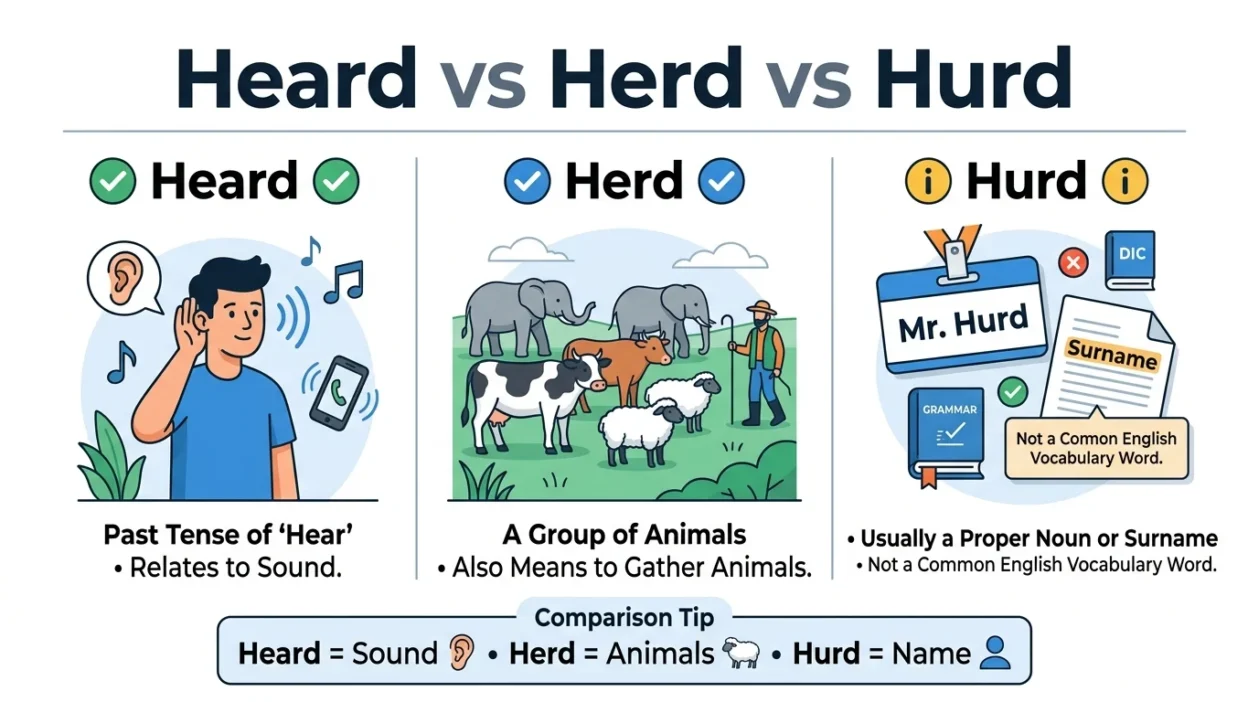
- Heard is the past tense and past participle of “hear” and means perceived a sound.
- Herd is a noun or verb related to a group of animals or gathering them together.
- Hurd is not a standard English word in general usage. It is mainly found as a surname (such as a family name) or in specific proper nouns.
Examples
- I heard the phone ring. ✅
- A herd of elephants crossed the river. ✅
- Hurd is Mr. Hurd’s last name. ✅
For everyday English, you’ll almost always use heard or herd, not hurd.
What Does “Heard” Mean?
Heard is the past tense and past participle of the verb hear.
It means:
Examples
- I heard someone knocking.
- She heard the news yesterday.
- We heard birds singing this morning.
- Have you heard that song before?
- They heard the announcement clearly.
In each sentence, heard relates to hearing or receiving sounds.
What Does “Herd” Mean?
Herd is usually a noun, although it can also be a verb.
As a noun, it refers to:
As a verb, it means:
Examples as a Noun
- A herd of cows grazed in the field.
- We saw a herd of deer.
- The safari guide spotted a herd of zebras.
Examples as a Verb
- Farmers herd sheep every morning.
- The dogs helped herd the cattle.
- Volunteers herded visitors toward the entrance.
What Does “Hurd” Mean?
Unlike heard and herd, hurd is not a standard English dictionary word for everyday vocabulary.
You’ll usually encounter Hurd as:
- A surname
- A company or place name
- A proper noun
Examples
- Mr. Hurd spoke at the conference.
- The award was presented to Susan Hurd.
Unless you’re referring to a name, hurd is generally not the correct spelling.
Heard vs Herd vs Hurd: Key Differences
The table below summarizes the differences.
| Word | Part of Speech | Meaning | Example |
|---|---|---|---|
| Heard | Verb | Past tense of hear | I heard a noise. |
| Herd | Noun / Verb | Group of animals or gather together | A herd of elephants |
| Hurd | Proper noun (usually) | Family name or specific name | Mr. Hurd |
Although these words sound similar, they are used in completely different contexts.
When Should You Use “Heard”?
Use heard whenever you’re talking about sounds, listening, or receiving information through hearing.
Common Situations
- Conversations
- Music
- News
- Alarms
- Nature sounds
- Announcements
Examples
- I heard the baby crying.
- Have you heard the latest news?
- She heard her name called.
- We heard thunder last night.
- They heard the teacher speaking.
When Should You Use “Herd”?
Use herd when discussing groups of animals or moving animals together.
Common Situations
- Farming
- Wildlife
- Zoos
- Ranches
- Animal documentaries
Examples
- A herd of buffalo crossed the road.
- The shepherd watched his herd.
- Rangers monitored the elephant herd.
- Cowboys herded the cattle home.
- The guide photographed a herd of antelope.
Why Do People Confuse These Words?
The main reason is pronunciation.
Heard and herd are perfect homophones in most English accents. They sound the same but have different meanings and spellings.
Because hurd is pronounced similarly when used as a surname, learners may mistakenly assume it’s another common English word.
Remember:
- Same sound.
- Different spelling.
- Different meaning.
Common Mistakes to Avoid
Many learners mix these words in writing.
1. Using “Herd” Instead of “Heard”
Incorrect:
- I herd the teacher speaking.
Correct:
- I heard the teacher speaking.
2. Using “Heard” for Animals
Incorrect:
- A heard of sheep crossed the field.
Correct:
- A herd of sheep crossed the field.
3. Using “Hurd” Instead of Either Word
Incorrect:
- I hurd the music.
Correct:
- I heard the music.
Unless you’re writing someone’s name, hurd is usually incorrect.
American vs British English
One advantage of these words is that there is virtually no difference between American and British English.
Both varieties use:
- heard
- herd
with the same meanings and spellings.
Pronunciation may vary slightly depending on regional accents, but the grammar and usage remain identical.
Memory Tricks to Remember the Difference
Here are some easy ways to remember these words.
Heard = Hear
Notice that heard contains the word hear.
Think:
- hear → heard
If you’re talking about listening or sound, choose heard.
Herd = Animals
Think of:
- herd of cows
- herd of sheep
- herd of elephants
If animals are together, use herd.
Hurd = Name
If you see Hurd, ask yourself:
“Is this someone’s name?”
If not, it’s probably the wrong spelling.
Related Words and LSI Keywords
To expand your vocabulary, here are related terms commonly associated with this topic:
- homophones
- confusing English words
- hear vs listen
- animal group names
- English spelling rules
- grammar mistakes
- pronunciation differences
- vocabulary guide
- English usage
- commonly confused words
These related expressions help reinforce the topic while naturally supporting SEO.
Example Sentences Side by Side
Seeing the words together makes the differences clearer.
| Correct Sentence | Explanation |
|---|---|
| I heard the bell ring. | Refers to hearing a sound. |
| A herd of horses ran across the field. | Refers to a group of animals. |
| Ms. Hurd teaches English. | Refers to a person’s surname. |
Notice that each word belongs to a completely different category.
FAQs
What is the difference between heard and herd?
Heard is the past tense of hear, while herd refers to a group of animals or the act of gathering them.
Is “hurd” a real word?
It is generally not used as a standard English vocabulary word. It mainly appears as a surname or proper noun.
Why do heard and herd sound the same?
They are homophones—words with different spellings and meanings but the same pronunciation.
Which word refers to animals?
Herd refers to a group of animals or gathering animals together.
Which word relates to hearing?
Heard is used when talking about listening or perceiving sounds.
Do American and British English use these words differently?
No. Both varieties use heard and herd in the same way.
How can I remember the correct spelling?
Remember:
- Hear → Heard
- Animals → Herd
- Name → Hurd
Summary
Understanding heard vs herd vs hurd is easier once you recognize that they belong to different parts of speech and serve completely different purposes. Heard is the past tense of hear and relates to sounds or listening. Herd refers to a group of animals or the action of gathering them together. Hurd, on the other hand, is not a common English vocabulary word and is usually seen as a surname or proper noun.
Although heard and herd sound identical, their meanings are entirely different. Paying attention to the context of your sentence will help you choose the correct spelling every time. Whether you’re writing for school, work, or everyday communication, mastering these commonly confused words will make your English clearer and more accurate.