Have you ever wondered whether you should click unselect or deselect when removing a highlighted option in software? These two terms appear similar, and many people use them interchangeably. However, if you’ve looked closely at computer programs, mobile apps, or technical documentation, you’ve probably noticed that one is far more common than the other.
Understanding unselect vs deselect is useful for anyone who uses computers, writes technical documentation, develops software, or simply wants to use the correct terminology. In this guide, you’ll learn the difference between these terms, their meanings, examples, common mistakes, and whether American and British English prefer one over the other.
Quick Answer
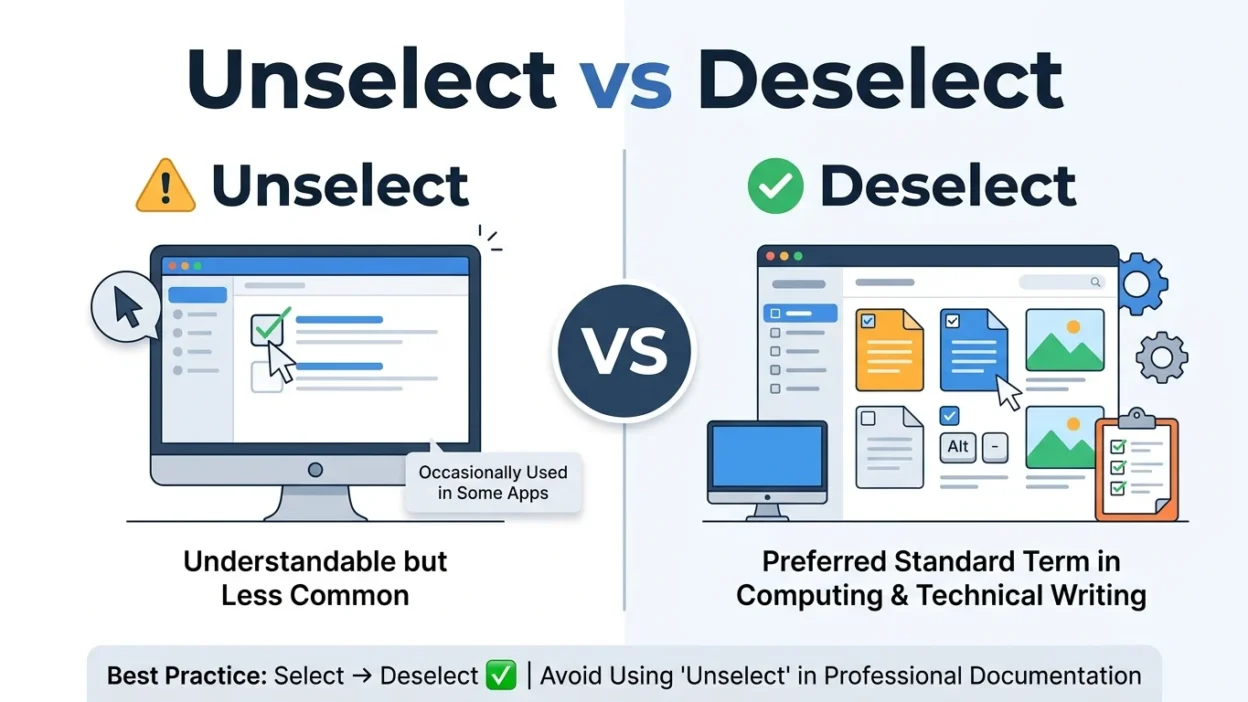
Deselect is the standard and widely accepted term in computing and technology.
Unselect is understandable and occasionally used, but it is much less common and is generally not the preferred choice in software interfaces or technical writing.
Examples
- Click the checkbox again to deselect it. ✅
- Press Ctrl and click to deselect the item. ✅
- Click the option to unselect it. ⚠️ (Understandable but less common)
If you’re writing documentation, tutorials, or user guides, deselect is the better choice.
What Does “Deselect” Mean?
Deselect is a verb that means:
It is widely used in:
- Computer software
- Mobile apps
- Graphic design programs
- Word processors
- Spreadsheets
- Programming documentation
- User manuals
Examples
- Click outside the object to deselect it.
- Press Esc to deselect the current item.
- Select all images, then deselect the duplicates.
- You can deselect multiple files by holding Ctrl and clicking them again.
- Tap the selected option to deselect it.
What Does “Unselect” Mean?
Unselect also means:
Although its meaning is easy to understand, unselect is less common in modern English, especially in computing.
Some applications or websites may use it, but most style guides, software companies, and technical writers prefer deselect.
Examples
- The app allows users to unselect filters.
- Click again to unselect the option.
These sentences are understandable, but replacing unselect with deselect generally sounds more natural and professional.
Unselect vs Deselect: Key Difference
Both words describe removing a selection, but one is the industry standard.
| Feature | Deselect | Unselect |
|---|---|---|
| Standard English | ✅ Yes | ⚠️ Less common |
| Common in software | ✅ Very common | Rare |
| Technical documentation | Preferred | Usually avoided |
| User interface labels | Preferred | Occasionally seen |
| Meaning | Remove a selection | Remove a selection |
In most situations, deselect is the recommended choice.
Why Is “Deselect” More Common?
The prefix de- often means:
- remove
- reverse
- undo
Examples include:
- deactivate
- decode
- defrost
- detach
- deauthorize
Similarly:
- select → deselect
This pattern has become standard in computer terminology.
By contrast, while the prefix un- can also indicate reversal (as in unlock or unplug), it is not the preferred form with select in technical English.
When Should You Use “Deselect”?
Use deselect whenever you’re talking about removing an existing selection in digital interfaces.
Common situations include:
- Selecting files
- Choosing menu options
- Highlighting text
- Clicking checkboxes
- Editing photos
- Creating spreadsheets
Examples
- Deselect all before continuing.
- Press Ctrl to deselect individual files.
- Tap again to deselect the photo.
- The software lets users deselect multiple layers.
- Deselect the checkbox if you don’t want notifications.
When Might You See “Unselect”?
Although less common, unselect still appears in some places.
Examples include:
- Older software
- Informal documentation
- Community forums
- User-created tutorials
- Certain app interfaces
Because readers recognize its meaning, it’s not confusing. However, professional documentation almost always favors deselect.
Common Mistakes to Avoid
Many writers make small terminology mistakes.
1. Mixing Both Terms in the Same Document
Choose one term and stay consistent.
Since deselect is the industry standard, it’s usually the best choice.
2. Assuming They Have Different Meanings
Both words mean essentially the same thing.
The difference is preference and frequency of use, not meaning.
3. Using “Unselect” in Professional Documentation
If you’re writing:
- software manuals
- help guides
- API documentation
- user instructions
prefer deselect.
4. Confusing “Deselect” with “Delete”
These words have completely different meanings.
- Deselect removes a selection.
- Delete removes the item itself.
Example:
- Deselect the file. ✅
- Delete the file. ✅
These actions are not interchangeable.
Real-World Examples
You’ll commonly see deselect in popular software.
Examples include:
- Microsoft Excel
- Microsoft Word
- Adobe Photoshop
- Google Sheets
- Visual Studio Code
- AutoCAD
- Figma
- Canva
Instructions often read:
- Deselect all.
- Deselect the current object.
- Deselect the checkbox.
- Deselect every selected item.
This widespread usage reinforces deselect as the preferred industry term.
American vs British English
Another common question is whether regional English affects the choice.
The answer is simple.
Both American English and British English overwhelmingly prefer:
- deselect
The word unselect exists in both varieties but remains far less common.
There is no significant regional difference in meaning or usage.
Related Words and LSI Keywords
To better understand this topic, here are related terms often used alongside unselect vs deselect:
- remove selection
- clear selection
- select
- highlight
- uncheck
- checkbox
- user interface
- software terminology
- computer commands
- interface design
- technical writing
- GUI controls
Using these related expressions naturally improves vocabulary while supporting SEO.
Tips to Remember the Difference
A simple memory trick makes this easy.
Think of common software commands.
You’ll often see:
- select
- deselect
Rarely will you see:
- select
- unselect
Another way to remember:
The opposite of activate is deactivate, not unactivate.
Similarly:
The opposite of select is generally deselect.
This pattern matches the language used by most software developers and technical writers.
FAQs
Which is correct: unselect or deselect?
Both are understandable, but deselect is the standard and preferred term.
Is “unselect” a real word?
Yes. It appears in some dictionaries and is occasionally used, but it is much less common than deselect.
Why do most software programs use “deselect”?
Because deselect has become the accepted industry standard in computing and user interface design.
Do unselect and deselect mean the same thing?
Yes. Both refer to removing a selection from an item.
Is there a difference between American and British English?
No. Both varieties overwhelmingly prefer deselect.
Should I use “unselect” in technical documentation?
It’s better to use deselect, as it aligns with industry conventions and reader expectations.
What is the opposite of “select”?
In computing, the standard opposite is deselect.
Summary
Understanding unselect vs deselect is straightforward once you recognize how these terms are used in modern English. While both words refer to removing a selection, deselect is the preferred and widely accepted choice in software, technical documentation, and user interfaces. Unselect is understandable but appears much less frequently and is generally avoided in professional writing.
If you’re creating user guides, designing software, or simply learning computer terminology, using deselect will make your writing sound more natural and consistent with industry standards. Since both American and British English favor deselect, it’s the safest choice for almost every audience.