Choosing between is used vs has been used vs was used can be confusing, especially when you’re writing formal English, academic content, or explaining how something works. Although all three expressions contain the verb use, they describe different situations and time relationships.
The good news is that the difference becomes much easier once you understand verb tense and voice. Is used usually describes a present or general situation, has been used connects a past action to the present, and was used describes a completed action in the past. Let’s explore each form with clear examples and simple rules.
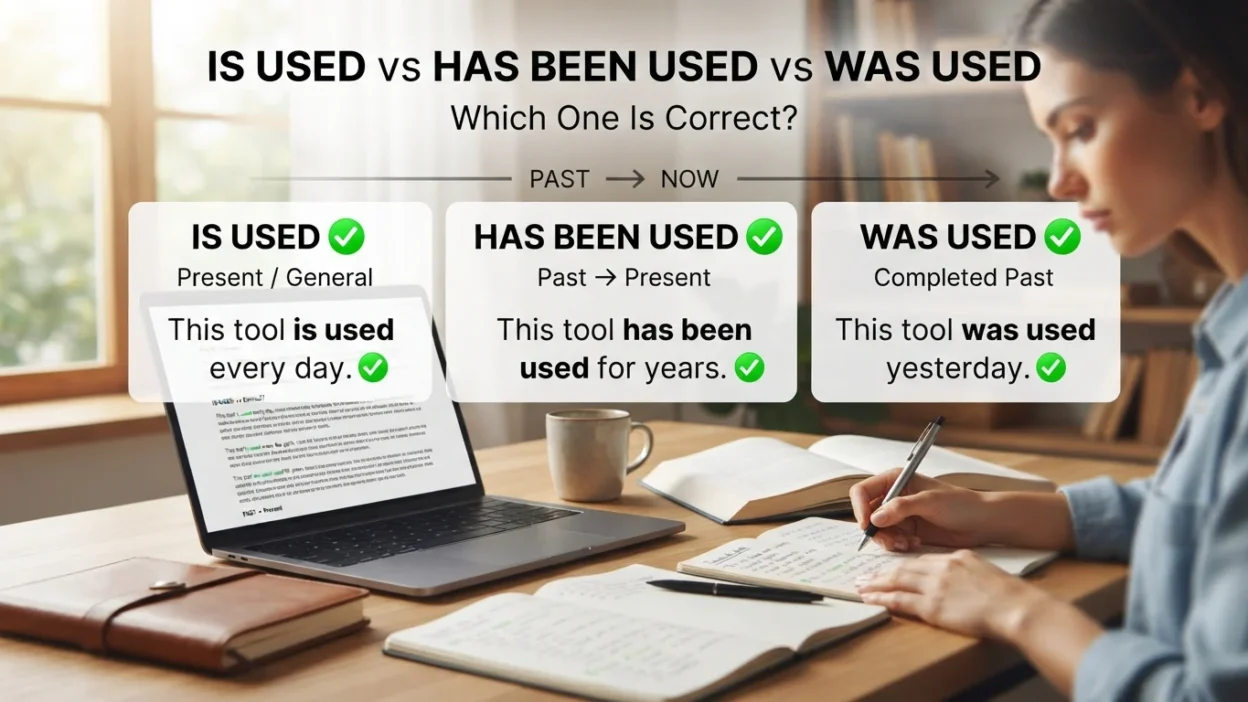
Quick Answer: Is Used vs Has Been Used vs Was Used
The three expressions are different forms of the passive voice.
| Expression | Tense | Basic Meaning | Example |
|---|---|---|---|
| Is used | Present simple passive | Used generally or currently | This tool is used by teachers. |
| Has been used | Present perfect passive | Used at some point before now, with a connection to the present | This tool has been used for many years. |
| Was used | Past simple passive | Used at a specific or completed time in the past | This tool was used yesterday. |
The Simple Rule
- Is used → general or present use
- Has been used → past use connected to now
- Was used → completed past use
What Does “Is Used” Mean?
Is used is the present simple passive form of the verb use.
The structure is:
Subject + is + past participle
For example:
The computer is used by students.
This sentence focuses on the computer and tells us that students use it.
We commonly use is used for:
- General facts
- Regular activities
- Common purposes
- Current situations
- Instructions and explanations
- Scientific or technical descriptions
Examples of “Is Used”
This machine is used to produce plastic products.
This describes the machine’s general purpose.
English is used around the world.
This expresses a general fact.
This medicine is used to treat certain conditions.
This explains the general purpose of the medicine.
The software is used by thousands of businesses.
This describes a current or general situation.
Key Idea
When you use is used, you are usually talking about something that is generally true, regularly happens, or is currently the case.
What Does “Has Been Used” Mean?
Has been used is the present perfect passive form.
The structure is:
Subject + has + been + past participle
For example:
The computer has been used by several students.
This tells us that the computer was used in the past, but the action has some connection to the present.
The exact time is often not stated.
We use has been used when:
- Something happened before now
- The exact time is not important
- The past action has a present connection
- We are talking about experience or history up to the present
- Something started in the past and remains relevant now
Examples of “Has Been Used”
This method has been used for decades.
The method began being used in the past and continues to be relevant now.
The equipment has been used several times.
The equipment was used in the past, and that experience is relevant now.
This technology has been used by researchers around the world.
The use began in the past and continues to be relevant.
The word has been used in many different contexts.
The word appeared in past usage, and that history matters now.
Key Idea
When you use has been used, think:
“It happened before now, and it matters or is relevant now.”
What Does “Was Used” Mean?
Was used is the past simple passive form.
The structure is:
Subject + was + past participle
For example:
The computer was used yesterday.
This describes a completed action in the past.
We commonly use was used when:
- The action happened at a specific past time
- The action is completed
- We are describing a past event
- The time period is finished
Examples of “Was Used”
The machine was used yesterday.
The action happened yesterday and is finished.
The old method was used in the experiment.
The sentence describes a completed past experiment.
The building was used as a hospital during the war.
This describes a past situation.
The word was used in the original document.
This refers to a completed historical or past document.
Key Idea
When you use was used, think:
“It happened in the past and is finished.”
Is Used vs Has Been Used vs Was Used: Detailed Comparison
| Feature | Is Used | Has Been Used | Was Used |
|---|---|---|---|
| Tense | Present simple | Present perfect | Past simple |
| Voice | Passive | Passive | Passive |
| Time | Present/general | Before now, connected to present | Completed past |
| Specific past time | Usually no | Usually no | Often yes |
| Example | It is used every day. | It has been used for years. | It was used yesterday. |
| Main focus | General/current use | Past-to-present connection | Finished past event |
Understanding the time relationship is the easiest way to choose the correct form.
Compare These Three Sentences
Let’s look at the same idea using all three forms.
1. The Tool Is Used by Engineers.
This means engineers generally use the tool.
Meaning: This is a general or current fact.
2. The Tool Has Been Used by Engineers.
This means engineers have used the tool at some time before now.
Meaning: The past use is relevant to the present.
3. The Tool Was Used by Engineers.
This means engineers used the tool at a particular time in the past.
Meaning: The action happened and was completed in the past.
The difference is not about the tool itself. The difference is the time perspective of the speaker.
Common Time Expressions
Certain time expressions can help you choose the correct tense.
Is Used
Common expressions include:
- Every day
- Usually
- Often
- Generally
- Regularly
- Nowadays
- Commonly
Example:
This software is used regularly by students.
Has Been Used
Common expressions include:
- For many years
- Since 2020
- Several times
- Recently
- So far
- Ever
- Never
- Already
Example:
This method has been used for many years.
Was Used
Common expressions include:
- Yesterday
- Last week
- Last year
- In 2010
- Two days ago
- During the experiment
- At that time
Example:
The method was used during the experiment.
Common Mistakes
Mistake 1: Using “Has Been Used” With a Finished Past Time
Avoid combining present perfect with a specific completed past time.
Incorrect:
The machine has been used yesterday.
Correct:
The machine was used yesterday.
The word yesterday refers to a finished past time, so the past simple is normally required.
Mistake 2: Using “Was Used” for a General Fact
Incorrect:
English was used around the world.
If you mean this is generally true today, use:
English is used around the world.
However, was used can be correct if you are discussing a specific historical period.
Mistake 3: Confusing “Has Been Used” With “Is Used”
Compare:
This method is used in modern laboratories.
This is a general or current fact.
This method has been used in modern laboratories.
This emphasizes previous experience or usage up to the present.
Mistake 4: Forgetting the Passive Structure
Remember that all three forms are passive.
Is used
Has been used
Was used
The person or thing doing the action may be included with by.
Example:
The tool is used by engineers.
American English vs British English
The basic difference between is used, has been used, and was used is the same in American and British English.
However, there can be some differences in how speakers use the present perfect.
British English traditionally uses the present perfect more often for recent events connected to the present.
For example:
British English: I have just used the computer.
American English may also use this form, but in some informal contexts, American speakers may be more comfortable with the simple past:
I just used the computer.
However, when it comes to the passive forms in your target phrase, the fundamental grammar rules remain the same.
For example:
The system is used every day.
The system has been used for years.
The system was used yesterday.
All three are natural in both American and British English.
How to Choose the Correct Form
Ask yourself three simple questions.
Question 1: Is it a general or current fact?
Use is used.
This tool is used in schools.
Question 2: Did it happen before now, and is it relevant now?
Use has been used.
This tool has been used for many years.
Question 3: Did it happen at a finished time in the past?
Use was used.
This tool was used last year.
This simple three-question method will help you choose the correct form in most situations.
FAQs
1. What is the difference between is used and was used?
Is used describes a general, regular, or current situation, while was used describes a completed action or situation in the past.
2. What is the difference between is used and has been used?
Is used usually describes current or general use. Has been used describes use that happened before now and has a connection to the present.
3. What is the difference between has been used and was used?
Has been used connects a past action to the present and usually does not specify a finished past time. Was used describes a completed action at a past time.
4. Can I say “has been used yesterday”?
Normally, no. Yesterday refers to a finished past time, so use the past simple:
It was used yesterday.
5. Is “is used” passive voice?
Yes. Is used is the present simple passive form of use.
6. Is “has been used” present perfect?
Yes. Has been used is the present perfect passive form.
7. Is “was used” past tense?
Yes. Was used is the past simple passive form of use.
8. Which form should I use for a general fact?
Use is used.
For example:
This type of software is used by many companies.
Final Summary
The difference between is used vs has been used vs was used is mainly about time and context. Is used is the present simple passive and is best for general facts, regular activities, and current situations. Has been used is the present perfect passive and describes something that happened before now while maintaining a connection to the present. Was used is the past simple passive and describes a completed action or situation in the past.
The easiest way to remember these forms is to focus on the timeline. If something is generally true or currently happening, choose is used. If something happened before now and remains relevant, choose has been used. If something happened at a completed time in the past, choose was used. These rules apply in both American and British English, with only minor differences in broader present-perfect preferences.