
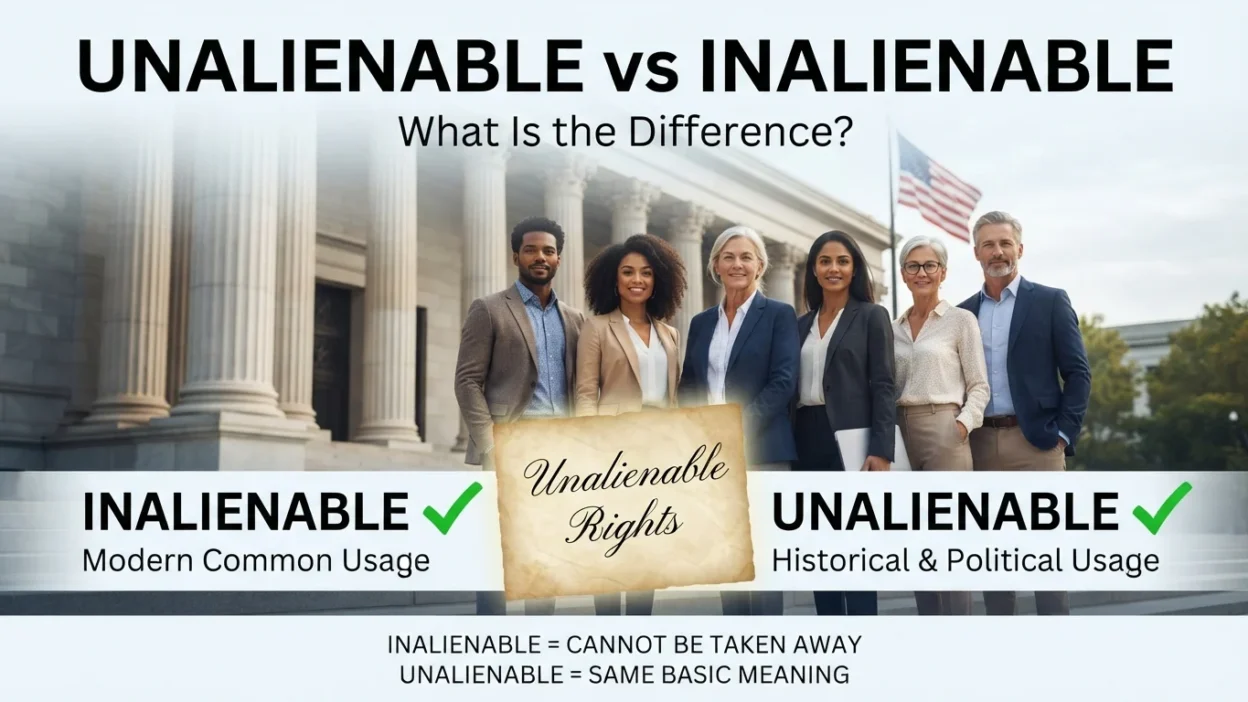
The difference between unalienable vs inalienable can be confusing because both words are closely related in meaning and are often used to describe rights, freedoms, or qualities that cannot be taken away or transferred. In many contexts, the two words can be used almost interchangeably, which makes the distinction seem more complicated than it really is.
The key difference is often usage and context rather than meaning. Inalienable is the more common word in modern English and is widely used in legal, political, philosophical, and formal contexts. Unalienable is less common but is strongly associated with the famous phrase “unalienable Rights” in the United States Declaration of Independence. This guide explains the meaning of both words, compares their usage, provides examples, and helps you choose the right term.
Quick Answer: Unalienable vs Inalienable
Unalienable and inalienable generally mean the same thing: something that cannot be taken away, surrendered, transferred, or given up.
Inalienable is the more common modern English word.
Unalienable is less common but is historically significant, especially in the phrase “unalienable Rights” from the U.S. Declaration of Independence.
Simple Rule
Use inalienable in most modern writing when you mean a right or quality that cannot be taken away or transferred.
Use unalienable when referring to historical wording, especially the phrase “unalienable Rights,” or when the context specifically calls for that form.
What Does “Inalienable” Mean?
Inalienable is an adjective meaning something that cannot be taken away, surrendered, transferred, or legally given up.
The word is commonly associated with fundamental rights and freedoms.
For example:
Everyone has certain inalienable rights.
This means that these rights are considered fundamental and cannot legitimately be taken away.
Other examples include:
Freedom is an inalienable right.
Human dignity is an inalienable value.
People should be able to enjoy their inalienable freedoms.
The word is especially common in discussions involving:
- Human rights
- Civil rights
- Personal freedoms
- Constitutional principles
- Political philosophy
- Law
- Ethics
The idea behind inalienable is that the right or quality is so fundamental that it cannot simply be transferred or permanently surrendered.
What Does “Unalienable” Mean?
Unalienable has essentially the same basic meaning as inalienable.
It describes something that cannot be taken away, transferred, or surrendered.
For example:
All people are born with unalienable rights.
The word is particularly well known because of the U.S. Declaration of Independence, which refers to “unalienable Rights.”
The historical phrase is often quoted in discussions about:
- Life
- Liberty
- The pursuit of happiness
- Human freedom
- Natural rights
Because of this historical connection, unalienable can sometimes have a distinctly American historical or political association.
Unalienable vs Inalienable: Comparison Table
| Feature | Unalienable | Inalienable |
|---|---|---|
| Basic meaning | Cannot be taken away or transferred | Cannot be taken away or transferred |
| Modern usage | Less common | More common |
| Historical association | Strongly associated with U.S. Declaration of Independence | Common in modern legal and formal language |
| Common context | Historical, political, philosophical | Legal, political, human rights, formal |
| Meaning difference | Usually none | Usually none |
| Example | Unalienable rights | Inalienable rights |
| Preferred modern choice | Less common | Generally preferred |
In most situations, unalienable and inalienable communicate the same idea.
What Is the Difference Between Unalienable and Inalienable?
The main difference is not usually meaning. Instead, it is frequency, historical usage, and stylistic preference.
The word inalienable is more widely used in modern English.
The word unalienable is less common but has a famous historical presence.
For example:
The Constitution protects inalienable rights.
This sounds natural in modern formal English.
The Declaration of Independence refers to unalienable Rights.
This is appropriate when discussing the historical wording of the document.
Both words express the concept of something that cannot be alienated or transferred.
Why Does “Unalienable” Appear in the Declaration of Independence?
The word unalienable is especially famous because of its use in the United States Declaration of Independence.
The document describes certain rights as “unalienable Rights.”
This historical wording has made unalienable an important term in American political and historical discussions.
However, the existence of this famous phrase does not mean that unalienable is always preferred over inalienable today.
Modern writers commonly use inalienable when discussing fundamental rights.
For example:
The right to personal freedom is considered inalienable.
But when directly quoting or discussing the historical language of the Declaration of Independence, unalienable is the appropriate form.
Examples of “Inalienable”
Here are some natural examples using inalienable.
Example 1: Human Rights
Every person should enjoy inalienable human rights.
The sentence refers to fundamental rights that should not be taken away.
Example 2: Freedom
Freedom of conscience is often described as an inalienable right.
This emphasizes the fundamental nature of the freedom.
Example 3: Dignity
Every human being has an inalienable right to dignity.
The word emphasizes that dignity is considered fundamental.
Example 4: Legal Context
The law recognizes certain inalienable rights that cannot be surrendered.
This uses the word in a formal legal context.
Example 5: Political Philosophy
The philosopher argued that individual liberty is an inalienable right.
Here, the word appears in a philosophical discussion.
Examples of “Unalienable”
Now consider these examples.
Example 1: Historical Discussion
The Declaration of Independence refers to unalienable Rights.
This is the most recognizable historical use.
Example 2: Political Writing
The people believed that freedom was an unalienable right.
The word emphasizes a fundamental freedom.
Example 3: Philosophical Context
Some philosophers argue that human dignity is unalienable.
The meaning is that dignity cannot legitimately be taken away.
Example 4: Historical Analysis
The concept of unalienable rights played an important role in the development of American political thought.
This is a natural use in historical writing.
Inalienable Rights vs Unalienable Rights
Both phrases can be grammatically correct.
Inalienable rights is the more common expression in modern English.
Unalienable rights is strongly associated with the historical phrase from the Declaration of Independence.
Consider these examples:
Modern usage: Human beings have inalienable rights.
Historical usage: The Declaration of Independence speaks of unalienable Rights.
The choice depends on whether you are writing about modern concepts or preserving a specific historical expression.
Common Mistakes
Mistake 1: Thinking One Word Is Incorrect
Some people believe that one of these words is always wrong.
That is not generally true.
Both unalienable and inalienable are established English words.
The difference is primarily one of usage and context.
Mistake 2: Using “Unalienable” Only Because It Sounds More American
Although unalienable is strongly connected with American history, it is not necessarily the best choice for every modern American English sentence.
For most contemporary formal writing, inalienable is more common.
Mistake 3: Assuming “Inalienable” Means “Impossible to Lose” in Every Situation
The word generally describes something that cannot be legally or legitimately surrendered or transferred.
It is often used as a principle or concept rather than a guarantee that something can never be violated in practice.
For example, saying someone has an inalienable right does not necessarily mean that the right can never be violated. It means the right is considered fundamental and not legitimately transferable or removable.
Mistake 4: Confusing “Inalienable” With “Alienable”
The word alienable means something that can be transferred or given up.
Therefore:
Alienable = can be transferred or surrendered.
Inalienable = cannot be transferred or surrendered.
Unalienable = cannot be transferred or surrendered.
The prefix in- or un- creates the negative meaning.
American English vs British English
There is no major difference in the basic meaning of unalienable and inalienable between American and British English.
However, unalienable has a particularly strong historical connection to American English because of the Declaration of Independence.
In modern American and British English, inalienable is generally the more common form.
For example:
American English: Inalienable human rights.
British English: Inalienable human rights.
The phrase works naturally in both varieties.
When discussing the historical wording of the U.S. Declaration of Independence, however, unalienable Rights should be preserved as the historical term.
Which One Should You Use?
If you are writing a modern article, essay, report, or formal document, inalienable is usually the safest choice.
For example:
Everyone has inalienable human rights.
If you are discussing the Declaration of Independence or quoting its historical language, use unalienable.
For example:
The Declaration of Independence refers to “unalienable Rights.”
Choose “Inalienable” When:
- Writing modern formal English
- Discussing human rights
- Discussing legal principles
- Writing about fundamental freedoms
- Writing academic or professional content
Choose “Unalienable” When:
- Discussing the Declaration of Independence
- Referring to historical American political language
- Preserving a historical quotation
- Discussing the historical concept of natural rights
FAQs
1. What is the difference between unalienable and inalienable?
Both words generally mean unable to be taken away, surrendered, or transferred. The main difference is usage. Inalienable is more common in modern English, while unalienable is strongly associated with historical American language.
2. Is “unalienable” a real word?
Yes. Unalienable is a legitimate English word. It is particularly well known because of the phrase “unalienable Rights” in the U.S. Declaration of Independence.
3. Is inalienable more common than unalienable?
Yes. Inalienable is generally more common in modern English, especially in legal, political, philosophical, and human-rights contexts.
4. Are inalienable rights and unalienable rights the same?
Generally, yes. Both phrases refer to rights that cannot legitimately be taken away, transferred, or surrendered. The choice often depends on context and historical association.
5. Which word should I use in modern writing?
Inalienable is usually the better choice for modern formal writing. It is widely understood and commonly used when discussing fundamental rights and freedoms.
6. Why does the Declaration of Independence use “unalienable”?
The historical wording of the Declaration of Independence uses “unalienable Rights.” This phrase has become closely associated with American history and political philosophy.
7. Is “inalienable” used in British English?
Yes. Inalienable is used in British English as well as American English. Its meaning is essentially the same in both varieties.
8. Can I use “unalienable” instead of “inalienable”?
In many contexts, yes. However, inalienable is generally more common in modern writing. If you are discussing a specific historical quotation, use the original historical wording.
Final Summary
The difference between unalienable vs inalienable is mostly about usage rather than meaning. Both words describe something that cannot legitimately be taken away, transferred, surrendered, or given up. They are commonly associated with fundamental rights, freedoms, human dignity, and political philosophy.
The main practical distinction is that inalienable is the more common word in modern English, while unalienable has a particularly strong historical association with the U.S. Declaration of Independence. Both American and British English recognize inalienable, while unalienable remains especially familiar in American historical and political contexts.